
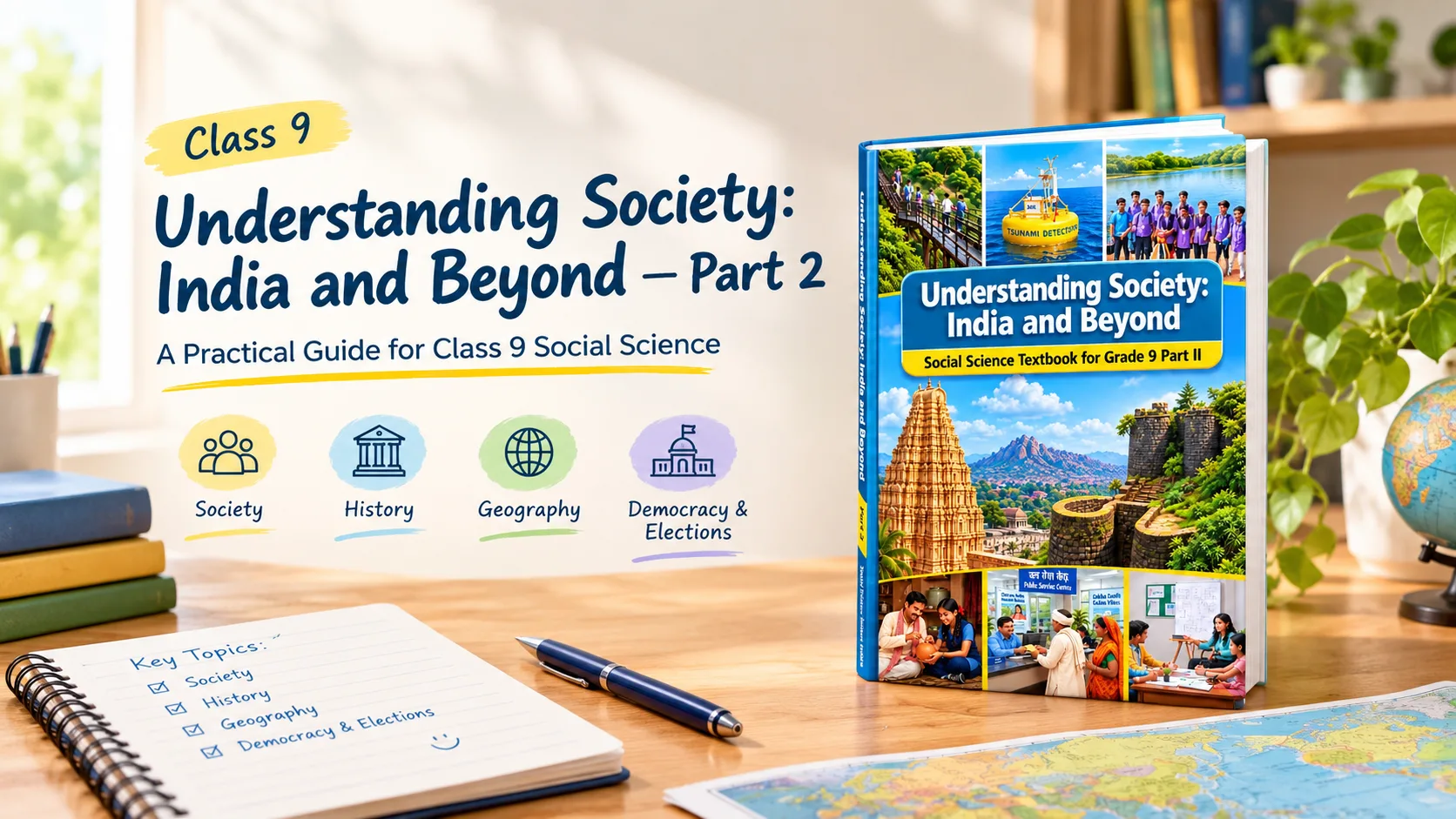
Social Science in Class 9 is not simply about remembering dates, definitions, and names. It is about understanding how societies develop, how institutions work, how people interact with one another, and how ideas such as democracy and citizenship shape everyday life.
For students preparing for the 2026–27 academic year, the new Class 9 Social Science curriculum places emphasis on understanding society through historical, geographical, political, economic, and cultural perspectives. NCERT also highlights inquiry, evidence-based reasoning, and critical thinking as important parts of Social Science learning.
What Is Understanding Society: India and Beyond Part 2?
Understanding Society: India and Beyond Part 2 is the Class 9 Social Science textbook for the second part of the curriculum. It provides students with opportunities to explore Indian society and its development while connecting classroom concepts with broader social and civic questions.
Rather than treating Social Science as a subject based entirely on memorisation, students can use the textbook to understand relationships between events, institutions, communities, and ideas.
Students looking for a Class 9 Social Science Textbook 2026–27 can use the textbook as the central resource for their school preparation.
What Can Students Learn From Part 2?
The NCERT Grade 9 Part 2 curriculum includes themes connected with the development of Indian society and institutions. Some areas include the relationship between state and society, democracy, and elections.
1. State and Society
Students are introduced to important developments in Indian history and society. This includes topics related to the Vedic period, political institutions, social organisation, early empires, knowledge traditions, trade, traders, guilds, and industries.
The useful approach here is to look for connections rather than memorising every point separately.
For example:
Event or development → social change → political organisation → impact on people
Creating these connections can make historical topics easier to remember.
2. Understanding Democracy
Democracy is another important area of Social Science. Students can explore what democracy means, its different features and forms, and how democratic ideas developed in different contexts.
Instead of learning a definition and moving on, students should ask:
- What makes a system democratic?
- Why are institutions important?
- How do citizens participate?
- How are different democratic systems organised?
- What challenges can democracy face?
Questions like these encourage understanding rather than rote learning.
3. Elections and Representation
The curriculum also introduces students to elections and the systems through which citizens participate in democratic processes. Topics include constituencies, electoral rolls, electoral systems, the Election Commission of India, and related processes.
These topics can seem complicated initially because they contain several new terms. Making a small glossary while studying can help.
For example:
Term → Simple meaning → Example
This three-step method is particularly useful for Civics chapters.
How to Study the Class 9 Social Science Textbook
A Class 9 Social Science Textbook part 2 can be much easier to study when students avoid trying to finish entire chapters in one sitting.
Start With the Main Idea
Before reading every paragraph, spend a few minutes looking at the chapter structure. Identify the major headings and try to understand what the chapter is going to explain.
Then read the chapter properly.
Make Short Notes
Do not copy entire paragraphs into your notebook.
Instead, write:
- important terms
- key events
- important people or institutions
- cause-and-effect relationships
- examples
- questions you find difficult
Your notes should help you remember the chapter later, not become a second textbook.
Connect Concepts With Examples
Social Science becomes easier when concepts are connected to familiar situations.
For example, while learning about elections, students can think about how constituencies, voters, candidates, and electoral processes work together.
Similarly, when studying society and institutions, try to understand how different parts of society influence one another.
How to Prepare for School Exams
For an NCERT Class 9 Social Science text book, reading the chapter once is only the beginning. Regular revision is important.
A simple study cycle can be:
Read → Understand → Make notes → Practise questions → Revise
After completing a chapter, close the book and explain the main ideas in your own words. If you cannot explain something without looking at the textbook, revisit that section.
For longer answers, practise writing in a structured manner:
Introduction → Main explanation → Example/evidence → Conclusion
This can make answers clearer and easier to evaluate.
Don't Treat Social Science as Pure Memorisation
One of the biggest mistakes students make is trying to memorise every line.
Instead, focus on understanding:
- What happened?
- Why did it happen?
- What changed because of it?
- Who was affected?
- How does it connect with the wider topic?
Once the underlying idea is clear, remembering supporting details becomes easier.
Build a Small Revision System
Students can create one-page revision sheets for each chapter.
For example:
Chapter: Democracy
Key concepts:
Democracy, institutions, participation, representation
Important points:
3–5 short points
Important terms:
5–10 terms with simple meanings
Possible questions:
3–5 questions
Difficult area:
One concept that needs another revision
This system takes little time but can be very useful before school examinations.
Where to Find the Book
Students searching for ncert Class 9 Social Science part 2 can refer to the official NCERT resources for textbook information and educational material. NCERT provides access to its textbook resources through its official website.
For physical book availability, students can also check the relevant bookstore listing and verify the title, part, class, publisher, and medium before purchasing.
Final Thoughts
Understanding Society: India and Beyond Part 2 can be approached as a subject for understanding rather than simply memorising. The most useful habit is to read actively, connect ideas, make short notes, and regularly practise explaining concepts in your own words.
For Class 9 students, a consistent routine of even 30–45 minutes of focused Social Science study can be more useful than trying to complete several chapters immediately before an examination.
The goal is simple: understand the idea first, remember the details second, and practise using what you have learned.