
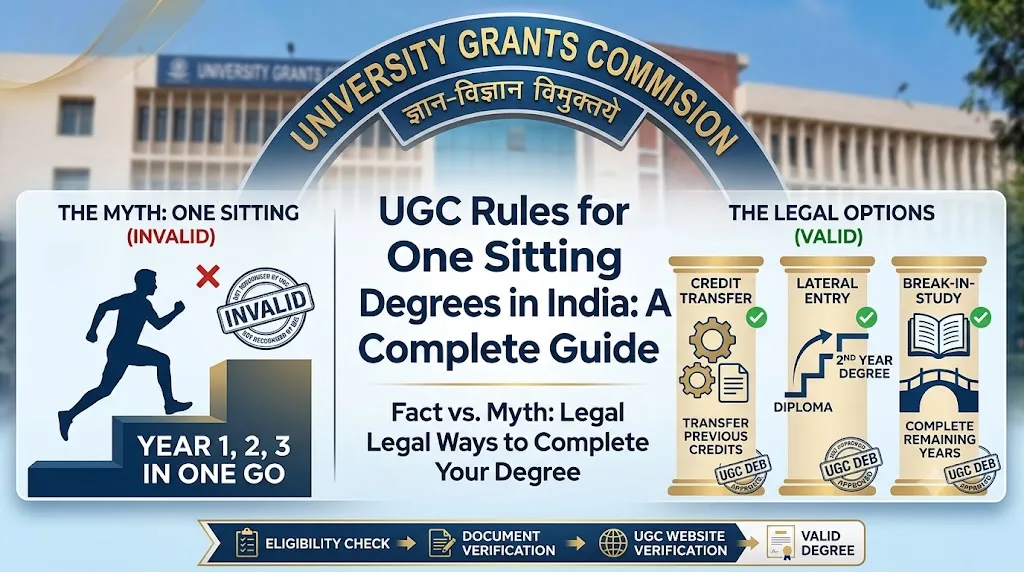
The idea of completing a degree in a single sitting is attractive to many students, working professionals, and learners who have discontinued their education. Searches for one sitting degree programs in India, one sitting graduation, and fast-track degrees have become increasingly common among people looking for flexible ways to complete their education.
However, there is considerable confusion surrounding the legal validity and recognition of such qualifications. A course advertised as a “one sitting degree” is not automatically a UGC-recognised degree. Students need to understand the applicable regulations, the status of the university, the mode of education, and the academic requirements before enrolling.
What Is a One Sitting Degree?
A one sitting degree generally refers to a qualification advertised as being completed through examinations or other academic requirements within a very short period, sometimes in a single examination session.
Traditional undergraduate and postgraduate degrees normally have prescribed academic durations and requirements. Therefore, an advertisement claiming that a student can obtain a conventional degree simply by appearing for one examination should be examined carefully.
The term “one sitting degree” is also sometimes used by private education consultants to describe programmes intended for students with education gaps. However, the marketing term itself does not establish that the resulting qualification is recognised.
The most important question is not whether a programme is advertised as fast or convenient, but whether the university and programme comply with applicable UGC regulations and other statutory requirements.
What Does the UGC Say About One Sitting Degrees?
The University Grants Commission maintains an official record of notifications specifically relating to the validity of one-sitting degrees. Its regulations page lists a 1996 notification regarding the validity of one sitting degrees and a separate notification concerning M.A., M.Sc., and M.Com. degrees obtained through one sitting in 1998–99.
This historical record is important because it shows that the phrase “one sitting degree” has been the subject of UGC regulatory action and should not be treated as an ordinary shortcut to a recognised university qualification.
For students considering admission today, the safer approach is to look at the current regulatory framework applicable to the specific university, degree, and mode of education rather than relying on an old advertisement or a consultant's claim.
The UGC currently maintains separate regulations for conventional degree programmes as well as Open and Distance Learning and online programmes. Its regulations page lists the 2024 Third Amendment to the ODL and Online Programmes Regulations, along with earlier regulations and amendments.
Is a One Sitting Degree UGC Recognised?
There is no blanket rule that makes every qualification marketed as a “one sitting degree” valid simply because the institution claims to be UGC approved.
The UGC explains that a statutory university can award a degree specified under Section 22 of the UGC Act, 1956, subject to the required approvals and applicable UGC regulations.
Therefore, students should verify several things:
- Whether the university is legally recognised.
- Whether the degree is among the degrees that the university is authorised to award.
- Whether the specific programme is permitted.
- Whether the chosen mode of education is recognised.
- Whether the admission and examination process follows applicable regulations.
- Whether the qualification meets the requirements of the organisation or institution where it will be used.
Simply seeing the words “UGC approved” on a website is not enough.
Why Academic Duration Matters
A recognised degree is not merely a certificate obtained after paying a fee and appearing for an examination. Higher education programmes have academic structures involving curriculum, credits, assessment, examinations, and other requirements.
For ODL and online programmes, UGC regulations provide that curricular aspects, assessment criteria, and credit frameworks for undergraduate and postgraduate degree programmes should follow the applicable standards used in conventional modes.
This is why students should be cautious about offers such as:
- “Degree in one exam”
- “Degree without studying”
- “Backdated degree”
- “Degree in a few months”
- “No classes or assignments required”
- “Guaranteed government-job-valid degree”
Such claims require careful verification before any payment or admission.
One Sitting Degree vs Online Degree
A one sitting degree and a recognised online degree are not necessarily the same thing.
An online degree is delivered through an approved online learning framework and must follow the applicable academic and regulatory requirements. Students generally have to satisfy admission, learning, assessment, examination, and credit requirements.
The UGC currently publishes regulations specifically covering Open and Distance Learning and online programmes.
For students who need flexibility, an approved online degree can therefore be a more appropriate option than choosing a programme solely because it promises extremely fast completion.
One Sitting Degree vs Distance Education
Distance education is another legitimate learning pathway when offered by an appropriately recognised institution and under the applicable regulatory framework.
The major difference is that distance education does not simply mean receiving a degree without completing academic requirements. Students enrolled in recognised ODL programmes are expected to follow the programme structure established by the institution and applicable regulations.
The UGC's regulatory framework specifically addresses ODL and online programmes, including academic standards and assessment requirements.
Students with employment commitments or education gaps can therefore investigate recognised distance programmes rather than relying on unverified one sitting degree advertisements.
Can You Pursue Two Degrees at the Same Time?
This is another topic that is often confused with one sitting degrees.
The UGC introduced guidelines for pursuing two academic programmes simultaneously in 2022. The initiative was linked to the National Education Policy's emphasis on flexibility and multiple pathways to learning.
The UGC continues to list these guidelines among its official initiatives and also lists a 2025 partial modification to the guidelines.
However, pursuing two academic programmes simultaneously does not mean that a student can compress a standard degree into one sitting. These are different concepts.
Students considering two degrees should check the latest UGC guidelines as well as the rules of the universities involved.
What About Students With an Education Gap?
One of the main reasons people search for one sitting graduation in India is an education gap.
For example, a student may have completed Class 12 but discontinued college because of financial, personal, or professional circumstances. Several years later, that student may want to return to higher education.
An education gap does not necessarily mean that a student needs a one sitting degree. Depending on eligibility, the student may be able to enrol in a recognised regular, distance, or online programme.
The appropriate route depends on previous qualifications, admission rules, age requirements where applicable, programme availability, and the student's career objective.
How to Verify a One Sitting Degree
Before enrolling in any programme advertised as a one sitting degree, students should follow a verification process.
1. Check the University
Start with the official UGC website and verify the institution's status. The UGC provides information about universities and also maintains a list of institutions identified as fake universities.
The current UGC website lists a List of Fake Universities, with the published list identified as being current as of February 2026.
2. Check the Exact Degree
Do not stop after verifying the university. Check whether the institution is authorised to award the specific degree you intend to pursue.
The UGC explains that specified degrees fall under the relevant provisions of Section 22 of the UGC Act.
3. Verify the Learning Mode
Ask whether the programme is:
- Regular
- Open and Distance Learning
- Online
- Another officially recognised mode
If a university advertises a distance or online programme, verify the institution and programme against the latest UGC information.
4. Ask for Written Information
Before paying fees, request official documentation showing:
- Programme name
- Duration
- Eligibility
- Admission procedure
- Examination structure
- Assessment requirements
- University name
- Recognition or entitlement details
- Fee structure
Avoid relying exclusively on WhatsApp messages, phone calls, social media advertisements, or verbal promises from agents.
5. Check Your Intended Use
A qualification may be used for different purposes, including employment, higher education, promotion, or professional eligibility.
The UGC states that equivalence is not determined universally by the UGC. For higher education, equivalence is decided by the concerned university, while employment-related equivalence is determined by the employing organisation.
Therefore, if you need a degree for a particular job, promotion, competitive examination, or further course, check the eligibility rules of that specific organisation before enrolling.
Red Flags to Watch For
Students should be particularly careful when an institution makes unrealistic promises.
“Guaranteed UGC approval”
No private advertisement should be accepted at face value. Verify the institution and programme through official sources.
“No study required”
A recognised degree normally involves academic requirements. A claim that students do not need to study or complete assessments deserves scrutiny.
“Degree in one examination”
This is one of the clearest reasons to investigate the programme carefully. Ask the institution to provide the exact regulatory basis for the claim.
“Backdated degree”
Students should be extremely cautious about any offer involving a degree with a previous date that does not correspond to the actual academic programme.
“Valid everywhere”
No institution should be assumed to have universal acceptance for every employment, professional, or higher-education purpose. The intended use matters.
Better Alternatives to One Sitting Degree Programs
If your goal is to obtain a legitimate qualification quickly while continuing work or managing other responsibilities, consider recognised flexible education options.
Online Degree Programmes
Online programmes can offer flexibility through digital learning platforms and remote access to course material. Students should verify the institution and programme's current status before admission.
Distance Degree Programmes
ODL programmes can be suitable for students who cannot attend a conventional campus. However, the university and programme should be checked against the applicable UGC framework.
Regular Degree Programmes
For students who can attend campus, a traditional programme remains a straightforward option with a clearly defined academic structure.
Multiple Academic Programmes
Students who want to study more than one subject can also investigate the UGC's framework for pursuing two academic programmes simultaneously, subject to applicable rules and university requirements.
Frequently Asked Questions
Is a one sitting degree valid in India?
Validity depends on the institution, degree, programme structure, mode of education, and applicable regulations. Students should not assume that every qualification marketed as a one sitting degree is recognised.
Does UGC allow one sitting graduation?
Students should distinguish historical UGC notifications concerning one sitting degrees from the current rules governing recognised degree programmes. The UGC's official regulations page contains specific historical notifications on one sitting degrees and current regulations governing degree programmes and ODL/online education.
Is an online degree better than a one sitting degree?
For students seeking flexibility, a properly recognised online degree can be a more transparent option because it follows an established academic and regulatory framework. The specific university and programme should always be verified.
Can I use a one sitting degree for a government job?
Do not assume acceptance. Government recruitment depends on the eligibility rules of the relevant recruitment authority and the recognition or validity requirements applicable to that post.
How can I check whether a university is genuine?
Use the official UGC resources to verify the university and check the UGC's information on fake universities and institutions violating regulations.
Conclusion
The demand for one sitting degree programs in India largely comes from students and professionals looking for flexible and faster ways to complete their education. However, the convenience promised by an advertisement should never be more important than recognition, academic validity, and future usability.
The UGC maintains historical notifications concerning one sitting degrees and currently regulates degree programmes, online education, and Open and Distance Learning through separate regulatory frameworks.
Before enrolling, verify the university, exact degree, programme, learning mode, duration, admission requirements, examination process, and intended use of the qualification. If you need a degree after an education gap or alongside employment, a recognised online, distance, or regular programme may provide a safer and more transparent route.
Ultimately, the best degree is not necessarily the one that promises the fastest certificate. It is the qualification that is properly awarded, verifiable, academically compliant, and suitable for your future education or career goals.
https://articlescad.com/one-sitting-degree-programs-in-india-complete-guide-2026-300024.html