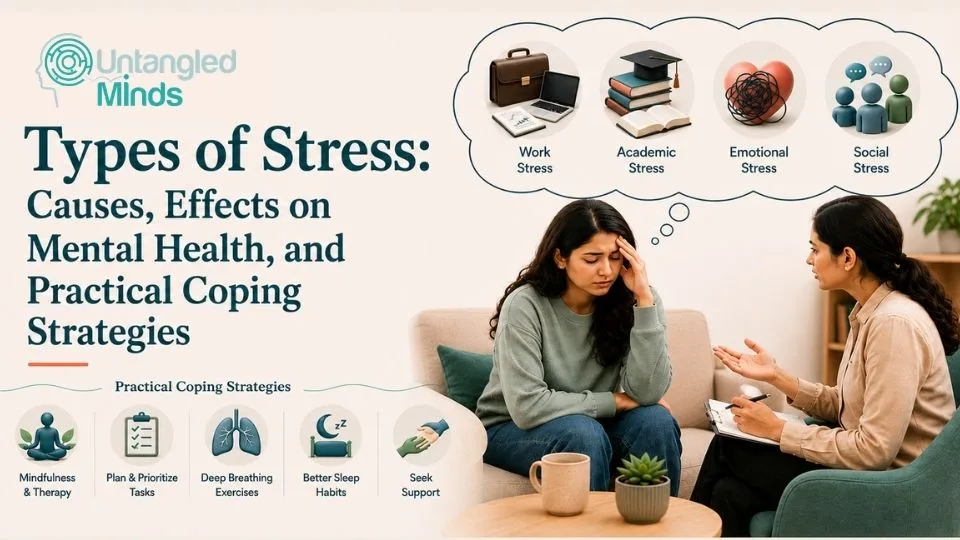
Most people use the word "stress" as though it describes one thing. It doesn't. Types of stress differ fundamentally in their duration, their source, their physical and psychological impact - and critically, what actually helps with each one.
I'm Shyamolie Desai, a Clinical Psychologist in Mumbai, and I work with stress-related concerns regularly. One of the most useful things I can do for someone early in the therapeutic process is help them understand which kind of stress they're actually dealing with - because the strategies that work for one type can be entirely ineffective for another.
Acute Stress - The One We're Built For
Acute stress is the immediate, short-lived response to a specific situation. A presentation you're dreading. A near-miss on the highway. A difficult conversation you have to have tonight. Your nervous system activates, you feel it physically - faster heartbeat, muscle tension, a kind of sharpened focus - and then, when the situation resolves, it dissipates.
This is the type of stress we're biologically designed to handle. It's meant to be temporary. And in small doses, it can actually enhance performance - that edge before an important meeting isn't always a bad thing.
The problem begins when acute stress becomes the constant background.
Chronic Stress - The One That Does the Most Damage
Chronic stress is what happens when stressors stop being discrete events and become the permanent texture of your daily life. Financial pressure that doesn't resolve. A job that drains you every single day. A relationship in ongoing conflict. A caregiving situation with no end in sight.
Your nervous system, which was designed for short, intense activation followed by recovery, ends up in a state of sustained low-grade arousal. Sleep deteriorates. Appetite changes. Irritability becomes your default setting. You stop noticing the tension in your shoulders because it's been there so long it feels like you.
The dangerous thing about chronic stress is how quietly it normalizes. I've sat with clients who described themselves as "managing fine" while describing days that would exhaust almost anyone. They'd stopped registering the load because the load had been there for years.
Episodic Acute Stress - The Pattern Nobody Talks About Enough
This is acute stress that occurs repeatedly, in a pattern. The person who seems to lurch from crisis to crisis - who always has something urgent happening, who tends to create or attract high-drama situations, who is perpetually overwhelmed in a way that feels cyclical.
Episodic stress is often tied to personality patterns and deeply ingrained ways of relating to the world - a tendency to take on too much, difficulty with planning, a cognitive style that catastrophizes. It doesn't respond to the same approaches as purely situational stress. Addressing it requires looking at the patterns that keep generating the stressors, not just managing the symptoms.
Eustress - The Kind That Helps
Worth mentioning because it genuinely changes the conversation: eustress is positive stress - the kind associated with excitement, challenge, growth. A new project you care about. Training for a physical goal. A demanding but rewarding phase of life.
Physiologically, eustress activates similar systems to distress. The distinguishing factor is appraisal - whether the demand feels threatening or meaningful. This isn't a license to reframe genuinely harmful stress as good. It's a reminder that not all activation is damaging, and that context and meaning matter in how stress lands.
Which Type Are You Actually Dealing With?
The reason this matters clinically is that the intervention needs to match the type. Breathing exercises and mindfulness are effective for acute stress management. They're insufficient for chronic stress that has a structural cause - a job that is genuinely unsustainable, a relationship that needs to change. Stress management skills help with the symptoms; they don't address the source.
If you've been doing all the "right things" - exercising, meditating, sleeping reasonably well - and you're still exhausted and running on empty, it's worth asking whether you're trying to manage symptoms while the underlying source remains entirely unchanged.
About Shyamolie Desai
I'm a Clinical Psychologist in Mumbai, and I work directly with individuals experiencing stress, burnout, and anxiety at my centers across Chembur, Sion, Wadala, and Santacruz - with online sessions available. In my clinical work, I start with assessment: understanding which type of stress is in play, where it's coming from structurally, and building a plan that actually addresses the root rather than just the surface.
Frequently Asked Questions
Can stress become a clinical condition?
Yes. Prolonged, unmanaged stress is a significant contributor to clinical anxiety, depression, and burnout. These are recognized conditions requiring structured treatment.
What's the difference between stress and anxiety?
Stress typically has an identifiable external source. Anxiety often persists even when the external stressor is absent - it's the nervous system's threat-detection running even when no immediate threat is present.
When should I seek professional help for stress?
When it's been going on for more than a few weeks, when it's affecting sleep, relationships, or your ability to function at work, or when your usual coping strategies have stopped working.
Does stress counselling actually help?
When it's properly structured - yes, significantly. The evidence for CBT-based stress management is strong. The key is addressing both the cognitive patterns and, where possible, the structural sources.