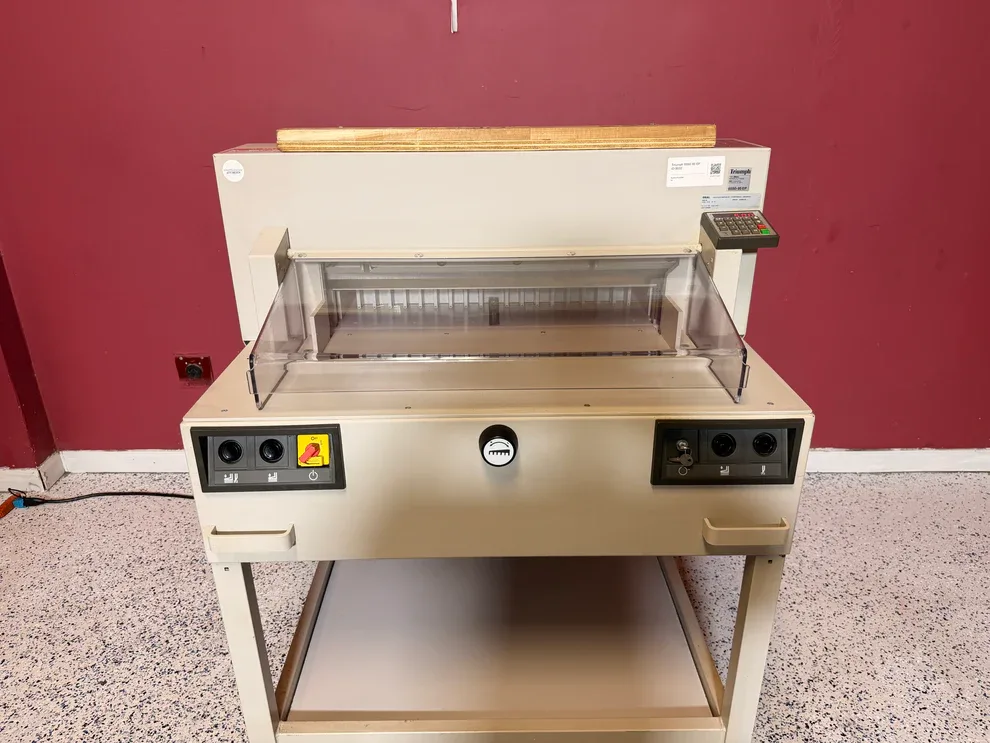
A clean, straight cut can completely change the appearance of printed material. A brochure with uneven edges looks unfinished, while a neatly trimmed stack immediately feels more professional. For print shops, copy centers, commercial printers, and businesses handling large amounts of printed material, a Triumph paper cutter can provide the strength and consistency needed for demanding cutting work.
Unlike a small office trimmer designed for a few sheets at a time, a professional paper cutter is built to handle substantial stacks of paper. It gives operators greater control over cutting width, paper positioning, and clamping. Models such as the Triumph 4850-95 are designed for professional production environments and combine a substantial cutting table with powered operation and an automatic paper clamp.
For businesses purchasing used print-finishing equipment, understanding the machine's specifications, safety features, maintenance requirements, and transportation needs is essential. A paper cutter is a major piece of equipment, so choosing one should involve more than simply comparing prices.
What Is a Triumph Paper Cutter?
A Triumph paper cutter is a heavy-duty guillotine-style machine used to cut stacks of paper and other suitable printed materials into precise sizes.
The basic concept is straightforward. Instead of cutting one sheet with a pair of scissors or a small desktop trimmer, the operator places a stack on a large cutting table. The machine holds the stack securely and brings a strong blade down through the material.
Think of it like slicing a large layered cake. If the layers move while you cut, the slices will not look even. Holding everything firmly in position is what produces a clean result.
Professional paper cutters apply the same basic principle to paper.
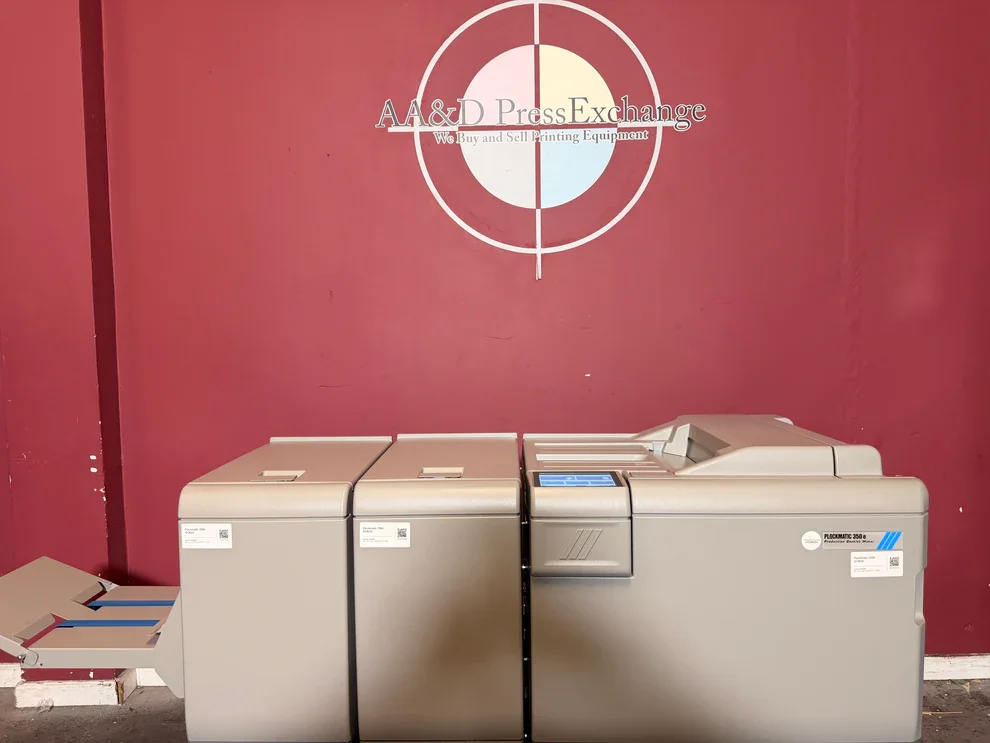
The Triumph 4850-95 listed by AA&D PressExchange, for example, has an 18-inch cutting width, an 18-inch cutting capacity, a 3-inch cutting height, automatic paper-clamp operation, a manually operated back gauge, and a 2 HP motor. The listed machine weighs 556 pounds.
Those specifications show why this type of equipment belongs in a professional production environment rather than on an ordinary office desk.
Why Professional Paper Cutting Matters
Printing and cutting are closely connected.
Imagine a print shop producing hundreds of business cards. The printer creates the sheets, but the finished cards still need to be separated accurately. The same applies to postcards, flyers, invitations, brochures, book covers, photographs, and many other products.
If cutting is inconsistent, even a high-quality print job can lose its professional appearance.
A production cutter can help with:
- Consistent dimensions
- Straight edges
- Repeatable cutting
- Large paper stacks
- Faster finishing
- Reduced manual trimming
- Better preparation for subsequent finishing steps
This can be particularly valuable when a business handles repeated orders with specific dimensions.
How Does a Triumph Cutter Work?
Although professional cutters can look complicated, the basic workflow is easy to understand.
Position the paper
The operator places the printed material on the cutting table.
The sheets need to be aligned properly before cutting begins. Guides and positioning mechanisms help establish the desired location.
Set the cutting position
The back gauge determines where the paper stack sits in relation to the blade.
On the Triumph 4850-95 listed by AA&D PressExchange, the back gauge is manually operated.
In simple terms, it acts somewhat like a movable stop. You position it according to the size you want to produce, then place the paper against it.
Secure the stack
The paper clamp holds the material in place.
This step is critical. If a stack shifts during cutting, the resulting edges may no longer match.
The Triumph 4850-95 listing specifies automatic paper-clamp operation.
Make the cut
Once everything is properly positioned and the machine's safety procedures are followed, the powered cutting mechanism makes the cut.
The result is a clean edge across the stack.
Repeat for the remaining sides
Many printed products require more than one cut. For example, a large printed sheet might contain multiple smaller pieces. The operator can reposition the material and repeat the process until the individual products are separated.
Cutting Capacity Is an Important Specification
One of the first specifications buyers should examine is cutting capacity.
For the Triumph 4850-95 listed by AA&D PressExchange, the cutting height is listed as 3 inches.
Cutting height tells you approximately how tall a stack the machine is designed to process. It should not be interpreted as meaning that every material can be stacked to that maximum and cut in exactly the same way.
Paper thickness, density, coating, and material characteristics can all influence practical performance.
For comparison, the current IDEAL 4850—part of the same broader guillotine-cutter family and a useful reference for understanding this class of equipment—is specified at an 80 mm cutting height and a 475 mm cutting length.
When evaluating a particular Triumph machine, always use the specifications for that exact model and configuration.
Cutting Width Determines What You Can Process
Cutting width is another major consideration.
The Triumph 4850-95 listing gives an 18-inch cutting width.
This measurement helps determine the largest dimension of a sheet that can be accommodated across the cutting area.
Why does that matter?
Suppose a print shop frequently produces large marketing sheets. A cutter with a small working area may require those sheets to be reduced before they can be processed. A larger professional cutter can provide more flexibility.
The ideal cutting width therefore depends on the materials a business handles regularly.
The Paper Clamp Helps Keep Cuts Consistent
Holding the stack firmly is just as important as having a sharp blade.
If sheets move during cutting, the top sheet might look correct while lower sheets gradually shift out of alignment.
An automatic clamp, such as the one specified for the Triumph 4850-95, helps secure the stack before cutting.
Think of cutting a stack of photographs. If you simply press down on them with your hand, the lower photographs may slide slightly. A proper clamp provides much more consistent pressure across the stack.
That consistency becomes increasingly important when hundreds of finished pieces must have matching dimensions.
What Can a Triumph Paper Cutter Produce?
A professional cutter can support many different print-finishing applications.
Business cards
Large sheets containing multiple cards can be divided into individual cards after printing.
Postcards
Printed postcard sheets can be trimmed into finished pieces with consistent dimensions.
Flyers
Large printed sheets can be reduced to the desired finished size.
Brochures
After folding or other finishing steps, edges may need trimming for a clean final appearance.
Book covers
Covers often require accurate trimming so they align properly with the pages inside.
Photographic prints
Professional photographers and art printers may need consistent borders and finished dimensions.
Marketing materials
Coupons, promotional cards, inserts, and other printed products can all require precision cutting.
The exact materials and thicknesses a particular Triumph model can safely process should always be confirmed against its specifications and operating documentation.
Why Accuracy Matters More Than Speed Alone
It can be tempting to evaluate a paper cutter by asking only how quickly it works.
However, production speed means little if every batch requires correction.
Imagine producing 1,000 postcards quickly but discovering that the cuts are inconsistent. The time saved during cutting could easily disappear through rework and wasted material.
A good production workflow balances:
Speed + positioning + clamping + cutting consistency + operator safety.
That combination creates useful productivity.
A cutter that produces reliable results repeatedly can be more valuable than one that simply has an impressive maximum operating figure.
Safety Should Always Come First
A professional paper cutter contains a powerful cutting mechanism. It should never be treated like an oversized office paper trimmer.
Operators should receive appropriate training and follow the manufacturer's safety procedures.
Modern professional guillotine cutters commonly incorporate protective systems designed to reduce the risk of accidental operation. For example, the current IDEAL 4850 includes a Safety Cutting System, a two-stage cutting trigger, monitored safety devices, automatic return functions, and a covered blade-changing system.
Older Triumph equipment can have different safety systems depending on the model and production year.
That makes it particularly important to inspect a used machine carefully. Buyers should verify that safety guards, controls, electrical components, and other protective mechanisms are present and functioning properly.
Safety should never be sacrificed to increase production speed.
Buying a Used Triumph Paper Cutter
Used equipment can provide an economical way to add professional finishing capability.
For example, AA&D PressExchange lists used print-finishing equipment, including a Triumph 4850-95 paper cutter. The listed example is priced at $2,250 and includes specifications such as its 2 HP motor, automatic clamp, 115 V electrical requirement, and 556-pound weight.
However, buyers should evaluate more than the asking price.
Check the machine's condition
Look for signs of excessive wear, damage, corrosion, or poorly repaired components.
Examine the blade
The blade is one of the most important working parts of the machine. Its condition can have a direct effect on cut quality.
Test the positioning system
Make sure the back gauge and other positioning components operate as expected.
Inspect the clamp
A cutter needs reliable clamping to maintain consistent results.
Review electrical requirements
Confirm that the machine's electrical requirements are compatible with the intended installation.
Ask about maintenance
Maintenance records can provide useful information about how the machine was treated.
Verify included accessories
Tables, tools, covers, and other accessories can affect both usability and value.
Why Machine Weight Matters During Transportation
A professional paper cutter is not a lightweight piece of office equipment.
The Triumph 4850-95 listed by AA&D PressExchange weighs 556 pounds.
That is roughly the weight of several large appliances combined.
Moving equipment of this size requires planning. Simply putting it on a standard pallet and wrapping it with plastic may not provide enough protection for a long-distance shipment.
The machine needs to be secured against movement, impact, and other transportation stresses.
Fort Worth Crating and Shipping Services for Heavy Equipment
When a professional cutter needs to be moved between locations, Fort Worth Crating and Shipping Services can be an important consideration.
Specialized crating is different from ordinary packaging. The goal is to create a protective structure around the equipment that takes into account its weight, dimensions, shape, and vulnerable components.
Depending on the machine and shipping method, preparation may include:
- Building a sturdy wooden crate
- Securing the cutter to a suitable base
- Protecting exposed surfaces
- Preventing movement inside the crate
- Using appropriate cushioning
- Preparing the shipment for freight handling
- Considering loading and unloading requirements
The reason is simple: a machine that weighs hundreds of pounds can generate substantial force if it shifts during transportation.
Good packaging is therefore part of protecting the investment.
Installation Requires Planning Too
Getting a cutter into the building is only one part of the process.
The installation area needs adequate floor space and enough room for operators to work safely around the machine.
The machine should also be positioned so that paper can be loaded and finished material can be removed without creating an awkward workflow.
For reference, the manufacturer's current IDEAL 4815 specifications list dimensions of approximately 1,410 × 762 × 1,053 mm and a weight of 199 kg before optional additional tables.
A professional cutter therefore needs considerably more planning than a desktop device.
Before delivery, measure doors, elevators, corridors, loading docks, and the intended installation area.
Maintenance Helps Preserve Cutting Quality
Even a robust cutter needs routine care.
A blade that becomes dull can produce less satisfactory results. Paper dust can accumulate over time, and mechanical components can require inspection or adjustment.
Operators should follow the maintenance procedures applicable to the specific Triumph model.
The blade should also be handled only by trained personnel using the correct procedures and equipment.
Current professional guillotine systems demonstrate how seriously blade maintenance is treated. The IDEAL 4850, for example, incorporates a dedicated blade-changing device with a covered cutting edge.
The lesson for owners of older equipment is straightforward: maintenance is not an optional extra. It is part of keeping the cutter safe and productive.
How to Choose the Right Cutter for Your Business
Before purchasing a Triumph paper cutter, make a short list of your actual production requirements.
Ask yourself:
What materials do we cut?
Paper, cardstock, brochures, photographs, and other materials can have different handling requirements.
What sizes do we produce?
Your largest regular sheet size should help determine the necessary cutting width.
How large are our stacks?
Estimate the normal stack height rather than choosing based solely on the maximum capacity.
How often will the machine run?
A cutter used occasionally has different requirements from one operating throughout a busy production day.
What electrical service is available?
Confirm compatibility before delivery.
How will the machine reach its final location?
Consider loading equipment, door dimensions, floor access, and transportation.
Who will operate it?
Proper training should be part of the implementation plan.
Final Thoughts
A Triumph paper cutter can be a valuable addition to a professional print-finishing operation when its capabilities match the work being produced. Instead of trimming sheets one at a time with slower manual tools, a heavy-duty cutter can process substantial stacks while providing controlled positioning and repeatable results.
The Triumph 4850-95, for example, combines an 18-inch cutting width, 3-inch cutting height, automatic paper clamping, manual back-gauge operation, and a 2 HP motor in a machine weighing 556 pounds.
For buyers considering used equipment, AA&D PressExchange provides another avenue for finding professional print-finishing machinery without automatically committing to the cost of new equipment.
But purchasing the machine is only the beginning. Proper inspection, safe operation, maintenance, installation, and transportation all contribute to long-term value. When heavy equipment must travel, dependable Fort Worth Crating and Shipping Services can also help ensure that the cutter is properly prepared for the journey.
Ultimately, the right paper cutter should do more than make a straight line. It should help a print operation work efficiently, produce consistent finished products, and turn printed sheets into professional materials customers are happy to receive.