
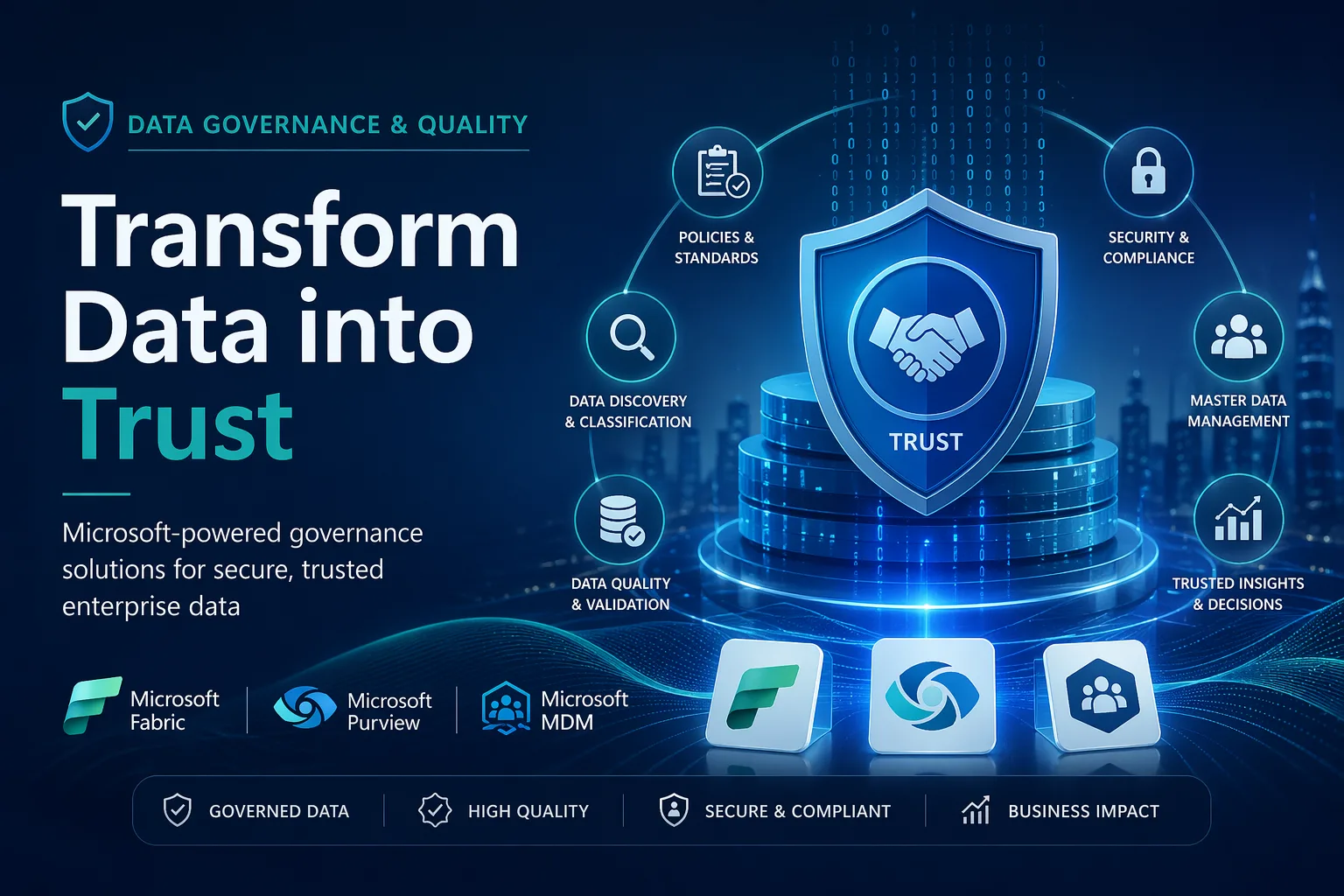
Data isn’t just an asset anymore, it’s the lifeblood of modern business. Yet, for many organizations, data feels more like a chaotic jungle than a well-managed garden. Teams drown in spreadsheets, analytics tools don’t talk to each other, and compliance teams are constantly playing catch-up. That’s where intelligent data governance comes in. And right now, Microsoft Fabric, Microsoft Purview, and Master Data Management (MDM) are reshaping what modern data governance solutions look like.
This is governance that’s built into the fabric of your data ecosystem, intelligent, automated, and business-friendly. Let’s break it down in a way that actually makes sense.
Why Modern Data Governance Needs a Rethink
The Explosion of Data Sources
Think about your organization five years ago versus today. Back then, you probably had a handful of databases, a CRM, maybe an ERP, and some reports in Excel. Today? You’ve got cloud apps, IoT data, real-time analytics, AI models, marketing platforms, data lakes, and dozens of SaaS tools.
Every new system generates data. Every new department creates their own dashboards. And before you know it, your data landscape looks like a bowl of spaghetti — messy, tangled, and impossible to manage.
Why Traditional Governance Falls Short
Traditional governance was built for a simpler world. It relied heavily on manual policies, centralized teams, and periodic audits. That might have worked when data moved slowly. But in today’s fast-paced, AI-driven world, that approach simply can’t keep up.
Organizations now need data governance solutions that are automated, scalable, and embedded directly into their technology stack. That’s exactly where Microsoft’s modern data ecosystem shines.
The Rise of Intelligent Data Platforms
Intelligent data platforms don’t just store data — they understand it, organize it, and make it usable. Instead of governance being an afterthought, it becomes a built-in capability.
Microsoft’s approach brings together analytics, AI, governance, and integration into one cohesive environment. Instead of stitching together a dozen disconnected tools, businesses can manage, govern, and analyze data from a single, unified platform.
Microsoft Fabric — The Unified Data Backbone
Microsoft Fabric is like the central nervous system of your data architecture. It connects everything — data engineering, data warehousing, data science, real-time analytics, and business intelligence — in one integrated experience.
Lakehouse Architecture in Simple Terms
If “lakehouse” sounds complicated, think of it this way: it’s the best of both worlds. You get the flexibility of a data lake (store everything) with the structure and performance of a data warehouse (clean, organized, and query-friendly).
This means teams don’t have to constantly move data around. They can work in the same environment, reducing duplication, errors, and confusion.
Real-Time Analytics and AI Readiness
Fabric isn’t just about storage — it’s designed for real-time insights and AI workloads. Businesses can stream data, analyze it instantly, and even feed it into AI models without massive data engineering overhead.
This makes modern data governance solutions more proactive rather than reactive. Instead of cleaning up messes later, organizations can prevent issues before they even happen.
Microsoft Purview — The Control Tower of Data
If Fabric is the engine, Microsoft Purview is the control tower. It provides visibility, control, and protection across your entire data estate.
Data Discovery and Classification
One of the biggest governance challenges is simply knowing what data you have. Purview automatically scans your systems, catalogs data assets, and classifies sensitive information like personal data, financial records, or confidential business data.
It’s like having an intelligent librarian who not only knows where every book is but also understands what’s inside each one.
Compliance, Risk, and Privacy
With stricter regulations like GDPR, CCPA, and industry-specific compliance requirements, businesses can’t afford governance gaps. Purview helps organizations track data lineage, manage access, and demonstrate compliance with clear audit trails.
This level of transparency strengthens data governance solutions and builds trust with regulators, customers, and internal stakeholders.
Why Master Data Breaks in Large Enterprises
In big organizations, different departments often maintain their own versions of key data — customers, products, employees, vendors. Marketing has one list. Sales has another. Finance has yet another.
This leads to confusion, errors, and poor decision-making.
How MDM Brings Consistency Across SystemsMDM creates a single, trusted version of core business data that all systems can reference. Instead of multiple conflicting records, everyone works from the same playbook.
When combined with Fabric and Purview, MDM becomes a powerful pillar of modern data governance solutions, ensuring accuracy, consistency, and reliability across the enterprise.
How Fabric, Purview, and MDM Work Together
From Data Creation to ConsumptionHere’s where the magic happens. Data is ingested into Microsoft Fabric, cataloged and governed through Purview, and aligned with business standards using MDM.
It’s a seamless lifecycle — from raw data to trusted insights.
Governance Without BottlenecksIn many organizations, governance slows things down. Teams complain that policies block innovation. But with this integrated approach, governance becomes an enabler rather than a barrier.
Automated policies, smart classification, and centralized control mean teams can move fast without sacrificing security or compliance.
This is what truly intelligent data governance solutions look like in action.
Business Benefits of Intelligent Data Governance
Faster Decision-MakingWhen data is clean, trusted, and easily accessible, leaders can make better decisions — faster. No more debating whose spreadsheet is correct or waiting weeks for IT to prepare reports.
Reduced Risk and Better ComplianceProactive governance reduces the risk of data breaches, compliance violations, and costly mistakes. Organizations gain confidence that their data is secure, compliant, and well-managed.
This isn’t just good governance — it’s good business. Modern data governance solutions directly support growth, efficiency, and innovation.
Role of Data Governance Consulting ServicesImplementing this kind of intelligent governance isn’t always easy. That’s where data governance consulting services come in.
Experienced consultants help organizations design governance frameworks, align technology with business goals, and ensure successful adoption across teams. They bring best practices, industry expertise, and practical implementation strategies that accelerate results.
Without the right guidance, even the best tools can fall short.
Choosing the Right Data Governance Service Partner
Not all partners are created equal. When selecting a data governance service provider, look for deep expertise in Microsoft Fabric, Purview, and MDM, as well as a strong track record of successful implementations.
A great partner doesn’t just implement technology — they help transform how your organization thinks about and uses data.
Implementation Roadmap for Enterprises
Phase 1 — Assessment and StrategyStart by understanding your current data landscape, governance maturity, and business objectives. Identify gaps, risks, and opportunities.
Many organizations begin this phase with data governance consulting services to ensure a solid foundation.
Phase 2 — Architecture and ToolingDesign your target data architecture using Microsoft Fabric, integrate Purview for governance, and establish MDM processes for master data alignment.
This is where strategy turns into reality.
Phase 3 — Adoption and EnablementTechnology alone isn’t enough. Train teams, establish data ownership, and promote a culture of data accountability across the organization.
A strong data governance service partner can help drive adoption and change management.
Common Challenges and How to Overcome Them
Resistance to change is one of the biggest hurdles. Some teams fear losing control of their data. Others worry about increased oversight.
Clear communication, leadership support, and demonstrating quick wins can help overcome these challenges.
Another common issue is underestimating complexity. That’s why partnering with experienced data governance consulting services is so valuable.
The Future of Data Governance in the AI Era
As AI becomes more embedded in business operations, governance will only become more critical. Organizations will need to govern not just data, but also AI models, algorithms, and outputs.
Microsoft’s ecosystem is well-positioned for this future, making intelligent data governance solutions a cornerstone of digital transformation.
Conclusion
Intelligent data governance is no longer optional — it’s essential. By combining Microsoft Fabric, Microsoft Purview, and Master Data Management, organizations can build data ecosystems that are secure, compliant, and truly business-ready. The result? Better insights, smarter decisions, and a competitive edge in an increasingly data-driven world.
With the right data governance service strategy and strong data governance consulting services, businesses can move from reactive control to proactive intelligence — transforming governance from a cost center into a powerful growth engine.