Moving an elderly family member to another city for treatment is never easy. Older patients can be weak, tired or in pain, and a long road journey may be hard on them. Families naturally worry about comfort, medical care and what could go wrong on the way.
A train ambulance service can be a practical choice for planned, long-distance transfers. It offers bed-to-bed movement, with a medical team travelling alongside the patient and a family attendant close by.
This guide explains how a train ambulance works for elderly patients, what safety and comfort measures to look for, and how to prepare. It is general information and does not replace the advice of your treating doctor.
Why Elderly Patients Need Extra Care During Transfers
Older patients often have more than one health condition at a time. They may also be more sensitive to long journeys, noise, temperature changes and missed medicines.
Common concerns during a transfer include:
- Weakness and difficulty sitting or standing for long
- Pain from fractures, arthritis or surgery
- Breathing difficulty or a need for oxygen
- Blood pressure, sugar and heart rate that need regular checking
- Confusion or anxiety in an unfamiliar place
- Risk of falls while being shifted
- Skin pressure problems after long periods of lying down
A good transfer plan takes these points seriously and matches the level of care to the patient's needs.
What Is a Train Ambulance Service?
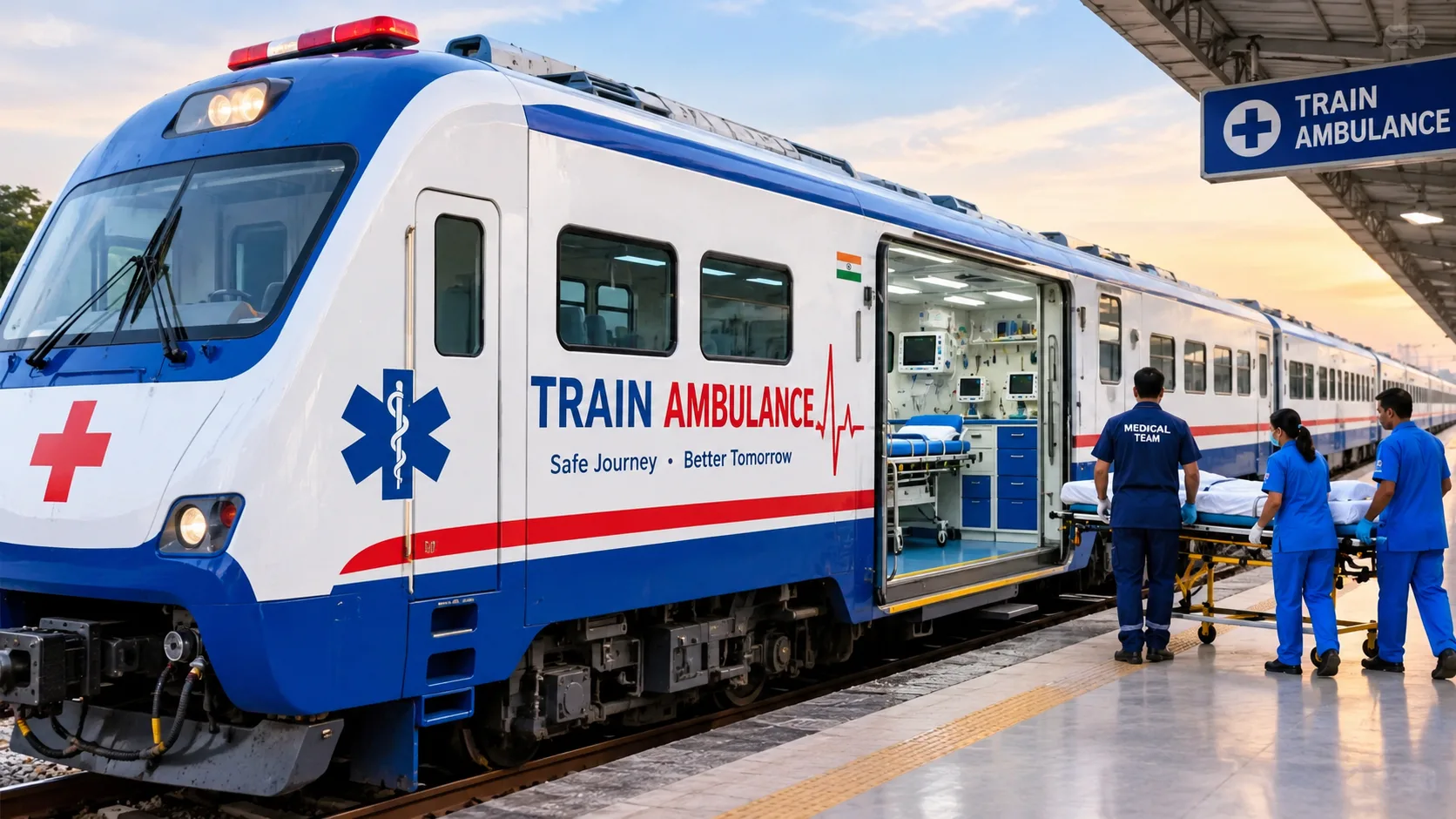
A train ambulance service moves a patient between cities by rail with medical care arranged for the whole journey. It is also called rail ambulance or medical train transport.
The process is bed-to-bed:
- A road ambulance picks up the patient from home or hospital.
- The patient is shifted to the train with the medical team.
- The team monitors the patient during the journey.
- On arrival, another ambulance takes the patient to the destination hospital.
It is meant for planned transfers when the patient is fit to travel. In a sudden emergency, call your local emergency number, such as 112, and reach the nearest suitable hospital first.
Why Families Choose a Train Ambulance for Elderly Patients
For many families, rail feels like a gentler option for an older person. Common reasons include:
- A steadier ride. Rail is generally smoother than hours on a highway, which can matter for patients in pain or with weak bones.
- Space to lie down. A reserved arrangement allows a stretcher or bed, so the patient does not have to sit upright.
- Room for a caregiver. A family member can usually travel along, which gives comfort and reassurance.
- More budget-friendly than air transport. For many routes, an affordable train ambulance is easier on the family's budget.
- Fewer sudden stops and traffic delays. Trains follow fixed routes and schedules.
Not every elderly patient is suitable for every mode of transport. Your doctor should confirm what is safe.
Levels of Care: Full ICU, Semi ICU and Basic Transfer
Most providers offer three levels. The right one depends on the patient's condition.
Full ICU train ambulance
This suits critical patients who need continuous monitoring and advanced support. Depending on the package, it can include a ventilator, cardiac monitor, oxygen supply, suction machine and infusion pumps, with a paramedic and a doctor.
Semi ICU train ambulance
This suits patients who are serious but more stable. It usually offers oxygen, monitoring and trained medical staff, with fewer advanced devices.
Basic patient transfer
This suits elderly patients who need a stretcher, help with movement and basic medical supervision but not intensive care. Examples include post-surgery recovery, mobility problems and long-term illness.
Exact inclusions differ between providers, so always ask for a written list.
Medical Support You Can Expect
Depending on the package, medical support for an elderly patient can include:
- Oxygen support
- Cardiac monitor tracking heart rate, blood pressure and oxygen saturation
- Suction machine
- Nebuliser and syringe or infusion pumps
- Stretcher or medical bed
- Emergency medicines and first-aid supplies
- Trained paramedic, and a doctor where the patient's condition requires it
Before booking, ask who will be on board, what their qualifications are, and how the team will respond if the patient's condition changes during the journey.
Comfort Measures to Ask About
Comfort is not an extra for an older patient. It is part of safe care. When talking to a provider, ask about:
- Safe shifting. How will the patient be moved between ambulance, platform and train? Trained hands and proper equipment reduce the risk of falls and pain.
- Positioning and support. Can the patient be kept in a comfortable position with proper support?
- Pressure care. For patients who lie down for long periods, ask how the team prevents skin pressure problems.
- Hydration and medicine timing. Will the team follow the patient's medicine schedule and fluid advice from the doctor?
- Temperature and ventilation. Older patients can be sensitive to heat and cold.
- Hygiene. Equipment, stretchers and masks should be clean and sanitised.
- Reassurance. A calm, patient team helps an anxious or confused patient feel safer.
The Role of the Family Attendant
A familiar face matters a lot to an elderly patient. Attendants can usually travel with the patient, though the number allowed depends on the package.
An attendant can help by:
- Keeping the patient's medicines, reports and ID proofs in order
- Telling the medical team about allergies, habits and past conditions
- Offering comfort and reassurance during the journey
- Staying in touch with the receiving hospital and relatives
Confirm the number of attendants allowed at the time of booking.
Step-by-Step Booking Process
- Talk to the treating doctor. Ask whether the patient is fit to travel by train and what level of care is needed.
- Call the provider. Share the patient's age, condition, current location, destination and preferred date.
- Describe special needs. Mention oxygen, ventilator, mobility issues, diabetes, memory problems or any recent surgery.
- Get a recommendation and written quotation. It should list equipment, staff and pickup and drop arrangements.
- Share documents. Send reports and ID proofs.
- Confirm the booking. The provider arranges the train, the medical team and road ambulances at both ends.
- Travel and handover. The patient is monitored during the journey and handed over to the receiving hospital.
Documents to Keep Ready
- Patient's ID proof and the attendant's ID proof
- Latest medical reports and the doctor's prescription
- Current list of medicines, with doses and timings
- Discharge summary or referral letter from the current hospital
- Consent form for patient transfer
- Admission details of the receiving hospital, if already arranged
Requirements can vary by patient and route, so confirm the exact list with your provider.
What Affects the Cost?
There is no single fixed price, and this article does not quote any. The cost generally depends on:
- Distance and route
- The patient's condition and the level of care
- Size of the medical team
- Number of attendants travelling
- Road ambulance pickup and drop at both ends
- Date of travel and availability
Compare written quotations by what is included, not just the total. A very low quote that leaves out key equipment or staff can cost more in the end.
City-Wise Coverage
Elderly patients travel to larger medical centres from many parts of the country. Here is a quick look at some key cities.
Delhi. With many large hospitals and strong rail links, the capital sees heavy patient movement, and train ambulance service in Delhi is a common request for older patients.
Noida. Its growing healthcare sector and links to the wider NCR make train ambulance service in Noida a useful option for nearby families.
Patna. Many older patients from Bihar travel to larger medical centres, and train ambulance service in Patna offers a steadier option for long routes.
Pune. Known for its hospitals and institutes, Pune sees regular patient movement, and train ambulance service in Pune supports both arrivals and departures.
Kolkata. A major medical destination for eastern India, Kolkata makes train ambulance service in Kolkata a regular need for families across the region.
Varanasi. Families from Uttar Pradesh and nearby areas often seek specialised care elsewhere, and train ambulance service in Varanasi can be arranged with medical support.
Mumbai. With large hospitals and strong rail connections, train ambulance service in Mumbai is useful for long-distance transfers.
Coverage often goes beyond these cities, so ask your provider about your exact route.
How to Choose a Reliable Provider
For an elderly patient, look for a provider who:
- Explains the plan, team and equipment clearly
- Gives a written quotation with everything listed
- Shares the qualifications of the doctor and paramedic
- Is patient and gentle in how they talk to the family
- Is reachable 24x7
- Coordinates ambulance pickup, rail travel and hospital handover
- Gives honest advice, including when another mode suits the patient better
Speak to more than one provider if you can, and trust the one who answers your questions most openly.
Need Help Planning a Transfer for an Elderly Patient?
If you are planning a patient transfer, you do not have to work it out alone. Our team can guide you on the right level of care, the documents needed and the next steps for a train ambulance service.
- Phone: 9031200544
- Email: [email protected]
- Website: trainambulance.in
Share the patient's condition, pickup city, destination and preferred date, and we will help you plan once your doctor confirms the patient is fit to travel.
Frequently Asked Questions
1. Is train ambulance safe for elderly patients? It can be, when the patient is medically fit to travel and the right level of care is arranged. The treating doctor should approve the transfer, and the journey should include trained staff, proper equipment and regular monitoring of the patient's condition.
2. Can an elderly patient lie down during the journey? Yes. A train ambulance service is arranged so the patient can travel lying on a stretcher or bed, with support and medical supervision. Ask your provider how the patient will be positioned and made comfortable before you confirm the booking.
3. Is ICU facility available for older patients? Yes, ICU-level transfers can include a ventilator, cardiac monitor, oxygen supply and suction machine, depending on the provider and package. Always ask for a written list of equipment and medical staff before you book.
4. Can a doctor and paramedic travel with the patient? Usually a paramedic travels with the patient, and a doctor can be included where the condition requires it. Ask who will be on board and what their qualifications are, so you know what level of support to expect.
5. Can family members travel with the patient? Usually, yes. Attendants can generally travel along with an elderly patient, though the number allowed depends on the package and arrangements. Confirm this at the time of booking so everyone knows what to expect on the day.Moving an elderly family member to another city for treatment is never easy. Older patients can be weak, tired or in pain, and a long road journey may be hard on them. Families naturally worry about comfort, medical care and what could go wrong on the way.
A train ambulance service can be a practical choice for planned, long-distance transfers. It offers bed-to-bed movement, with a medical team travelling alongside the patient and a family attendant close by.
This guide explains how a train ambulance works for elderly patients, what safety and comfort measures to look for, and how to prepare. It is general information and does not replace the advice of your treating doctor.