Heavy industry has always depended on precision, strength, and reliability. From forged steel components and industrial machinery to power-generation equipment and mining systems, manufacturers must produce components capable of performing under demanding operating conditions.
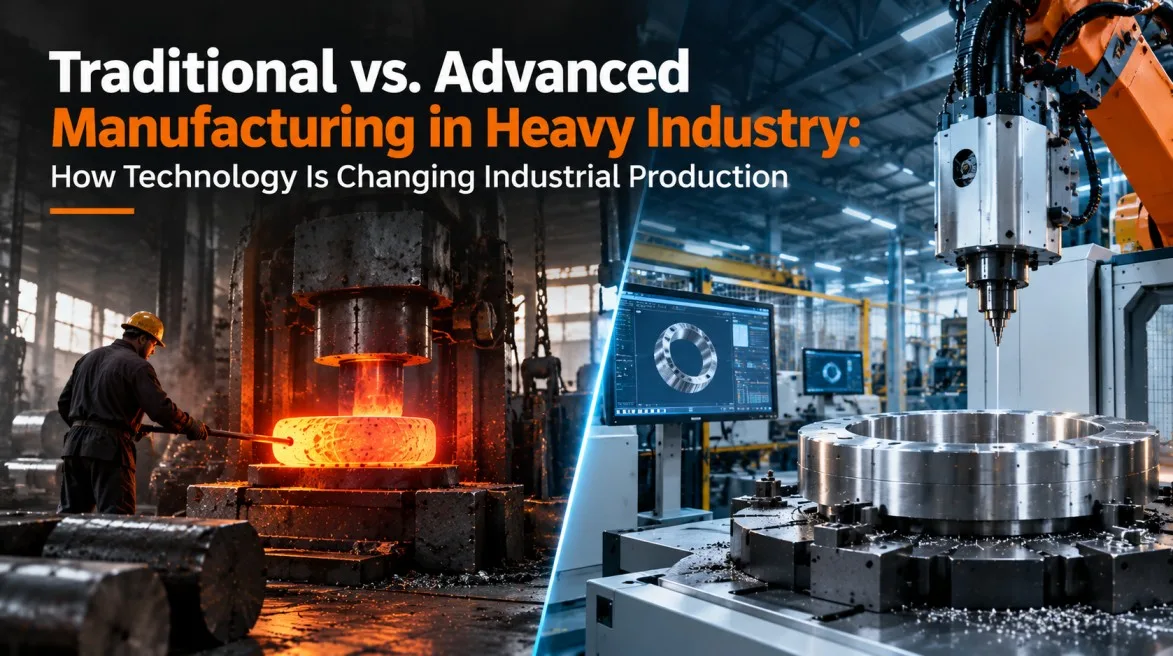
For decades, traditional manufacturing methods formed the foundation of industrial production. Skilled workers, mechanical equipment, established forging techniques, and hands-on quality checks helped manufacturers produce components for a wide range of applications.
Today, advanced technologies are changing how these operations are planned, executed, and monitored. Automation, computer-aided design, CNC machining, digital monitoring, and data-driven quality control are helping manufacturers improve consistency, productivity, and process visibility.
However, the transition is not simply about replacing traditional manufacturing with technology. It is about combining proven engineering expertise with modern capabilities to meet increasingly demanding industrial requirements.
What Is Traditional Manufacturing in Heavy Industry?
Traditional manufacturing relies on established production techniques, mechanical equipment, and the experience of skilled workers.
In heavy engineering and metalworking, these methods may include conventional forging, manual material handling, mechanical machining, operator-led process adjustments, and inspection using established measurement techniques.
Traditional manufacturing continues to play an important role because many industrial processes depend on practical experience and a deep understanding of materials.
Its key strengths include:
- Extensive experience with established production methods
- Flexibility in certain customized manufacturing operations
- Practical knowledge of material behaviour
- Proven techniques for producing large and complex components
- Lower technology requirements for some production activities
However, processes that depend heavily on manual intervention may face challenges with repeatability, production visibility, and consistent execution when manufacturing requirements become more demanding.
The objective is not to eliminate traditional expertise, but to identify where modern technology can improve it.
What Is Advanced Manufacturing?
Advanced manufacturing integrates modern machinery, digital tools, automation, and improved process-control systems into industrial production.
In heavy industry, these capabilities can be applied across forging, machining, material handling, inspection, maintenance, and production planning.
Common examples include:
- CNC machining: Computer-controlled equipment for producing components to specified dimensions and tolerances.
- Industrial automation: Automated systems that support repetitive or demanding production tasks.
- Digital process monitoring: Systems that record and display important production parameters.
- Computer-aided design (CAD): Digital tools for developing and evaluating component designs.
- Automated inspection: Measurement systems that help identify dimensional deviations.
- Predictive maintenance: Data-driven approaches to identifying potential equipment problems before failure occurs.
The level of adoption varies between manufacturers. Some facilities automate individual processes, while others integrate digital tools across multiple stages of production.
5 Ways Technology Is Changing Industrial Production
1. Greater Consistency in Manufacturing
Consistency is one of the most important requirements in heavy engineering.
Components such as forged shafts, rings, flanges, hubs, and gear blanks must meet defined engineering specifications. Variations in dimensions, material properties, or manufacturing conditions can create problems during assembly and operation.
Advanced machinery and process monitoring can help manufacturers reduce avoidable variation.
For example, CNC machining can execute programmed operations repeatedly, while temperature-monitoring systems can help operators maintain appropriate conditions during forging and heat treatment.
These technologies do not remove the need for skilled operators. Instead, they give production teams better tools to maintain repeatable manufacturing conditions.
2. Improved Production Efficiency
Industrial production involves more than the time required to manufacture a component. Material movement, equipment setup, waiting periods, rework, and unplanned downtime can all affect productivity.
Automation and digital production planning can help manufacturers identify bottlenecks and coordinate activities more effectively.
Potential benefits include:
- Reduced manual handling in suitable operations
- Better coordination between production stages
- Improved equipment utilisation
- More predictable production schedules
- Reduced avoidable rework
The actual improvement depends on the production process, equipment, workforce training, and implementation quality.
3. Better Quality Monitoring and Traceability
Traditional quality checks remain valuable, but modern manufacturing increasingly combines inspection with process data and digital records.
Manufacturers can record important information related to raw materials, production parameters, heat treatment, machining, testing, and final inspection.
This creates a more complete view of how a component was manufactured.
Depending on the application, advanced inspection equipment can also help identify dimensional deviations or defects that require further investigation.
For OEMs, stronger traceability can make supplier qualification, quality investigations, and documentation management more effective.
4. Data-Driven Maintenance and Decision-Making
Unexpected equipment failure can disrupt production schedules and increase operating costs.
Advanced manufacturing systems can use equipment data, operating trends, and maintenance records to help identify developing problems.
For example, changes in vibration, temperature, or operating performance may indicate that a machine requires inspection.
When supported by appropriate monitoring and maintenance procedures, this information can help manufacturers plan interventions more effectively.
Digital records can also help production managers identify recurring bottlenecks, compare performance across production runs, and make more informed operational decisions.
5. Improved Workplace Safety
Heavy manufacturing involves high temperatures, heavy loads, powerful machinery, and material-handling risks.
Automation can reduce the need for workers to perform certain repetitive or hazardous tasks directly. Remote monitoring and automated handling systems can also improve control in suitable applications.
However, technology alone does not guarantee a safer workplace. Equipment guarding, operator training, preventive maintenance, emergency procedures, and compliance with safety standards remain essential.
The strongest approach combines appropriate technology with an established safety culture.
Traditional vs. Advanced Manufacturing: Key Differences
Production Methods
Traditional manufacturing relies more heavily on established machinery and manual operations. Advanced manufacturing incorporates automation and programmed processes to improve repeatability and production efficiency.
Process Monitoring
Traditional processes often depend on operator observations and conventional checks. Advanced systems can use sensors and digital monitoring tools to track important production parameters.
Quality Control
Traditional manufacturing uses established inspection techniques to verify component quality. Advanced manufacturing can combine these methods with digital measurement, automated inspection, and production data.
Maintenance
Traditional maintenance commonly relies on scheduled servicing and operator-reported issues. Advanced approaches can use equipment data to identify potential problems and support more informed maintenance planning.
Production Planning
Traditional planning may involve manual coordination and conventional schedules. Digital production systems can improve visibility across manufacturing stages and help teams coordinate resources.
Decision-Making
Traditional manufacturing benefits from practical experience and established procedures. Advanced manufacturing builds on this expertise by adding data-driven insights and analytical tools.
The two approaches are not mutually exclusive. Many effective manufacturing facilities combine proven production methods with modern monitoring, machining, and quality-control technologies.
Why Forging Manufacturers Need Both Expertise and Technology
Forging illustrates why manufacturing experience remains important even as technology advances.
The quality of a forged component depends on several interconnected factors, including raw material quality, heating temperature, deformation, material flow, heat treatment, machining, and inspection.
Digital tools can help monitor process conditions, while modern machining and inspection equipment can support dimensional accuracy and quality verification.
Nevertheless, selecting suitable forging parameters, understanding material behaviour, and resolving manufacturing challenges still require engineering knowledge.
For OEMs sourcing forged components, the objective should be to evaluate the complete manufacturing capability rather than focusing on whether a supplier uses the newest equipment.
Important considerations include:
- Forging capacity and component-size range
- Experience with required material grades
- Heat-treatment and machining capabilities
- Inspection and testing facilities
- Quality management and traceability
- Production capacity and delivery reliability
- Ability to meet application-specific specifications
How CHW Forge Fits Into the Evolving Manufacturing Landscape
For manufacturers such as CHW Forge, serving demanding industrial sectors requires a combination of forging expertise, engineering capability, manufacturing control, and quality assurance.
CHW Forge operates across applications including heavy engineering, power generation, oil and gas, mining, construction, aerospace, and other industrial sectors.
In these environments, OEMs need more than a component that meets a drawing. They need manufacturing partners that understand material requirements, production processes, inspection expectations, and the importance of consistent quality.
As technology continues to evolve, the wider forging industry has opportunities to strengthen production planning, traceability, machining accuracy, and process monitoring while retaining the practical expertise developed through years of manufacturing experience.
The key is to adopt technologies that address genuine production requirements and support measurable improvements in quality, efficiency, and reliability.
The Challenges of Adopting Advanced Manufacturing
Although advanced manufacturing offers significant opportunities, implementation requires careful planning.
Modern equipment and digital systems can involve substantial investment, employee training, system integration, and ongoing maintenance.
Manufacturers must also ensure that production data is accurate, systems are properly maintained, and employees understand how to use new tools effectively.
For this reason, a phased approach can be more practical than attempting to modernise every production process simultaneously.
Manufacturers can begin by identifying the areas where technology is most likely to address quality problems, reduce bottlenecks, improve safety, or strengthen traceability.
The success of digital transformation should be measured through operational outcomes rather than the number of automated machines installed.
Final Thoughts
The future of heavy industry will not be defined by traditional manufacturing versus advanced manufacturing. It will be shaped by how effectively manufacturers combine established engineering knowledge with modern technology.
Traditional methods provide valuable experience and proven manufacturing practices. Advanced technologies add opportunities for improved consistency, process visibility, efficiency, and quality control.
For forging manufacturers and heavy-engineering companies, this combination is particularly important because industrial components must meet demanding specifications and perform reliably throughout their service life.
As OEM requirements continue to evolve, manufacturers that invest thoughtfully in technology, workforce skills, engineering expertise, and quality systems will be better positioned to support increasingly complex industrial production requirements.
The real advantage lies not in technology alone, but in using technology to make manufacturing more precise, reliable, and efficient.