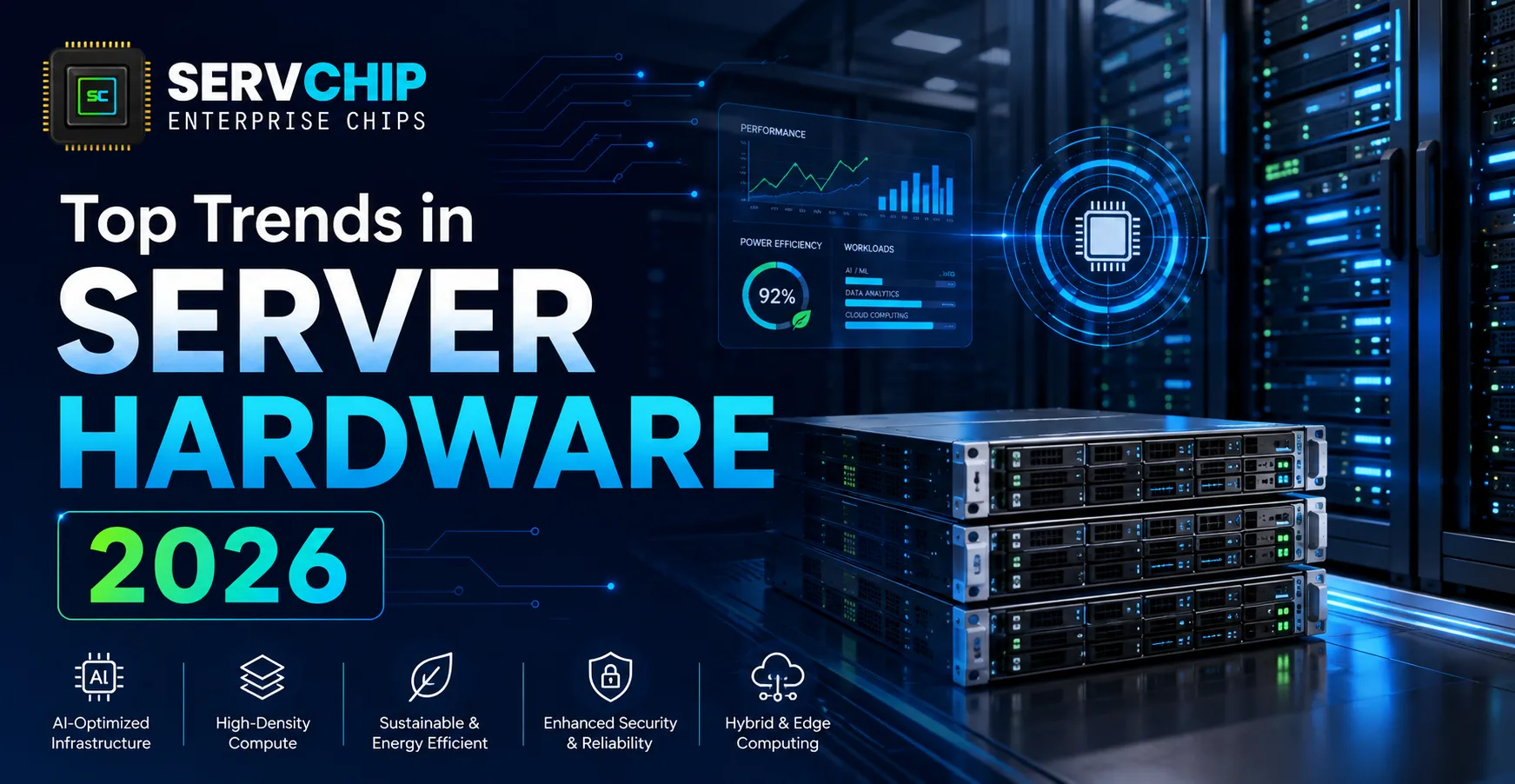
The engine room of the modern enterprise is changing faster than at any point in the last decade. Between the explosion of AI inference workloads, tightening energy budgets, and the shift toward distributed compute, 2026 is shaping up to be a pivotal year for infrastructure decision-makers. Choosing the right enterprise server hardware today isn't just a procurement checkbox — it's a strategic bet on how your organization will compete, scale, and control costs over the next five years. Companies like Servchip, innovators in enterprise server hardware, are helping IT leaders make sense of this shift so they don't get caught flat-footed by a hardware refresh cycle that looks nothing like the last one.
Below, we break down the four trends most likely to shape enterprise server hardware purchasing decisions this year — and what they mean for your data center strategy going forward.
1. AI Workloads Are Rewriting Server Design From the Ground Up
It's no exaggeration to say AI has become the single biggest driver of new enterprise server hardware investment. Analysts now peg global AI infrastructure spending well into the hundreds of billions of dollars for 2026 alone, and much of that money is flowing into GPU-dense, accelerator-heavy server configurations that look almost nothing like the general-purpose boxes enterprises bought five years ago. Where a rack once held a handful of CPUs coordinating standard workloads, it's now common to see two GPUs paired with every CPU, alongside dedicated neural processing units for inference tasks.
This isn't limited to hyperscalers and cloud giants anymore. Mainstream enterprises adopting generative AI, retrieval-augmented generation (RAG), and machine learning pipelines are discovering that their existing server fleets simply weren't built for this kind of density or throughput. The result is a wave of refresh cycles focused specifically on AI-optimized enterprise server hardware — machines with more memory bandwidth, faster interconnects, and BIOS configurations tuned for parallel processing rather than sequential compute.
The practical upshot for IT teams: budgeting for "a server upgrade" in 2026 increasingly means budgeting for a fundamentally different class of machine, not a faster version of the old one.
2. Energy Efficiency Becomes a Procurement Metric, Not an Afterthought
Power used to be a line item. Now it's a design constraint that shapes purchasing decisions from day one. As AI-driven compute density climbs, total cost of ownership — power draw, cooling requirements, and lifecycle support — has overtaken sticker price as the metric enterprises actually optimize for when selecting data center hardware.
Liquid and immersion cooling, once reserved for supercomputing labs, are moving into mainstream enterprise deployments as air cooling hits its physical limits against high-density racks. Vendors are also leaning on more power-efficient silicon architectures to squeeze better performance per watt out of every server, since electricity costs and carbon-compliance pressures are rising in tandem in several major markets. According to <cite index="6-1">a 2026 survey of enterprise data center decision-makers, roughly 21% plan to shift to liquid cooling</cite> as part of this efficiency push.
For enterprises, this means efficiency credentials are no longer a sustainability nice-to-have — they're a hard requirement showing up in RFPs and procurement scorecards alongside raw performance benchmarks.
3. Edge Computing Pushes Server Hardware Out of the Central Data Center
As latency-sensitive applications — real-time analytics, IoT processing, local AI inference — become business-critical, enterprises are pushing compute out of centralized facilities and toward the edge. Edge server hardware refers to smaller, ruggedized, often remotely managed servers deployed close to where data is generated: retail locations, factory floors, branch offices, or telecom towers, rather than a central data hall.
This shift is reshaping how vendors design enterprise server hardware for compact footprints, remote manageability, and resilience in environments that don't have the climate control or redundant power of a traditional data center. It also means enterprises need a hybrid strategy that treats edge nodes and centralized infrastructure as one coordinated system rather than two separate worlds.
The tradeoff is real: edge deployments trade some raw processing power for lower latency and reduced bandwidth costs, which for many use cases — especially real-time AI inference — is a worthwhile exchange.
4. Modular and Composable Data Center Hardware Design
Perhaps the most structural shift underway is the move toward modular, prefabricated data center hardware. Traditional data center construction can take 18 to 24 months — far too slow for organizations trying to respond to AI-driven demand spikes. Modular data halls, prefabricated power and cooling blocks, and composable server architectures let enterprises scale capacity in weeks rather than years.
Composable infrastructure takes this a step further by disaggregating compute, storage, and networking resources so they can be allocated dynamically based on workload needs, rather than locked into a fixed server configuration at purchase time. This flexibility is becoming especially valuable as workload profiles shift quickly between AI training, inference, and traditional enterprise applications — sometimes within the same quarter.
For growing enterprises, modular design also lowers the barrier to entry: you no longer need to overbuild a facility on day one to accommodate hardware needs you might have in three years.
If your organization is trying to navigate these shifts without a dedicated infrastructure team, see how our services support these trends — from AI-ready server procurement to energy-efficient rack design and edge deployment planning, Servchip works alongside IT leaders to translate industry trend reports into an actual, workable hardware roadmap.
Conclusion: Turning Hardware Trends Into Business Value
None of these trends exist in isolation. AI workloads are driving the need for better cooling and power efficiency; efficiency pressures are accelerating modular design adoption; and modular design is what makes rapid edge expansion feasible in the first place. Together, they represent a broader shift: enterprise server hardware is no longer a static, five-year commodity purchase — it's a living part of business strategy that needs to flex with workload demand, energy costs, and where your customers and data actually are.
Organizations that treat 2026's hardware trends as interconnected — rather than picking one and ignoring the rest — will be better positioned to control costs, support AI initiatives, and scale infrastructure without constant rip-and-replace cycles. Getting ahead of these shifts now, rather than reacting to them during your next forced refresh, is what separates infrastructure that enables growth from infrastructure that constrains it.
Ready to plan your next hardware refresh around these trends rather than around last decade's assumptions? Talk to our team about upgrading your infrastructure and we'll help you map out a roadmap that fits your workloads, budget, and timeline.
FAQ: Server Hardware Trends in 2026
Is AI increasing enterprise server hardware demand? Yes. AI training and inference workloads are the single largest driver of new server investment in 2026, pushing enterprises toward GPU-dense, accelerator-heavy configurations that differ significantly from traditional general-purpose servers.
What is edge server hardware? Edge server hardware refers to compact, often ruggedized servers deployed close to where data is generated — such as retail stores, factories, or branch offices — rather than in a centralized data center. It reduces latency for real-time applications like local AI inference and IoT processing.
Why is energy efficiency such a big focus for data center hardware right now? Rising power costs, carbon-compliance regulations, and the sheer density of AI workloads have made power draw and cooling efficiency a top-line procurement metric, not just a sustainability goal. Enterprises increasingly evaluate total cost of ownership over sticker price alone.
What does modular data center hardware actually mean? It refers to prefabricated, standardized building blocks — power modules, cooling units, compute racks — that can be assembled and scaled quickly, cutting deployment timelines from years to weeks compared to traditional data center construction.
Do small and mid-sized enterprises need to worry about these trends, or is this just for hyperscalers? These trends started with hyperscalers, but they're increasingly relevant to mid-sized enterprises too, especially as AI adoption spreads and vendors design more accessible, scaled-down versions of AI-ready and modular hardware for smaller deployments.