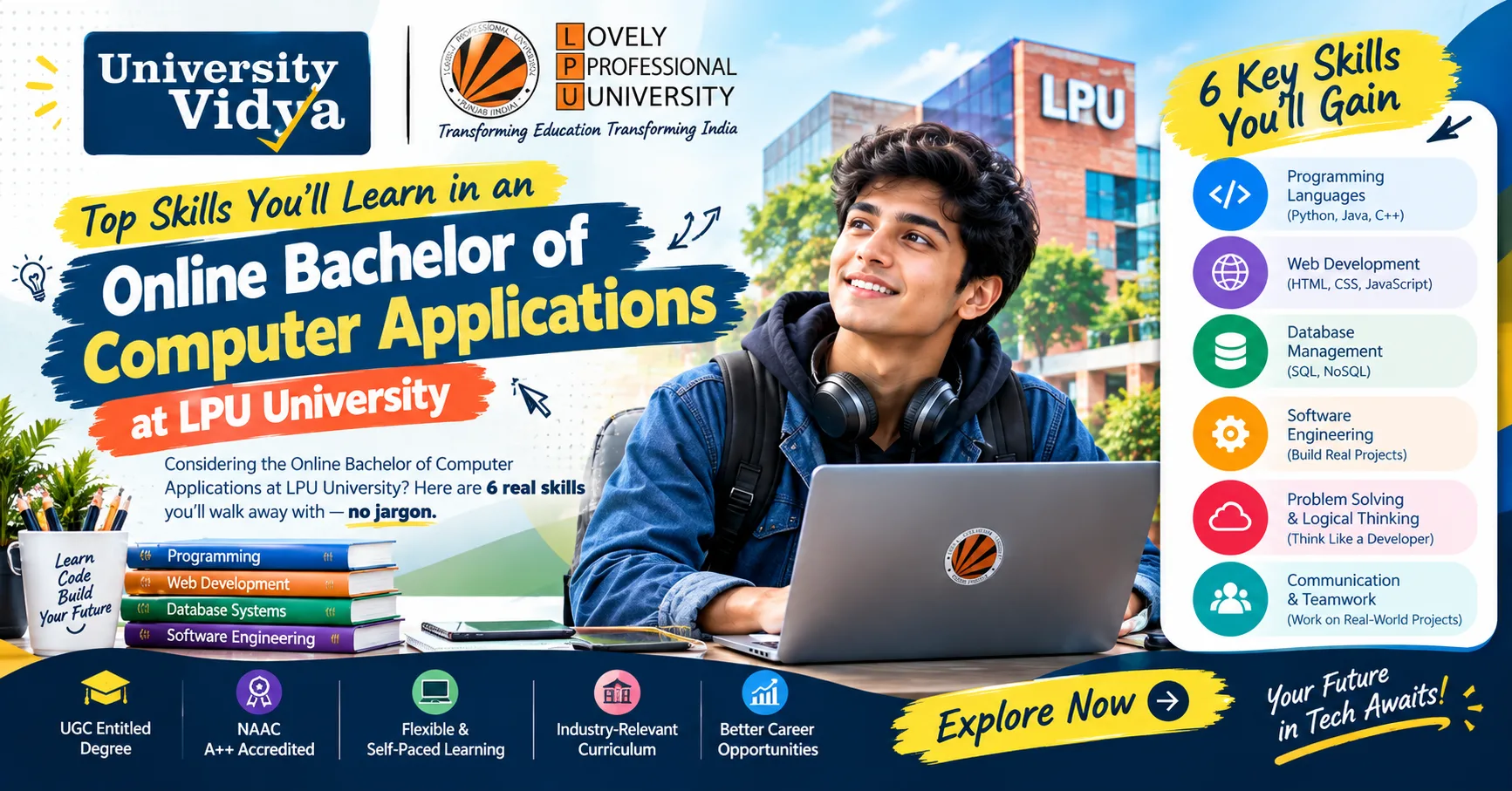
Picking a degree based on a syllabus PDF is hard it lists subject names, not what you'll actually be able to do by the end. If you're weighing the Online Bachelor of Computer Applications LPU University offers, this article skips the jargon and walks you through the real, usable skills you'll pick up along the way, plus what studying it actually feels like week to week.
What a Typical Week Looks Like?
Before getting into skills, it helps to know the rhythm of the course. LPU Online runs the BCA over three years, split into six semesters, with weekend live classes taught by faculty alongside recorded lectures you can revisit anytime.
Here's roughly what that structure gives you:
- Live weekend sessions where you can ask questions in real time, not just watch a video.
- Recorded lectures you can rewatch before exams or whenever a topic didn't click the first time.
- Master classes and guest lectures led by working industry professionals, not just academics.
This mix matters if you're studying alongside a job you get structure without losing flexibility.
Skill One: You'll Actually Learn to Code, Not Just Read About It
The programming track starts simple and builds up fast. You'll begin with C, move into Object-Oriented Programming through C++, and later work with Java three languages that, together, cover most of what entry-level developer roles ask for.
By the second year, you're not just writing code that runs; you're learning to structure it properly using data structures and algorithms, which is the part recruiters actually test in interviews.
Skill Two: Databases Stop Being a Mystery
Every app, website, and system you'll ever build needs somewhere to store data — and Database Management Systems (DBMS) is where you learn exactly how that works. You'll get hands-on with SQL, the query language used to create, retrieve, and update data.
This single skill shows up in almost every tech job description, from software developer to data analyst, which makes it one of the most transferable things you'll learn in the whole degree.
Skill Three: You'll Understand How the Internet Actually Works
Computer Networks and Web Technology subjects pull back the curtain on things you use daily without thinking about how devices talk to each other, how websites load, and how systems stay connected. It sounds abstract until you realise it's the foundation for careers in network administration, cloud support, and web development.
Why This Matters Beyond the Exam
Understanding networking basics also makes you far more comfortable troubleshooting real-world tech problems a skill that quietly impresses employers even outside pure IT roles.
Skill Four: Software Engineering Teaches You to Think Like a Builder
Knowing how to code is one thing; knowing how to build something that actually works reliably is another. Software Engineering as a subject teaches you the process planning, designing, testing, and fixing software properly instead of just hacking something together.
This is often where live projects and hackathons come in, giving you a taste of building something from scratch under a deadline, much like a real job would.
Skill Five: You'll Get Genuinely Comfortable Communicating Technical Ideas
It's easy to assume a computer applications degree is all code but English Communication Skills is a deliberate part of the curriculum too, and for good reason. Being able to explain a technical problem clearly to a non-technical manager is a skill that separates good developers from great ones.
This soft-skill layer runs alongside every technical subject, not as an afterthought.
Skill Six: Certifications and Real Projects Add Proof to Your Resume
Beyond the core syllabus, the programme weaves in industry certifications, live projects, and community or NGO-based projects as part of the learning experience. These aren't optional extras they're what turns a resume line into an actual portfolio you can talk about in interviews.
Combined with placement support and structured interview preparation, this gives you tangible things to show, not just a degree title to mention.
What If You're Not Sure Tech Is Right for You Yet?
If coding and networks don't sound like your thing, that's completely fine the online degree space has options built around different strengths. An Online BBA suits people drawn to business strategy and management, an Online B.com fits those who enjoy numbers and finance, and an Online BA works well if your interests lean toward humanities, communication, or social sciences.
The right degree isn't the most popular one it's the one that matches how you actually think and what you enjoy doing daily.
Choosing With Confidence, Not Guesswork
An online BCA from a university like LPU gives you a genuinely well-rounded skill set coding, databases, networking, software thinking, and communication all built for real job readiness, not just theory. The trick is making sure the specific programme, faculty, and support system fit how you learn best.
If you're still comparing your options across universities and streams, platforms like University Vidya make it easier to look at courses side by side and figure out which one actually fits your goals before you commit a single rupee or semester to it.