Introduction: The Hidden Conflict Behind Every Hit Song
A song goes viral. Streams cross millions. Money starts flowing.
But behind the scenes? Confusion, disputes, delayed payments—and sometimes broken relationships.
In today’s collaborative music industry, a single track can involve producers, lyricists, composers, session musicians, mixing engineers, and even marketing contributors. Each of them deserves a fair share. Yet, one of the biggest challenges artists and professionals face isn’t creating music—it’s agreeing on who owns what.
This is where things get messy.
Miscommunication, lack of documentation, and outdated systems often lead to royalty disputes that can cost artists not just money—but trust and future opportunities. As the industry evolves, so does the need for smarter solutions. That’s why the concept of a song royalty split verification platform is gaining serious traction.
In this blog, we’ll break down the real-world problems in royalty splits—in simple, practical terms—and explore how modern verification platforms are solving them.
Understanding the Basics: What Are Music Royalty Splits?
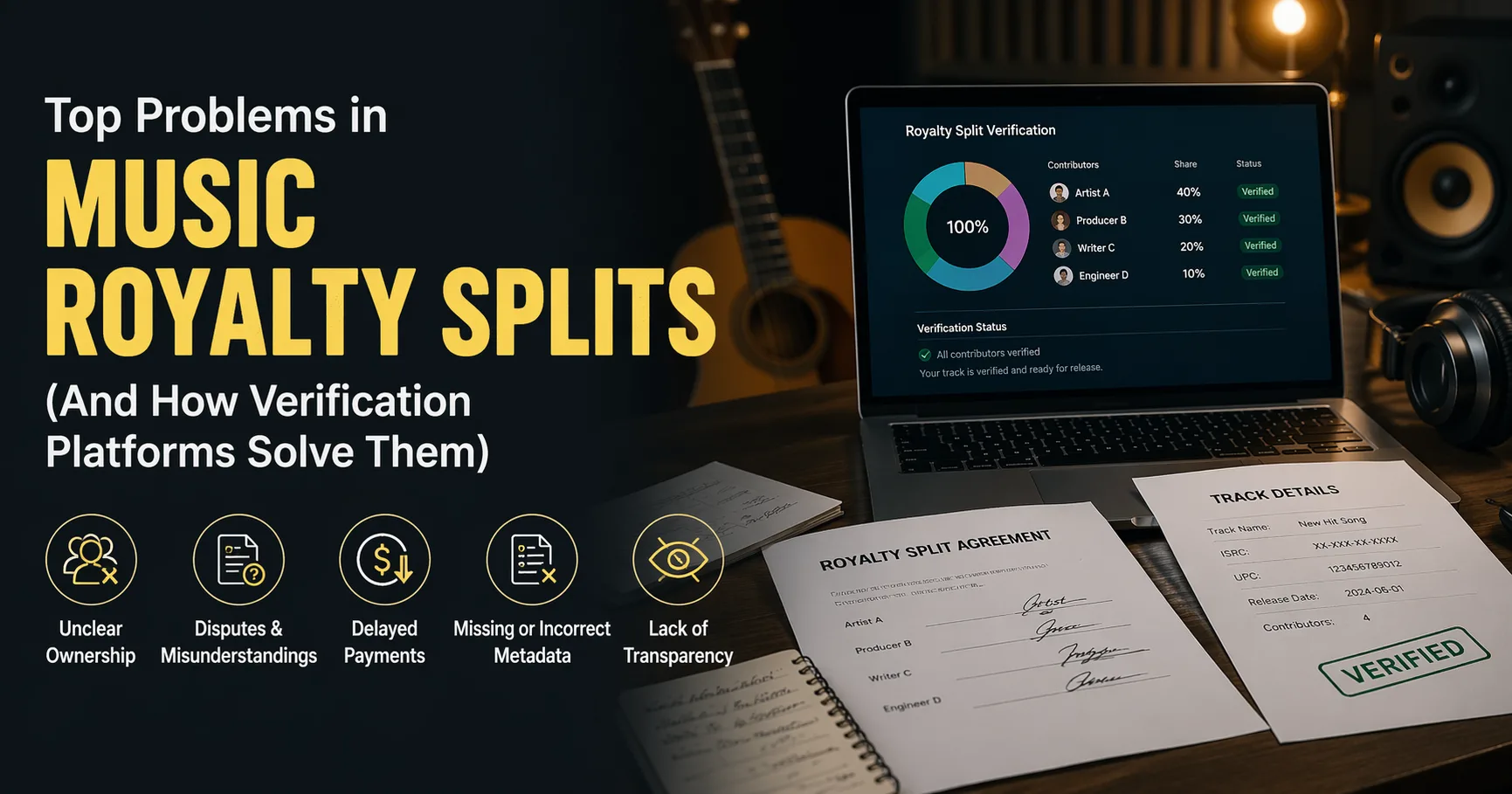
When a song earns money—whether from streaming, licensing, or performances—that revenue is shared among everyone involved in creating it. This distribution is known as music ownership splits, where each contributor is assigned a percentage based on their role. This percentage breakdown is called the song royalty percentage split. It may sound simple, but in reality, it often gets complicated.
Key Points:
- Revenue is divided among contributors
- Known as music ownership splits
- Each person gets a percentage share
Example:
- Producer: 30%
- Lyricist: 25%
- Composer: 25%
- Vocalist: 20%
Looks simple, but gets complex quickly.
Problem #1: No Clear Agreement at the Start
What Happens:
Many artists jump straight into recording without formally agreeing on splits. Everything is based on “we’ll figure it out later.”
Later never comes—or comes with conflict.
Why It’s Dangerous:
- Memory fades
- Contributions get exaggerated
- Verbal agreements get disputed
A producer might feel they deserve 50%, while the artist believes it’s 20%.
Real Impact:
These issues often create a ripple effect across the entire release process. Projects get delayed because agreements aren’t finalized on time, disputes can escalate into legal conflicts between collaborators, and in many cases, revenue is either held back or lost altogether. What starts as a small misunderstanding can quickly turn into a major setback for everyone involved.
How Verification Platforms Solve This:
A song royalty split verification platform allows all collaborators to:
- Define splits before release
- Digitally confirm their shares
- Lock agreements in a transparent system
This removes ambiguity and creates a single source of truth.
Problem #2: Miscommunication Between Collaborators
What Happens:
Different collaborators often have different expectations.
For example:
- A beatmaker thinks they’re co-producer
- The artist sees them as a freelancer
No one clarifies roles properly.
Why It’s Common:
Music collaboration is often informal, especially in independent scenes.
Real Impact:
These issues often surface after a song becomes successful, leading to disputes among contributors over their rightful share. In many cases, payments get withheld until conflicts are resolved, which can strain relationships and even break long-term partnerships.
Solution via Platforms:
Verification platforms bring much-needed clarity and structure to royalty splits by clearly defining each contributor’s role, tracking their contributions, and providing real-time updates to everyone involved. This ensures complete transparency, where all stakeholders can easily see who is part of the project, what their percentage share is, and whether the split has been approved. Instead of relying on assumptions or informal agreements, everything is properly documented and verified.
- Defines clear roles for each contributor
- Tracks contributions accurately
- Provides real-time updates to all stakeholders
- Shows who is involved in the project
- Displays each person’s percentage share
- Confirms approval status of splits
Replaces assumptions with clear, transparent documentation.
Problem #3: Incorrect or Missing Metadata
What Happens:
Metadata includes contributor names, roles, and ownership percentages, which are essential for tracking and distributing royalties.
If this data is incorrect or incomplete, it can lead to missing, delayed, or misdirected royalty payments.
Why It’s a Big Deal:
Streaming platforms and PROs rely on metadata to distribute money.
Even a small error can result in:
- Payments going to the wrong person
- Payments not being processed at all
Real Impact:
Metadata errors have a massive financial impact on the music industry, with billions in royalties remaining unclaimed globally. When contributor details or ownership splits are incorrect or missing, payments fail to reach the rightful owners. Over time, this not only results in lost income but also creates long-term gaps in royalty tracking that are difficult to recover.
How Platforms Help:
A song royalty split verification platform acts as a safeguard by ensuring all data is accurate and properly validated before a song is released. It works like a quality control layer, catching errors early and making sure every contributor is correctly documented and approved.
- Ensures accurate data entry
- Validates all contributors and their details
- Detects errors before the song goes live
Helps prevent lost royalties and ensures everyone gets paid correctly.
Problem #4: Lack of Transparency in Royalty Distribution
What Happens:
Artists often operate in the dark when it comes to their earnings. They don’t have clear visibility into how much a song has generated, when payments are expected, or whether their agreed music ownership splits are actually being applied correctly. This lack of clarity is especially common when working with labels, distributors, or third-party systems where data isn’t easily accessible.
Why It Matters:
- Creates confusion and uncertainty
- Builds distrust—even without intentional wrongdoing
Real Impact:
Lack of transparency in royalty distribution creates serious trust issues within a team. Artists may start feeling exploited when they don’t have clarity on earnings, while collaborators lose confidence in the system and in each other. Over time, this uncertainty damages relationships and can break long-term collaborations that are essential in the music industry.
Platform Solution:
Modern verification platforms bring transparency and clarity by making royalty data easily accessible and understandable for everyone involved. They ensure that all contributors can track and verify their earnings without confusion or dependency on third parties.
- Transparent dashboards
- Real-time royalty tracking
- Clear split breakdowns
Everyone can verify:
- Earnings
- Distribution
- Their exact share
Transparency isn’t just a feature—it’s a trust builder.
Problem #5: Manual Errors in Split Calculations
Royalty splits are often calculated manually using spreadsheets, which makes the process highly prone to human error. While it may seem manageable at first, even small mistakes can create major issues later in the payment cycle.
- Splits managed through manual spreadsheets
- High chances of human error
Common Errors:
- Percentages not adding up to 100%
- Wrong allocations to contributors
- Duplicate or conflicting entries
Real Impact:
These errors can lead to serious financial and operational problems, as incorrect splits often result in wrong payouts and inconsistencies in earnings. Fixing these mistakes takes significant time and effort, and in many cases, it creates frustration among collaborators. Over time, this can lead to disputes over accountability, with team members blaming each other for errors that could have been avoided.
How Platforms Solve It:
A song royalty split verification platform removes these risks by automating validation and ensuring accuracy at every step. It acts as a safeguard against manual mistakes and keeps the process clean and reliable.
- Automatically validates splits
- Ensures total equals 100%
- Prevents duplicate or conflicting entries
This significantly reduces human error and ensures accurate royalty distribution.
Problem #6: Delayed or Missing Payments
What Happens:
Even when splits are agreed upon, payments don’t always reach every contributor on time. This happens because the royalty distribution process depends on multiple systems and accurate data, and even a small gap can delay the entire flow.
Why This Happens:
- Lack of proper documentation of music ownership splits
- Disconnected systems between streaming platforms, distributors, and payment channels
- Delays caused by intermediaries like labels or aggregators
Real Impact:
These delays create cash flow problems for artists, especially independent creators who rely on timely income. Over time, repeated delays lead to frustration and mistrust among collaborators, affecting long-term working relationships.
Platform Solution:
A song royalty split verification platform simplifies and streamlines the entire process by ensuring everything is verified and structured from the beginning. It helps reduce dependency on fragmented systems and manual coordination.
- Streamlined payment routing
- Contributor validation
- Automated distribution triggers
When splits are verified early, payment systems work more efficiently and payouts become faster and more reliable.
Problem #7: Disputes After the Song Becomes Successful
What Happens:
Everything seems smooth in the beginning—until the song becomes successful. As soon as it starts generating significant revenue, unexpected issues arise where new contributors may claim involvement, and existing collaborators begin to question or demand changes in their share.
Why It Happens:
- Success increases the perceived value of contribution
- Contributors reassess their role after the song gains traction
Real Impact:
These situations can quickly escalate into serious conflicts, leading to legal battles, freezing of royalties, and long-term damage to professional reputations.
Platform Solution:
A song royalty split verification platform prevents such disputes by securing agreements early and making them tamper-proof. It ensures that all contributors have already reviewed and approved their shares before release.
- Timestamped agreements
- Digital proof of consent
- Immutable records
Once splits are verified, they cannot be easily changed or manipulated.

Problem #8: No Standardization Across the Industry
What Happens:
There is no single standard system for managing royalty splits across the music industry. Different teams rely on different methods—emails, WhatsApp messages, paper contracts, or Excel sheets—making the entire process fragmented and inconsistent..
Why It’s a Problem:
- Hard to track information across multiple sources
- Easy to lose or misplace important data
- Difficult to manage and scale as collaborations grow
Platform Solution:
A song royalty split verification platform brings structure and consistency by centralizing everything into one system. It replaces scattered communication and manual processes with a streamlined, standardized workflow that is easier to manage and scale.
- Standardized workflows
- Unified data systems
- Scalable processes
Especially useful for:
- Labels
- Music startups
- Large collaboration networks
Standardization reduces chaos and makes collaboration more efficient.
Problem #9: Legal Risks and Compliance Issues
What Happens:
When royalty splits are unclear, informal, or not properly documented, it opens the door to serious legal complications. Without clear records, it becomes difficult to prove ownership or justify how revenue should be distributed.
Risks Include:
- Copyright disputes over song rights and ownership claims
- Ownership conflicts between multiple contributors and stakeholders
- Licensing issues affecting distribution, usage, and monetization rights
Real Impact:
These legal uncertainties can quickly turn into expensive legal battles, lead to song takedowns from platforms, and result in significant revenue loss for all contributors involved.
Platform Solution:
A song royalty split verification platform helps reduce these risks by ensuring that all agreements are properly recorded, verified, and legally structured from the beginning. It creates a reliable system that can be used as proof in case of disputes.
- Legally documented agreements
- Contributor consent records
- Audit-ready data
This strengthens your legal position and protects your revenue.
Problem #10: Difficulty Managing Large Collaborations
What Happens:
Modern music production often involves large teams, sometimes with 10 or more contributors working on a single track. Managing royalty splits manually in such cases quickly becomes complex and chaotic, increasing the chances of confusion and errors.
Challenges:
- Tracking contributions across multiple collaborators and roles
- Coordinating approvals from all contributors on time
- Updating percentages accurately without creating conflicts
Platform Solution:
A song royalty split verification platform simplifies large-scale collaboration by bringing everything into one organized system. It ensures smoother coordination, better control, and complete visibility for all contributors involved.
- Multi-user collaboration with real-time access and updates
- Split adjustments with proper consent and approval workflows
- Centralized management for all contributors and data
No more chasing people for approvals—everything is managed in one place.
Why the Industry Is Moving Toward Verification Platforms
The shift toward verification platforms isn’t random—it’s driven by real changes in how the music industry operates today. As collaborations grow and revenue streams become more complex, the need for accurate, transparent systems has become essential.
1. Rise of Independent Artists
More artists are now releasing music independently without relying on traditional labels. This means they are responsible for managing their own music ownership splits, payments, and agreements. Without proper systems in place, handling these tasks manually becomes risky and inefficient—making verification platforms a reliable solution.
2. Global Collaborations
Music is no longer limited by geography. Artists, producers, and writers from different countries frequently collaborate on the same track. This increases the complexity of managing song royalty percentage split, as different laws, currencies, and systems come into play. Verification platforms help bring everything into one unified structure.
3. Streaming Economy Growth
With the rise of streaming platforms, songs now generate revenue from multiple sources across the world. More streams mean more data, and more data requires higher accuracy. Even small errors in splits or metadata can lead to significant revenue loss, making verification systems crucial.
4. Demand for Transparency
Today’s artists want full visibility into their earnings and rights. They don’t want to rely on assumptions or delayed reports. A song royalty split verification platform provides clear, real-time insights, ensuring that every contributor knows exactly what they are earning and why.
What to Look for in a Song Royalty Split Verification Platform
If you’re considering one, here are must-have features:
Split Agreement Tools : Easily define and confirm song royalty percentage split .
Contributor Verification : Ensure everyone approves their share .
Metadata Management : Prevent errors before distribution
Real-Time Tracking : See earnings and distribution clearly
Secure Documentation : Maintain legally valid records
Best Practices for Artists and Music Professionals
Even with the right tools, following proper practices is essential to avoid mistakes and disputes.
- Define splits early – Don’t wait until release day
- Document everything – Avoid relying on verbal agreements
- Use reliable tools – Don’t depend on scattered systems
- Communicate clearly – Ensure everyone understands their role
- Verify before publishing – Fixing issues later is much harder
Final Thoughts: From Chaos to Clarity
The music industry thrives on collaboration, but without the right structure, it often leads to confusion and conflict. Royalty splits should be a system of fairness and recognition—not stress and uncertainty.
Traditional methods like informal agreements and spreadsheets are no longer reliable in today’s fast-paced, global music ecosystem. A song royalty split verification platform changes that by bringing transparency, accuracy, and trust into the process—ensuring every contributor is clearly recognized and fairly paid.
Closing Line
Create freely. Collaborate openly. But when it comes to money—verify everything.