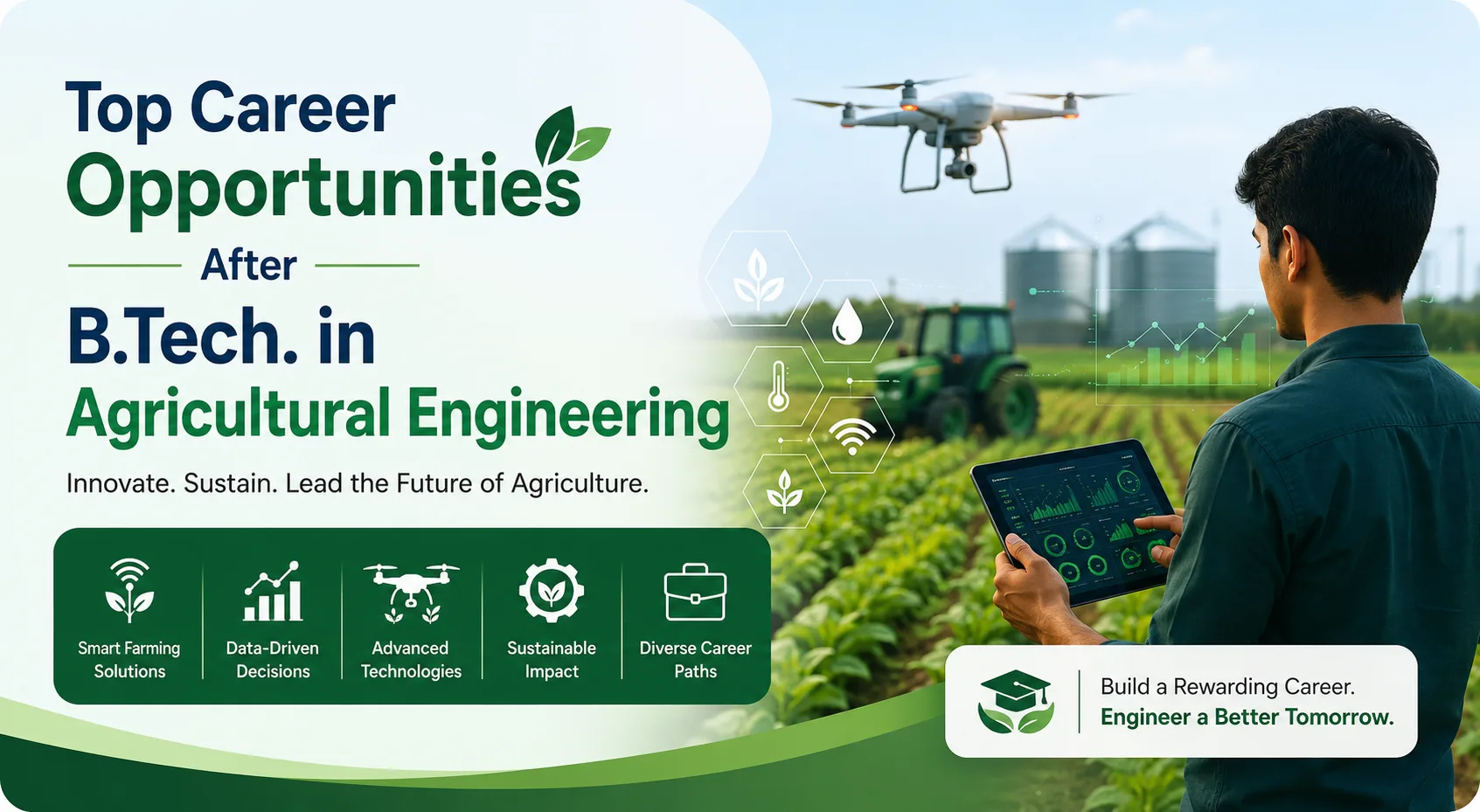
Modern agriculture is evolving into a technology-driven ecosystem powered by automation, sustainability, artificial intelligence, and smart infrastructure. Today, agriculture is no longer limited to traditional farming practices. It now includes drone monitoring, precision irrigation, renewable energy systems, AI-based crop analysis, and data-driven farming solutions.
This transformation is creating exciting opportunities for students pursuing B.Tech. in Agricultural Engineering.
Unlike the old perception that agricultural engineering only focuses on farm equipment, the field now connects engineering innovation with environmental sustainability, food security, automation, and rural development.
That is why career opportunities after B.Tech. in Agricultural Engineering are growing rapidly across industries connected to:
- agritech innovation
- smart farming systems
- renewable energy
- irrigation engineering
- food processing
- sustainability technology
- agricultural automation
- climate-smart infrastructure
This guide explores the top career opportunities, future industry trends, emerging technologies, essential skills, and long-term growth potential after B.Tech Agricultural Engineering.
Whether students are exploring B.Tech in Agricultural Engineering or researching B.Tech Agriculture in Delhi NCR, this article provides a practical and future-focused perspective.
Why Agricultural Engineering Is Becoming More Important
The agricultural sector is facing major global challenges including:
- increasing food demand
- water scarcity
- climate change
- resource management issues
- sustainable farming requirements
Traditional farming systems alone cannot solve these challenges.
Modern agriculture now depends heavily on engineering-based innovation to improve productivity, sustainability, and efficiency.
Agricultural engineers help develop:
- smart irrigation systems
- precision farming technologies
- automated machinery
- sustainable agricultural infrastructure
- renewable energy applications
- climate-resilient farming systems
This is why B.Tech. in Agricultural Engineering is becoming one of the most future-oriented engineering programs.
What Students Learn in B.Tech. in Agricultural Engineering
B.Tech. in Agricultural Engineering is an interdisciplinary engineering program that combines:
- agriculture
- mechanical engineering
- environmental science
- irrigation systems
- renewable energy
- automation technologies
- food processing
- soil and water management
Students learn how to solve agricultural problems using engineering principles and modern technology.
How Technology Is Transforming Agriculture
Agriculture is becoming smarter, faster, and more technology-driven.
Several innovations are reshaping the industry.
AI-Powered Farming
Artificial intelligence helps improve:
- crop monitoring
- yield prediction
- disease detection
- resource management
Agricultural Drones
Drones are now used for:
- crop analysis
- spraying
- field mapping
- precision monitoring
Smart Irrigation Systems
Technology-driven irrigation systems improve water efficiency and reduce wastage.
IoT-Based Agriculture
Connected sensors help farmers monitor:
- soil conditions
- moisture levels
- weather patterns
- crop performance
Sustainable Farming Technologies
Modern systems now focus on environmentally responsible farming methods.
These innovations are creating strong career demand for graduates from B.Tech in Agricultural Engineering programs.
Top Career Opportunities After B.Tech. in Agricultural Engineering
One of the biggest strengths of agricultural engineering is career flexibility.
Graduates can work across:
- technology industries
- sustainability sectors
- manufacturing companies
- agritech startups
- government organizations
- food industries
- environmental engineering sectors
Below are some of the top career opportunities.
TO KNOW MORE CLICK BELOW:
B.Tech. in Agricultural Engineering