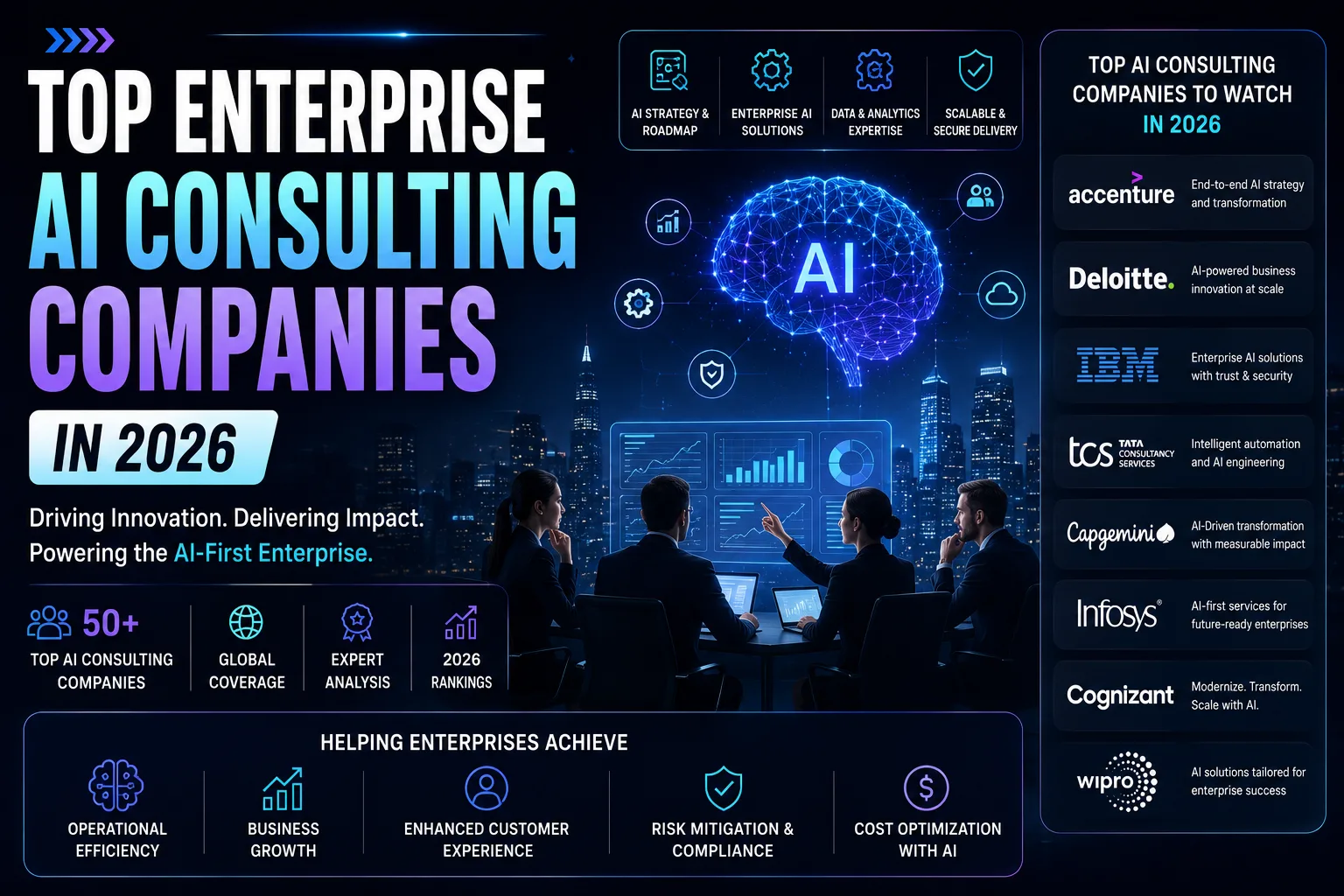
Artificial intelligence has moved far beyond experimentation. By 2026, enterprises are no longer asking whether they should adopt AI; they are asking how quickly they can scale it across departments while maintaining security, compliance, and measurable business value. The emergence of advanced generative AI models, autonomous agents, multimodal systems, and enterprise-grade AI platforms has transformed AI from a technology initiative into a boardroom priority. Organizations across healthcare, manufacturing, retail, financial services, telecommunications, and government sectors are investing heavily in AI-powered automation, predictive analytics, customer experience enhancement, and decision intelligence.
The rapid pace of innovation has created a challenge that many enterprises struggle to overcome internally. Building AI systems requires expertise in data engineering, machine learning, cloud infrastructure, cybersecurity, governance, regulatory compliance, and organizational change management. Few companies possess all these capabilities under one roof. This gap has fueled demand for specialized AI consulting firms capable of guiding organizations from strategy to deployment.
What makes 2026 particularly interesting is the shift from isolated AI projects to enterprise-wide AI transformation. Businesses are now integrating AI into supply chains, finance departments, human resources, marketing functions, and customer support operations simultaneously. As a result, consulting firms that can combine technical excellence with business strategy have become essential partners. The leading enterprise AI consulting companies are helping organizations navigate this transition while minimizing risk and maximizing return on investment.
Why AI Consulting Has Become a Strategic Necessity
The complexity of enterprise AI implementation continues to increase. Organizations must determine which use cases provide the highest value, identify data readiness gaps, choose technology vendors, establish governance frameworks, and monitor outcomes over time. Without expert guidance, AI projects can become expensive experiments that never reach production.
AI consulting firms bring proven methodologies, industry expertise, and implementation experience that dramatically reduce the likelihood of failure. Their consultants have often worked across dozens or even hundreds of AI transformation projects, allowing them to identify potential obstacles before they become critical problems. This experience is particularly valuable when enterprises are integrating AI into mission-critical operations where downtime, security breaches, or inaccurate outputs can have significant consequences.
Enterprise AI Spending Trends
Enterprise spending on AI continues to rise as organizations seek competitive advantages through automation and intelligence. Companies are directing investments toward generative AI copilots, intelligent document processing, predictive maintenance, customer service automation, and AI-enhanced cybersecurity. The organizations achieving the greatest success are not necessarily those spending the most money. Instead, they are the ones partnering with consultants who align AI initiatives with measurable business objectives and operational realities.
How Enterprise AI Consulting Firms Create Value
Enterprise AI consulting firms serve as architects of digital transformation. Their role extends far beyond selecting algorithms or implementing software tools. They help organizations establish strategic roadmaps that connect AI investments directly to business outcomes such as revenue growth, cost reduction, risk mitigation, and customer satisfaction improvements.
Consulting firms typically begin with an assessment of organizational readiness. This includes evaluating data quality, technology infrastructure, workforce capabilities, governance frameworks, and existing business processes. From there, consultants identify high-impact use cases that offer strong returns while remaining technically feasible. This structured approach prevents organizations from pursuing ambitious but impractical AI projects.
Another major value driver is execution. Many enterprises possess strong ideas but lack the expertise to implement them effectively. AI consulting companies bridge this gap by providing data scientists, machine learning engineers, cloud architects, prompt engineers, governance specialists, and change management professionals. Their multidisciplinary teams ensure projects move efficiently from concept to deployment.
Strategy, Governance, and Implementation
One of the most important contributions of AI consultants is governance. As regulations surrounding AI continue to evolve, enterprises must ensure transparency, accountability, fairness, and security throughout their AI ecosystems. Consulting firms help establish governance structures that satisfy regulatory requirements while enabling innovation.
Implementation expertise is equally critical. AI projects frequently fail because of integration challenges rather than model performance issues. Leading consulting firms understand how to connect AI systems with enterprise resource planning platforms, customer relationship management systems, data warehouses, and cloud environments. This integration expertise often determines whether an AI initiative delivers lasting value.
Industry-Specific AI Transformation
Different industries face different challenges. Healthcare organizations prioritize patient outcomes and regulatory compliance. Financial institutions focus on fraud detection and risk management. Manufacturers seek operational efficiency and predictive maintenance. Retailers concentrate on personalization and demand forecasting.
The best consulting firms possess deep industry knowledge alongside technical expertise. This combination allows them to tailor AI solutions to specific business contexts rather than relying on generic implementation models.
Evaluation Criteria for AI Consulting Companies
Selecting the right AI consulting partner requires careful consideration of several factors. Enterprises should evaluate firms based on technical capabilities, industry expertise, scalability, governance practices, and proven success stories.
Technical Expertise
Technical depth remains one of the most important evaluation criteria. The strongest consulting firms possess expertise in machine learning, deep learning, natural language processing, computer vision, generative AI, agentic systems, cloud computing, and MLOps. They maintain partnerships with leading technology providers and continuously invest in emerging capabilities.
Organizations should look for consultants who understand both traditional AI systems and modern generative AI architectures. As AI technologies evolve rapidly, consultants must demonstrate an ability to adapt and innovate rather than relying solely on established methodologies.
Industry Experience
Experience within a specific industry can significantly accelerate project success. Consultants who understand industry regulations, operational workflows, customer expectations, and competitive dynamics are better positioned to deliver practical solutions.
Responsible AI and Governance
Responsible AI has become a central concern for enterprises worldwide. Organizations increasingly demand transparency, fairness, explainability, privacy protection, and risk management. Consulting firms with mature governance frameworks are often better equipped to help enterprises deploy AI responsibly at scale.
Top Enterprise AI Consulting Companies in 2026
Accenture
Accenture remains one of the most influential enterprise AI consulting companies in 2026. Its global reach, extensive technology partnerships, and large-scale implementation capabilities make it a preferred choice for multinational organizations. The company combines strategic consulting with engineering expertise, enabling clients to move from planning to deployment efficiently.
Accenture has invested heavily in generative AI services, AI agents, cloud transformation, and industry-specific AI accelerators. Its ability to integrate AI across complex enterprise environments gives it a significant advantage in large transformation projects. Organizations seeking end-to-end support often view Accenture as a comprehensive partner capable of managing every phase of AI adoption.
Deloitte
Deloitte continues to be a major player in enterprise AI consulting. The firm's strengths lie in combining technology implementation with risk management, governance, and regulatory compliance. This makes Deloitte particularly attractive to highly regulated industries such as healthcare, banking, and government.
Deloitte's AI services emphasize responsible AI practices while helping organizations scale innovation. Its multidisciplinary teams bring together business strategists, technologists, data scientists, and compliance specialists to address complex enterprise challenges.
PwC
PwC has established itself as a trusted advisor for organizations seeking AI-driven transformation. The firm's approach focuses on aligning AI initiatives with business objectives and measurable outcomes. Rather than emphasizing technology alone, PwC helps organizations redesign processes and operating models around AI capabilities.
Its strong expertise in governance, risk management, and business transformation positions it well for enterprises navigating complex regulatory environments.
IBM Consulting
IBM Consulting leverages decades of expertise in enterprise technology and artificial intelligence. The company benefits from its close integration with IBM's AI ecosystem, including Watson technologies, hybrid cloud solutions, and enterprise automation platforms.
IBM's consulting services are particularly valuable for organizations seeking advanced AI capabilities while maintaining strict security and governance standards. Its focus on enterprise-grade solutions continues to resonate with large organizations operating critical infrastructure.
Capgemini
Capgemini has emerged as a leading force in AI consulting through its emphasis on innovation, cloud transformation, and digital engineering. The company supports organizations across industries with AI strategy, implementation, and scaling initiatives.
Capgemini's ability to combine consulting expertise with engineering execution makes it an appealing option for enterprises seeking practical outcomes rather than theoretical roadmaps.
McKinsey & Company
McKinsey & Company remains one of the most influential strategy consulting firms in the AI space. Its strength lies in helping executives identify high-value opportunities and create enterprise-wide transformation strategies.
McKinsey's AI expertise extends beyond technology implementation. The firm focuses heavily on organizational change, workforce transformation, and operating model redesign. This strategic perspective makes it particularly valuable for large-scale transformation initiatives.
Boston Consulting Group (BCG)
Boston Consulting Group (BCG) continues to be a prominent AI consulting provider. BCG combines deep strategic expertise with advanced analytics capabilities, helping organizations unlock value from AI investments.
The firm's approach emphasizes measurable business impact rather than technology adoption alone. By focusing on outcomes, BCG helps enterprises prioritize initiatives that deliver sustainable competitive advantages.
Bain & Company
Bain & Company has strengthened its position in enterprise AI consulting by helping organizations integrate AI into broader business strategies. The firm's customer-centric methodology ensures AI initiatives remain closely aligned with business goals.
Bain's expertise in performance improvement and organizational transformation enables clients to realize value more quickly while minimizing disruption.
Cognizant
Cognizant offers extensive AI consulting and digital transformation services across industries. Its strengths include application modernization, automation, cloud migration, and AI implementation.
The company has built a strong reputation for helping enterprises operationalize AI solutions efficiently. Its delivery capabilities and technical expertise make it a compelling option for organizations pursuing large-scale deployments.
Infosys
Infosys continues to expand its influence in the enterprise AI market through investments in AI platforms, automation solutions, and digital transformation services. The company's global delivery model allows it to support organizations of varying sizes across multiple regions.
Infosys focuses heavily on practical implementation, helping enterprises translate AI strategies into operational realities. Its combination of technical expertise and cost-effective execution remains a key differentiator.
Comparison of Leading AI Consulting Firms
Enterprise Services Comparison Table
CompanyCore StrengthBest ForGlobal ScaleGovernance FocusAccentureEnd-to-end AI transformationLarge enterprisesExcellentHighDeloitteRisk and complianceRegulated industriesExcellentVery HighPwCBusiness transformationEnterprise modernizationHighHighIBM ConsultingEnterprise AI platformsComplex infrastructuresHighVery HighCapgeminiEngineering and executionDigital transformationHighModerateMcKinseyStrategy and leadershipExecutive AI initiativesExcellentHighBCGAnalytics and innovationCompetitive differentiationExcellentHighBainBusiness performanceGrowth-focused firmsHighModerateCognizantOperational implementationLarge deploymentsHighModerateInfosysCost-effective scalingGlobal enterprisesHighModerateChoosing the Right AI Consulting Partner
Choosing an AI consulting company is similar to selecting a long-term business partner rather than hiring a temporary service provider. The right firm will influence strategic decisions, operational processes, workforce development, and technology investments for years to come. As a result, enterprises should prioritize compatibility, expertise, and proven outcomes over marketing claims.
Organizations should begin by clearly defining their objectives. Are they seeking operational efficiency, customer experience improvements, revenue growth, risk reduction, or all of the above? Different consulting firms excel in different areas. Understanding internal priorities makes the selection process significantly more effective.
Budget considerations also matter, but focusing exclusively on cost can be shortsighted. A lower-cost engagement that fails to deliver meaningful outcomes may ultimately be more expensive than a premium engagement that generates substantial business value. Enterprises should evaluate consulting partners based on expected return on investment rather than project cost alone.
Questions Every Enterprise Should Ask
Before selecting a consulting firm, organizations should ask several critical questions:
- What AI projects have you completed within our industry?
- How do you measure AI project success?
- What governance frameworks do you recommend?
- How do you address data privacy and security concerns?
- What support do you provide after deployment?
- How do you manage organizational change and workforce adoption?
The answers to these questions often reveal more about a consulting firm's capabilities than marketing materials or sales presentations.
Measuring Long-Term AI SuccessSuccessful AI implementation extends beyond deployment. Organizations should establish metrics related to productivity improvements, customer satisfaction, operational efficiency, revenue growth, and risk reduction. Effective consulting firms help clients define these metrics early and continuously monitor progress.
Long-term success also depends on organizational adoption. Even the most advanced AI system delivers limited value if employees do not trust or use it. Consulting firms that prioritize training, communication, and change management often achieve better outcomes than those focused solely on technical implementation.
Conclusion
The enterprise AI consulting landscape in 2026 is more competitive and sophisticated than ever before. Organizations are moving beyond experimentation and embracing AI as a fundamental driver of business transformation. This shift has elevated the importance of consulting firms that can combine strategic vision, technical expertise, governance capabilities, and industry knowledge.
Companies such as Accenture, Deloitte, PwC, IBM Consulting, Capgemini, McKinsey, BCG, Bain, Cognizant, and Infosys continue to lead the market by helping enterprises navigate the complexities of AI adoption. Each brings unique strengths, making the best choice dependent on an organization's goals, industry requirements, and transformation priorities.
Enterprises that select the right consulting partner gain more than technical support. They gain access to expertise, frameworks, and execution capabilities that accelerate innovation while reducing risk. In a world where AI increasingly shapes competitive advantage, choosing the right consulting firm may become one of the most important strategic decisions an organization makes.
FAQs
1. What does an enterprise AI consulting company do?
An enterprise AI consulting company helps organizations develop AI strategies, identify use cases, implement AI solutions, establish governance frameworks, and measure business outcomes. These firms often provide end-to-end support from planning through deployment and optimization.
2. Which AI consulting company is best for large enterprises?
Accenture, Deloitte, IBM Consulting, McKinsey, and BCG are often considered strong choices for large enterprises because of their global scale, industry expertise, and ability to manage complex transformation programs.
3. How much do enterprise AI consulting services cost?
Costs vary significantly depending on project scope, duration, complexity, and consulting firm. Enterprise engagements can range from tens of thousands to millions of dollars for large-scale transformation initiatives.
4. Why is AI governance important in 2026?
AI governance helps organizations manage risks related to privacy, security, bias, transparency, and regulatory compliance. Strong governance frameworks are essential for responsible and sustainable AI adoption.
5. How should companies choose an AI consulting partner?
Organizations should evaluate technical expertise, industry experience, governance capabilities, implementation track record, scalability, and alignment with business objectives. Selecting a partner with relevant experience often improves project outcomes.