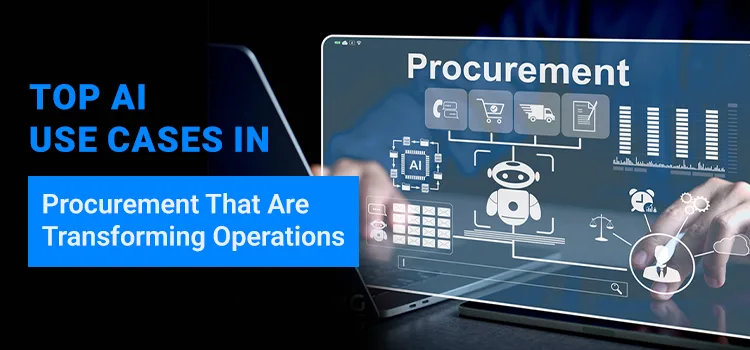
Procurement is one of those areas that are rapidly evolving due to the adoption of AI technology in businesses. Procurement normally involves routine activities, vast amounts of data, and human decision-making. All this might lead to a slowdown of the process and higher costs for businesses.
AI application in procurement allows companies to optimize all of the above processes using data analytics, automation of routine procedures, and decision-making. Furthermore, AI gives more insight into the performance of suppliers, contracts, and procurement budgets.
There are various AI procurement use cases in operation today that are revolutionizing the area of procurement. These use cases include spend analysis, supplier risk management, contract analysis, demand forecasting, and intelligent sourcing.
AI Procurement Use Cases
Let’s have a detailed look at use cases of AI in procurement. They are as follows:
1. Automated Spend Classification
Spend classification is one of the most practical applications of AI in procurement. Procurement teams often manage thousands of transactions across multiple categories.
Manual classification can consume significant time. It can also create inconsistent category structures across business units.
AI can evaluate transaction descriptions, supplier details, and previous purchasing history. This would enable the categorization of transactions into relevant spend categories.
Such a task is known as automated spend classification. AI-driven models can be optimized for greater efficiency over time.
Greater efficiency helps procurement departments understand organizational spending. This would help in identifying duplicated purchases, fragmented spending, and areas of saving potential.
AI can also spot abnormal spending behavior, which helps in effective category management and procurement sourcing.
2. Intelligent Procurement Automation
There are several repetitive tasks involved in procurement. These may include making purchase orders, processing invoices, approving, and data entry.
Procurement automation software may make use of AI to automate such tasks. The AI tools can capture data from documents and automatically route them.
An AI tool can capture an invoice and match it with purchase data. This will enable identifying any missing data before processing the invoice for approval.
The process of automation can make procurement less manual and allow employees to engage in strategic activities.
3. AI Supplier Risk Assessment
Supplier risk can affect costs, production, compliance, and business continuity. Procurement teams need timely information to manage these risks.
AI supplier risk assessment can analyze large volumes of supplier data. Sources may include financial information, performance records, news, and compliance data.
AI is capable of recognizing patterns that are associated with possible risks for suppliers. It can also indicate changes that should be evaluated by people.
For instance, the AI can notice worsening performance of suppliers. In addition, it can signal financial or other risks.
In this way, procurement professionals can evaluate alerts and make necessary investigations. This will allow for effective supplier management.
It is important to emphasize that AI does not decide about suppliers. It only gives indications for teams’ attention.
4. Predictive Analytics for Demand Forecasting
Demand forecasting will help make better purchasing decisions. Bad predictions could lead to oversupply or lack of supplies.
Predictive analytics in procurement involves the analysis of data in order to establish demand patterns.
The AI system will be able to forecast demand based on past purchases, seasonal variations, market conditions, and even the performance of the suppliers.
Procurement officers will be able to use such predictions in making purchasing decisions.
Such predictions can be used for improving inventory management. Predictions will also be useful in planning and making purchases from suppliers.
Predictions will depend on the accuracy of data. Organizations need to have good data when it comes to procurement.
5. AI-Powered Supplier Discovery
Finding suitable suppliers can require extensive research. Procurement professionals may need to compare hundreds of potential suppliers.
AI can make supplier discovery more efficient. It can analyze supplier databases, product information, certifications, and performance records.
Procurement teams can define specific requirements for a sourcing project. AI can then identify suppliers that match those requirements.
This process can shorten supplier research cycles. It can also help teams discover suppliers outside their existing networks.
Human review remains important before adding suppliers to an approved vendor list. Procurement teams should verify qualifications, compliance, and commercial terms.
6. Contract Analysis and Management
Contracts carry vital information such as price, obligations, renewal, and risks. Manually checking these aspects could be time-consuming.
AI can read the contracts and determine the important clauses within. These include dates, price, obligations, and renewal.
Unusual clauses can be identified by AI as well. It is one way to recognize risks associated with the contract.
Contract intelligence makes it possible to gain visibility regarding contracts made with suppliers. It also helps in avoiding missed renewals.
This shows why contract management is one of AI procurement use cases.
7. Generative AI for Procurement Teams
Generative AI is introducing new possibilities for procurement professionals. It can create summaries, draft communications, and answer questions using approved information.
There are several generative AI in procurement examples.
The procurement expert may instruct the AI to make a summary of the supplier’s agreement. AI can also compare supplier proposals.
The application of generative AI could involve drafting supplier e-mails and procurement documents. Generative AI can also make a summary of the supplier’s performance reports.
Yet another application includes procurement knowledge management. Employees can ask questions regarding procurement policies and procedures.
It is necessary to put controls on confidential information. Human review must be included in key procurement processes.
8. Intelligent Purchase Order Management
Purchase orders are central to procurement operations. Errors can create delays, payment issues, and supplier disputes.
AI can monitor purchase order data and identify anomalies. It can compare orders against contracts, supplier records, and historical transactions.
The system can flag unusual prices or quantities. It can also identify duplicate orders or missing information.
These capabilities can improve purchasing accuracy. They can also help procurement teams resolve issues earlier.
9. Supplier Performance Monitoring
Supplier performance affects the outcomes of procurement. Usually, procurement teams evaluate the delivery time, quality, prices, and services of suppliers.
With the help of AI, all of this data could be combined. With AI, performance trends and supplier issues could be identified.
Such data could be used by procurement teams when performing supplier reviews. Additionally, procurement teams could find where improvements are required.
AI-powered supplier tracking gives constant access to the information. Teams do not need to wait until the next supplier review.
10. Fraud and Anomaly Detection
Procurement data may have odd transactions. This is because of errors, lapses, or even fraud.
AI is capable of analyzing transaction patterns in large numbers. It is able to distinguish transactions that are not typical of the purchasing process.
Some examples are duplicate payments, abnormal pricing, and odd supplier relationships. AI can flag these transactions for review.
This feature is able to enhance procurement processes. It may also assist in effective financial governance.
The Future of AI in Procurement
AI is gaining importance in modern-day procurement methodologies. It serves not only as a tool for task automation.
The best practice is a combination of human knowledge with the abilities of AI technologies. Strategic decisions are still required from the procurement specialists.
Firms should start with defining their business issues. It is also necessary to set up the basis of data and performance metrics.
Proper implementation implies proper security and governance of AI technologies. The team should decide on the people authorized to get access to procurement data.
Also, they should validate the output of the AI technologies before making significant decisions.
With further technological development, the use of AI in procurement will become more complicated. Greater automation and analysis power can be expected.
The goal is not to remove people from procurement. The goal is to help them spend more time on strategic work.
With the use of automated spend classification and AI-based supplier risk assessment, the opportunities are increasing. The use of predictive analytics in procurement could help improve planning and visibility.
On the other hand, procurement automation solutions could help in reducing repetitive workloads. Generative AI could make the procurement-related information more accessible.
All these AI-based procurement applications could change the procurement function when used appropriately. Organizations could create more agile procurement functions using the right technology and data.