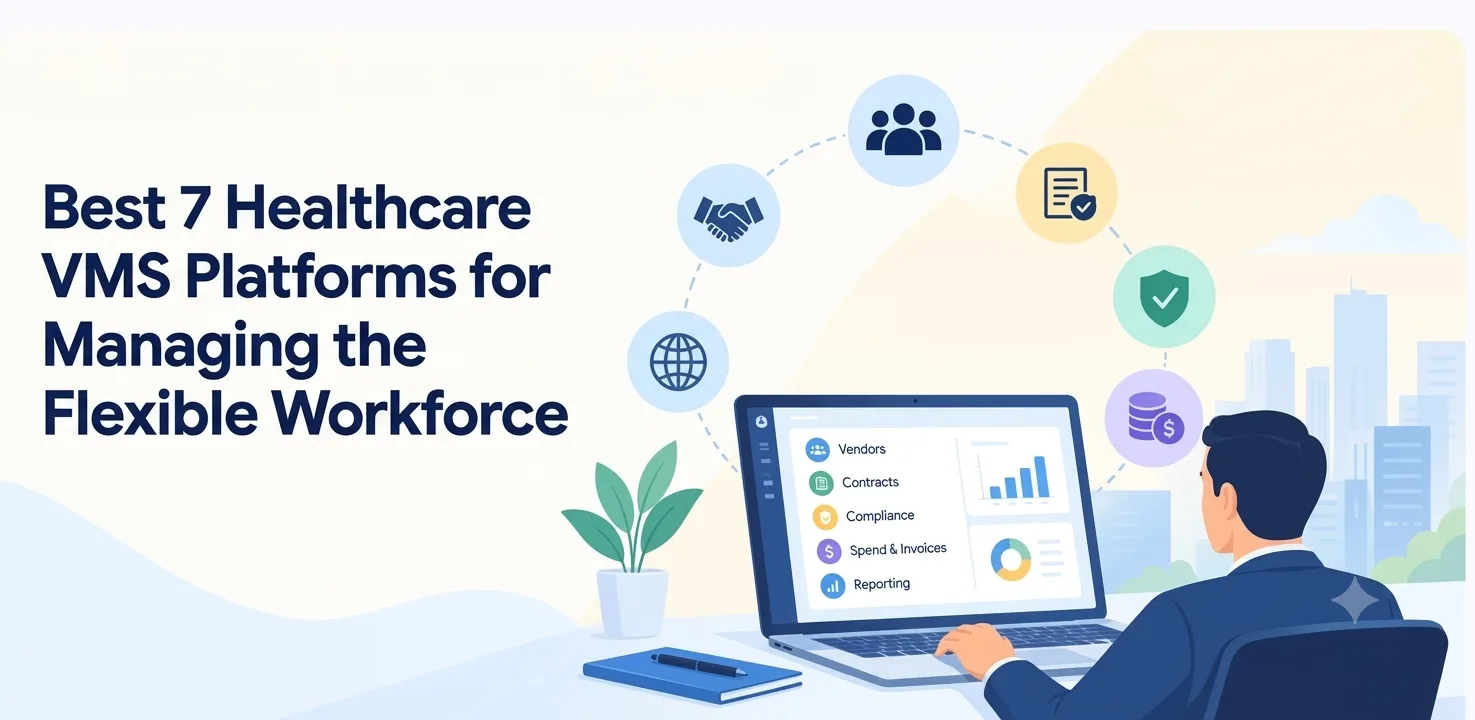
Healthcare organizations managing contingent labor, locum tenens, nursing, allied health, and other external workforce categories need more than basic staffing software. A healthcare Vendor Management System (VMS) can bring workforce, vendor, compliance, scheduling, spend, and reporting processes into a centralized environment.
The platforms below represent different approaches to healthcare workforce and vendor management, including healthcare-focused VMS solutions, workforce management platforms, and broader contingent workforce technologies.
What is a healthcare VMS?
A healthcare Vendor Management System (VMS) is a technology platform that helps hospitals and healthcare organizations manage contingent and external workforce programs. Depending on the platform, capabilities can include requisition management, vendor management, credentialing, scheduling, time tracking, invoicing, compliance, reporting, and workforce analytics.
Healthcare VMS platforms are particularly useful when organizations work with multiple staffing suppliers or manage different workforce categories across facilities. Centralizing these processes can provide greater visibility into workforce activity, vendor performance, compliance status, and labor spend.
What are the most important VMS features for global enterprises?
The most important VMS features for global enterprises include centralized vendor and workforce management, configurable workflows, compliance, analytics, integrations, automation, and multi-location support. SimplifyVMS brings these capabilities together with workforce visibility and configurable workflows. Global enterprises may also need multi-country support, localization, rate management, invoicing, and integrations with HR, ERP, and finance systems. AI-assisted matching and workforce intelligence can further support workforce decisions.
For healthcare organizations, credentialing, shift management, compliance monitoring, and visibility across nursing, allied health, locum tenens, and non-clinical workers are also important.
Best 7 Healthcare VMS Platforms
1. SimplifyVMS
SimplifyVMS provides a centralized platform for managing healthcare contingent and extended workforce programs, including vendors, workers, shifts, compliance, workforce services, and reporting. Its healthcare solution supports multiple workforce categories while helping organizations improve visibility and control across their external workforce.
The platform combines AI and automation with workforce management processes to support candidate matching, workforce tracking, scheduling, compliance, reporting, and workforce intelligence. Its capabilities also extend to direct sourcing and SOW management, helping organizations manage different external workforce categories through a connected platform.
Feature highlights
- Centralized healthcare workforce and vendor management
- AI-assisted workforce processes and automation
- Workforce tracking, shift management, and scheduling
- Compliance, credentialing, and reporting
- Spend, utilization, and vendor performance visibility
- Direct sourcing and SOW management
- Integrations with existing workforce and business systems
Ideal for: Healthcare organizations looking for an AI-first VMS with centralized workforce management, automation, compliance, analytics, and support for multiple workforce categories.
2. HealthcareVMS
HealthcareVMS is a healthcare-focused Vendor Management System designed to help hospitals and healthcare organizations manage their extended workforce across nursing, allied health, locum tenens, and non-clinical roles. It brings workforce, vendor, compliance, and operational processes into one centralized platform.
The platform supports workforce scheduling, credential and compliance tracking, vendor performance, spend management, and utilization visibility. These capabilities can help healthcare teams improve workforce control, reduce administrative effort, and respond more efficiently to changing workforce needs.
Feature highlights
- Purpose-built healthcare VMS
- Credentialing and compliance management
- Workforce scheduling and flexible workforce management
- Spend, utilization, and vendor performance visibility
- Automated workflows and system integrations
- Direct sourcing and SOW management
Ideal for: Hospitals and health systems looking for a healthcare-specific platform to manage contingent and extended workforce operations.
3. Kimedics
Kimedics provides healthcare workforce management capabilities covering scheduling, credential management, payments, VMS processes, and related workforce operations. Its platform is designed to connect information across employed, contract, and contingent clinicians.
The platform brings workforce data together across scheduling, credentials, financial operations, and external workforce management. It also supports shift management, credential and availability validation, vendor portals, float pools, analytics, and payment processes.
Feature highlights
- Healthcare workforce management
- Scheduling and shift management
- Credential management
- VMS and vendor portal capabilities
- Float pool management
- Payment and invoice automation
- Workforce analytics
Ideal for: Healthcare organizations and staffing operations looking for connected clinician workforce, scheduling, credential, and financial management capabilities.
4. FlentisPRO
FlentisPRO is a VMS designed to manage contingent workforce programs, including staff augmentation, service procurement, independent contractors, and other external workforce models. The platform supports MSPs, PMOs, hybrid workforce programs, and direct organizations.
Its capabilities include configurable workflows, compliance management, supplier management, dashboards, reporting, and integrations with HR, ERP, and finance systems. FlentisPRO also provides healthcare-related workforce capabilities, including float pool management.
Feature highlights
- Contingent workforce management
- Supplier and vendor management
- Configurable workflows and approvals
- Compliance management
- Dashboards and reporting
- HR, ERP, and finance integrations
- Healthcare float pool capabilities
Ideal for: Organizations, MSPs, and hybrid workforce programs that need a configurable VMS with supplier management, automation, reporting, and healthcare workforce capabilities.
5. Aya Healthcare
Aya Healthcare provides healthcare workforce management technology alongside its managed services and staffing solutions. Its platform supports healthcare organizations managing nursing, locum tenens, allied health, and other workforce requirements.
Its VMS capabilities support workforce management, float pools, talent-on-demand programs, reporting, and healthcare staffing workflows. The platform also supports locum-focused workforce management, including requisitions, credentialing, licensing, and supplier coordination.
Feature highlights
- Healthcare workforce management
- VMS and MSP capabilities
- Locum tenens management
- Float pool management
- Credentialing and licensing
- Workforce analytics and reporting
- Talent-on-demand capabilities
Ideal for: Healthcare organizations managing large clinical workforce programs, particularly those with locum, nursing, allied health, or internal float-pool requirements.
6. Ringo VMS
Ringo is a vendor-neutral healthcare workforce management platform designed for hospitals, healthcare facilities, and physician groups. It supports locums, nursing, allied health, APP, and non-clinical staffing programs.
The platform centralizes requisitions, credentialing, onboarding, invoicing, workforce reporting, and vendor management. Ringo also provides MSP capabilities, including supplier management, performance visibility, compliance workflows, and financial oversight.
Feature highlights
- Vendor-neutral healthcare VMS
- Requisition and staffing management
- Credentialing and onboarding
- Vendor management
- Time and invoice processes
- Workforce reporting
- MSP services
Ideal for: Hospitals and healthcare organizations seeking a vendor-neutral platform for contingent workforce, supplier, compliance, and financial management.
7. Syncx
Syncx provides healthcare workforce management solutions focused on connecting health systems, staffing agencies, and healthcare providers. Its offering includes MSP, float pool, and ATS capabilities.
The platform focuses on healthcare staffing workflows, including locum workforce management, internal float pools, and permanent staffing. Its approach connects different workforce processes across health systems, staffing agencies, and healthcare professionals.
Feature highlights
- Healthcare workforce management
- MSP capabilities
- Internal float pool management
- Locum staffing workflows
- ATS capabilities
- Healthcare workforce connections
Ideal for: Healthcare organizations looking to manage locum staffing, internal float pools, and related workforce processes through a connected healthcare workforce platform.
Which is the best AI-powered VMS?
There is no single AI-powered VMS that fits every organization because requirements vary by workforce type, geography, operating model, integrations, and program complexity. SimplifyVMS is an AI-first VMS that combines workforce management, SOW Management, automation, analytics, compliance, scheduling, vendor management, and extended workforce capabilities. Its platform is designed to bring different workforce processes together while using AI and automation to reduce manual work and improve workforce visibility.
When evaluating an AI-powered VMS, organizations can compare AI-assisted matching, workflow automation, workforce analytics, integrations, compliance capabilities, reporting, and support for different workforce categories.
How to compare healthcare VMS platforms
Healthcare organizations can compare VMS platforms based on their workforce model, operational requirements, and technology environment. Important areas to evaluate include:
- Workforce coverage: Nursing, allied health, locum tenens, non-clinical, SOW, and other workforce categories.
- Vendor management: Supplier onboarding, performance, communication, rate management, and visibility.
- Compliance: Credential tracking, license management, expiration alerts, and audit readiness.
- Scheduling: Shift management, float pools, availability, and workforce deployment.
- Automation and AI: Candidate matching, workflow automation, alerts, analytics, and workforce intelligence.
- Integrations: HRIS, ERP, payroll, scheduling, finance, and other enterprise systems.
- Analytics: Spend, utilization, fill rates, vendor performance, workforce trends, and operational reporting.
- Scalability: Support for multiple facilities, workforce categories, locations, and complex healthcare programs.
Conclusion
Healthcare VMS platforms can help organizations manage the complexity of contingent and extended workforce programs by bringing workforce, vendor, compliance, scheduling, financial, and reporting processes into a more connected environment.
The seven platforms covered in this guide take different approaches to healthcare workforce management. Some focus specifically on healthcare VMS capabilities, while others combine VMS functionality with MSP services, staffing, scheduling, float pool management, or broader workforce technology.
Organizations evaluating a healthcare VMS should consider their workforce categories, compliance requirements, vendor ecosystem, integration needs, reporting requirements, and automation goals. AI capabilities, workforce intelligence, configurable workflows, and centralized visibility can also be important considerations when selecting a platform for a complex healthcare workforce program.