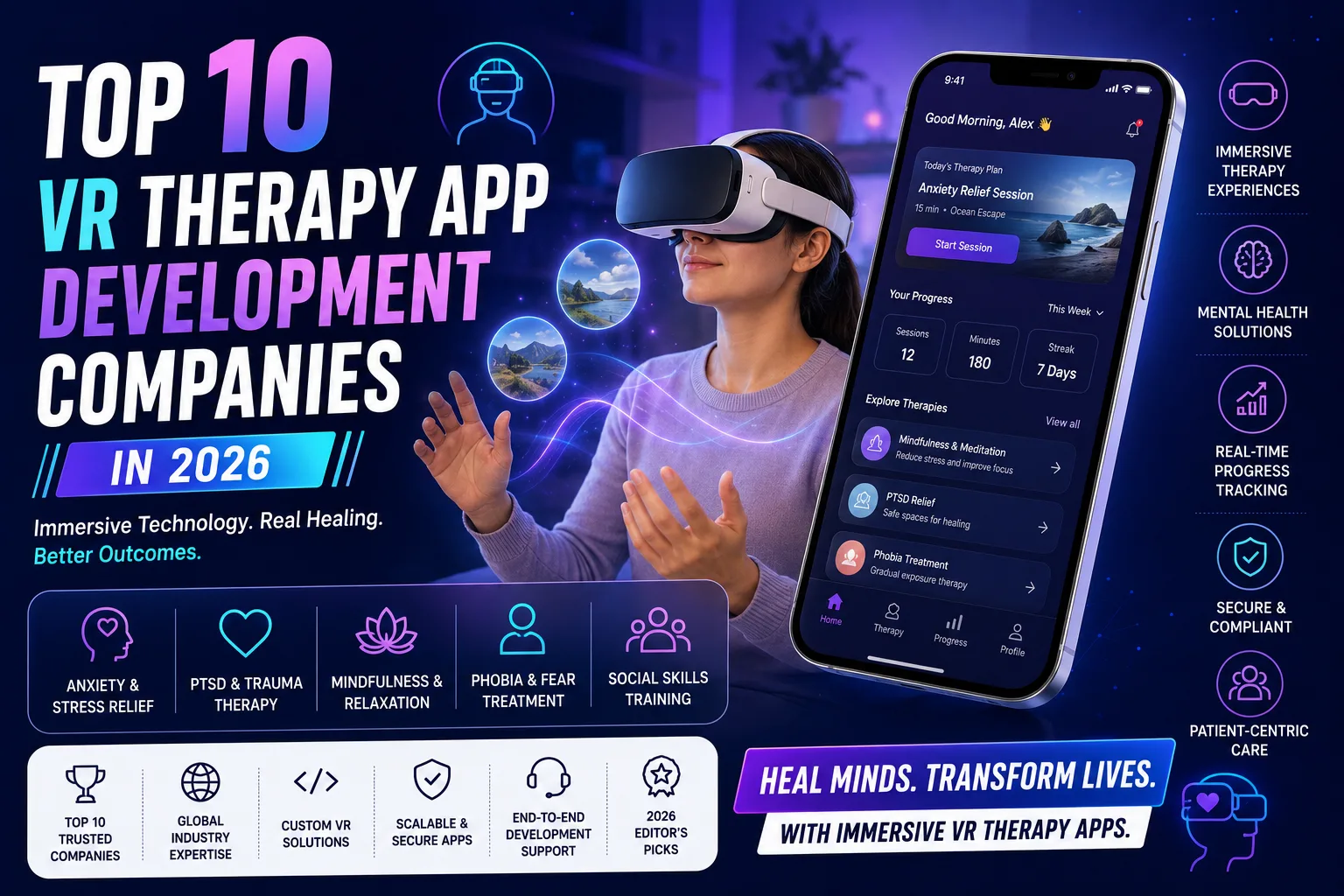
Virtual Reality is becoming an increasingly useful technology in modern healthcare. Its ability to create controlled, interactive, and immersive environments has opened new possibilities for therapy and rehabilitation. Healthcare providers and digital health companies are exploring VR applications for behavioral therapy, pain management, physical rehabilitation, relaxation, exposure-based interventions, and patient education.
Unlike conventional healthcare applications, a VR therapy platform needs to combine immersive content with a complete software ecosystem. Patients may need access to personalized therapy programs, while therapists require dashboards for assigning sessions, reviewing progress, and managing treatment workflows. The platform may also require AI, analytics, wearable integrations, cloud infrastructure, and secure data management.
For this reason, businesses planning a VR therapy product need a development partner with experience in both healthcare and immersive technology. Below are the Top 10 VR Therapy App Development Companies in 2026.
1. Idea Usher
Idea Usher is a custom software development company specializing in healthcare applications, Artificial Intelligence, Virtual Reality, Augmented Reality, and enterprise digital solutions. The company works with startups, healthcare providers, and businesses to build customized technology products.
Its VR therapy development services can cover both the immersive and software sides of the product. A platform can include interactive VR environments, patient profiles, therapist dashboards, therapy scheduling, progress monitoring, analytics, AI-powered personalization, wearable connectivity, notifications, and cloud infrastructure.
Idea Usher can also develop supporting mobile and web applications that allow therapists and administrators to manage the VR therapy ecosystem outside the headset.
Best For:
- VR therapy applications
- Digital therapeutics
- Healthcare AR/VR platforms
- AI-powered therapy solutions
- Rehabilitation applications
- Patient engagement technology
2. Quytech
Quytech specializes in emerging technologies including Virtual Reality, Augmented Reality, Artificial Intelligence, blockchain, and mobile application development. Its teams develop customized immersive products for businesses across multiple industries.
For healthcare applications, the company's VR capabilities can be used to create interactive therapeutic environments, rehabilitation exercises, medical simulations, and patient engagement experiences.
Best For:
- Healthcare VR development
- Immersive therapy
- AR/VR applications
- Medical simulations
3. ScienceSoft
ScienceSoft provides software development and technology consulting services for healthcare organizations and enterprises. Its healthcare capabilities include medical applications, AI, analytics, IoT, cloud computing, and enterprise software.
The company's broader healthcare expertise can be particularly useful for VR therapy platforms that require secure data handling, analytics, healthcare integrations, and enterprise-level infrastructure.
Best For:
- Enterprise healthcare software
- Digital health platforms
- Healthcare analytics
- Secure medical applications
4. Groove Jones
Groove Jones focuses on immersive technology, developing VR, AR, mixed reality, and interactive experiences. The company has experience creating highly engaging virtual environments for healthcare, education, training, and enterprise applications.
For VR therapy products, its experience with interactive environments can help businesses create experiences that encourage patients to actively participate in therapeutic activities.
Best For:
- Immersive VR environments
- Healthcare visualization
- Interactive therapy experiences
- Mixed reality applications
5. Program-Ace
Program-Ace specializes in VR, AR, 3D development, simulations, and custom software engineering. The company has experience developing virtual environments and interactive simulations that can be adapted to specialized use cases.
Its expertise can be useful for healthcare organizations that require detailed 3D environments for rehabilitation, therapy exercises, simulations, or patient education.
Best For:
- VR rehabilitation
- 3D therapy environments
- Healthcare simulations
- Extended reality solutions
6. Andersen
Andersen provides custom software development services for healthcare organizations, enterprises, and technology businesses. Its healthcare capabilities include cloud development, mobile applications, enterprise software, data management, and digital transformation.
The company can support VR therapy projects by developing the surrounding digital infrastructure, including patient portals, therapist dashboards, APIs, analytics, and secure cloud systems.
Best For:
- Enterprise healthcare platforms
- Digital health applications
- Healthcare cloud software
- Patient management solutions
7. Saritasa
Saritasa develops custom software using VR, AR, IoT, mobile, and cloud technologies. The company has experience creating connected applications that communicate with devices, sensors, and other technology systems.
This can make its expertise valuable for VR therapy platforms that integrate wearable devices, motion sensors, smartphones, or other connected healthcare equipment.
Best For:
- Connected VR therapy
- Wearable integration
- IoT healthcare applications
- AR/VR solutions
8. Zco Corporation
Zco Corporation provides software development services across mobile applications, VR, AR, game development, and enterprise software. Its immersive development capabilities include interactive 3D experiences and VR applications.
Healthcare businesses can use these capabilities to build engaging therapy environments while also developing supporting mobile and web applications.
Best For:
- VR healthcare applications
- 3D interactive experiences
- Mobile healthcare apps
- Immersive software
9. iTechArt
iTechArt provides custom software engineering services with expertise in cloud applications, Artificial Intelligence, mobile development, and enterprise platforms. The company works with organizations that need scalable technology products.
For VR therapy businesses, iTechArt can contribute to backend systems, APIs, cloud infrastructure, analytics, and patient-facing applications that complement the VR experience.
Best For:
- Healthcare software engineering
- Cloud-based healthcare platforms
- Digital health applications
- Scalable backend systems
10. RisingMax
RisingMax develops digital products using Virtual Reality, Augmented Reality, Artificial Intelligence, blockchain, and mobile technologies. The company creates immersive applications for businesses looking to incorporate emerging technologies.
Its capabilities can be applied to healthcare use cases including rehabilitation, therapy, medical training, wellness, and patient engagement.
Best For:
- VR therapy solutions
- Healthcare AR/VR applications
- Rehabilitation platforms
- Immersive wellness products
Essential Features of a VR Therapy App
The functionality of a VR therapy application should be based on the treatment model and clinical objectives. However, several features can form the foundation of a modern platform.
Immersive Therapy Content
The VR component should contain carefully designed environments that support the intended therapy. This may involve relaxation spaces, rehabilitation environments, simulated situations, or guided therapeutic exercises.
Patient Management
Patients can have secure accounts that allow them to access assigned therapy programs, view instructions, complete sessions, and review their activity.
Therapist Dashboard
Therapists can use a dedicated dashboard to manage patients, assign therapy programs, review sessions, and monitor progress.
Treatment Plans
The application can organize therapy activities into structured programs, allowing patients to follow a defined sequence of sessions.
Progress Tracking
The system can track relevant information such as completed sessions, duration, exercise performance, and engagement.
AI-Powered Personalization
AI can potentially help personalize selected aspects of the therapy experience based on patient activity and predefined treatment parameters.
Wearable Integration
Compatible sensors and wearable devices can provide additional information during therapy sessions, depending on the application's purpose.
Analytics and Reporting
Analytics dashboards can help therapists understand patient engagement and review activity over time.
Notifications
Reminders and notifications can encourage patients to maintain their assigned therapy schedules.
How to Choose the Right VR Therapy App Development Company
Choosing the right development company is critical because VR therapy combines healthcare requirements with complex immersive technology.
Before selecting a partner, evaluate:
- Previous healthcare software projects
- VR and AR development experience
- 3D modeling and animation capabilities
- Experience with VR headsets
- AI and machine learning expertise
- Wearable and sensor integrations
- Healthcare API development
- Data security practices
- Cloud infrastructure
- Healthcare UX/UI design
- Testing and quality assurance
- Post-launch maintenance
It is also important to discuss the intended therapy use case before development begins. A rehabilitation application, for example, may require motion tracking and sensor integration, while a behavioral therapy application may place greater emphasis on controlled virtual environments and session management.
How Much Does It Cost to Build a VR Therapy App?
There is no universal development cost because every VR therapy product has different requirements. A basic application with a small number of environments can be relatively straightforward, while an enterprise platform with AI, wearables, analytics, multiple devices, and healthcare integrations requires considerably more development work.
The overall cost can be influenced by:
- Number of VR environments
- 3D modeling and animation
- Interaction complexity
- Supported VR headsets
- AI functionality
- Wearable integrations
- Patient and therapist applications
- Cloud infrastructure
- Healthcare API integrations
- Security requirements
- Testing and maintenance
Businesses can reduce initial investment by starting with an MVP focused on one therapeutic use case and a limited number of core features.
Benefits of VR Therapy Applications
VR therapy platforms can offer several potential advantages when designed around appropriate therapeutic goals.
Immersive Experiences: VR creates controlled environments that can make certain therapy activities more interactive.
Patient Engagement: Interactive digital environments can encourage users to participate actively in therapy sessions.
Consistent Sessions: Digital environments can be reproduced consistently across multiple sessions.
Remote Participation: Depending on the therapy model and clinical requirements, certain activities may be completed outside traditional clinical environments.
Digital Monitoring: Software can capture session activity and provide data that supports patient monitoring and engagement analysis.
Final Thoughts
The combination of Virtual Reality and healthcare software is creating new opportunities for therapy and rehabilitation. Modern VR therapy applications can bring together immersive environments, patient management, therapist workflows, AI, analytics, and connected devices within a single platform.
The Top 10 VR Therapy App Development Companies listed above offer different strengths across immersive technology and healthcare software development. The right choice will depend on your therapeutic objectives, target audience, technical requirements, VR hardware, security expectations, and budget.
For businesses planning to develop a VR therapy app, working with an experienced development partner can help transform an initial concept into a secure, scalable, and engaging healthcare product while providing the technical foundation needed for future expansion.