The scent of chemicals and dust. The hum of fluorescent lab lights overhead. Somewhere beneath it all, a heartbeat—steady, focused. Not just a man in a white coat, but a child once navigating dirt roads in Agaro, Ethiopia, holding a test tube over an open flame, discovering what burns, what changes, what remains.
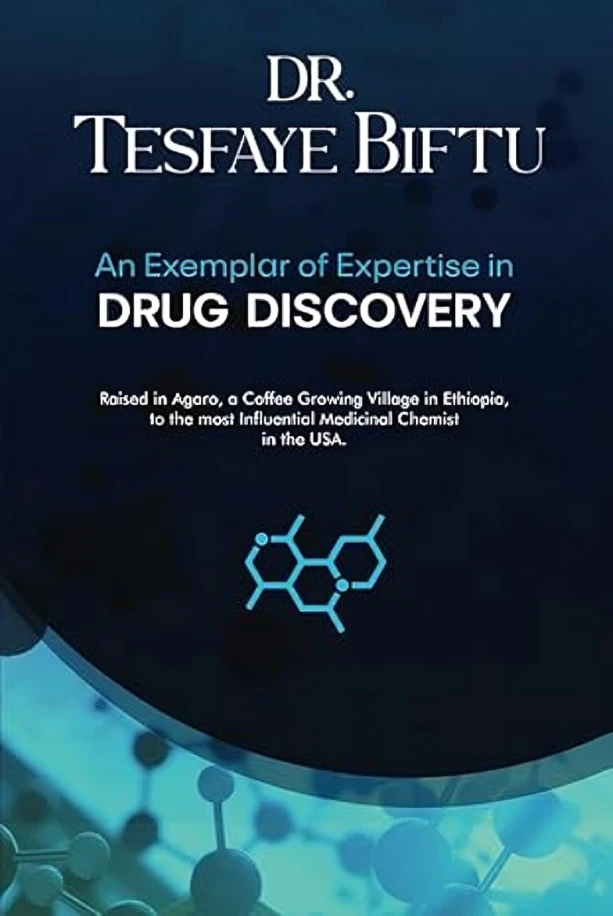
Dr. Tesfaye Biftu’s story, as told in Dr. Tesfaye Biftu – An Exemplar of Expertise in Drug Discovery, is far more than a chronology of scientific achievements. It is, at its core, a quiet meditation on endurance—of spirit, of memory, of integrity in the face of complexity. Beneath the precise language of chemistry and the structured chapters of professional life, there is something far more elemental: a journey of identity, healing, and the relentless pursuit of purpose.
What stays with the reader long after the book closes is not just the scale of Biftu’s scientific contributions—though they are considerable—but the deeply human arc beneath them. A boy raised by a principled father and a resilient mother in a region rich in culture and tension. A young man shaped by systems he did not design yet moved through with curiosity and grace. A Black scientist navigating elite American research institutions while carrying both the expectations and the quiet burden of being one of the few.
There are recurring moments of stillness in this biography—instances that invite reflection rather than proclamation. When Biftu returns to Ethiopia amid political violence to rescue his imprisoned father, it’s not dramatized. It’s a son’s instinct, an act shaped by loyalty more than language. That moment, like many others in the book, gestures to the emotional weight of belonging—to family, to country, to self.
Themes of displacement and rootedness thread their way through every stage of his life. Whether in the halls of Brandeis University or the glass towers of Merck, Biftu carries with him a sense of origin. The book doesn’t romanticize his journey. It acknowledges the isolation of being brilliant and under-credited; the sting of being told one’s role is peripheral when it was, in fact, central. There is no bitterness in how the story is told—just a steady naming of facts and, in that, a kind of justice.
Perhaps the most powerful emotional chord lies in how Biftu holds both science and faith without conflict. In a world that often splits them apart, his story suggests they are two languages pointing to the same truth: that healing is sacred work. Whether through drug molecules or prayer, through teaching or remembering, the work is the same—making life bearable, even beautiful, for others.
The sections that explore his views on religion and nationalism are among the most thought-provoking. His rejection of racial superiority and sectarian separation seems especially important right now. He doesn't talk like a pundit; he talks like someone who has lived through governments, coups, and moving. His voice is heavy with the weight of lived complexity, and his demand for togetherness sounds more like a way to stay alive than a political position.
He hasn't been a mother himself, but memories of his mother and later his wife, who were both strong and dignified, come back to him. They are not footnotes; they are the building blocks. He has a deep respect for their strength that is clear but not loud. It's in the way he talks about their sacrifices and how they stayed strong even when things changed. By doing this, the book becomes a subtle testament to the hard work that goes into success.
There is also a throughline of mentorship—extending a hand back even while moving forward. Biftu’s later-life work in education, particularly in rebuilding pharmaceutical programs in Ethiopia, is a kind of homecoming. Not flashy, not headline-grabbing, but vital. It suggests that achievement isn't the end of the road but a tool that can be used by others.
The book's emotional power comes from what it doesn't add to. The story doesn't give in to the need to make things bigger or more dramatic. It trusts that the reader will comprehend the meaning of a gesture, the weight of a quiet choice, and the honor of performing the task without making a big deal out of it. That restraint makes it much more powerful.
For readers who care about representation in science, about the untold stories behind life-saving medications, about how one can remain intact while navigating systems not built to include them—this book is essential. But it is also for anyone seeking affirmation that persistence, guided by values, can shape a life of consequence.
Ultimately, Dr. Tesfaye Biftu – An Exemplar of Expertise in Drug Discovery, reminds us that healing—whether scientific or social—is rarely immediate. It comes in layers, in steady efforts, in stories told not to impress but to bear witness. And in this telling, the molecules fade into the background. What remains is the man.