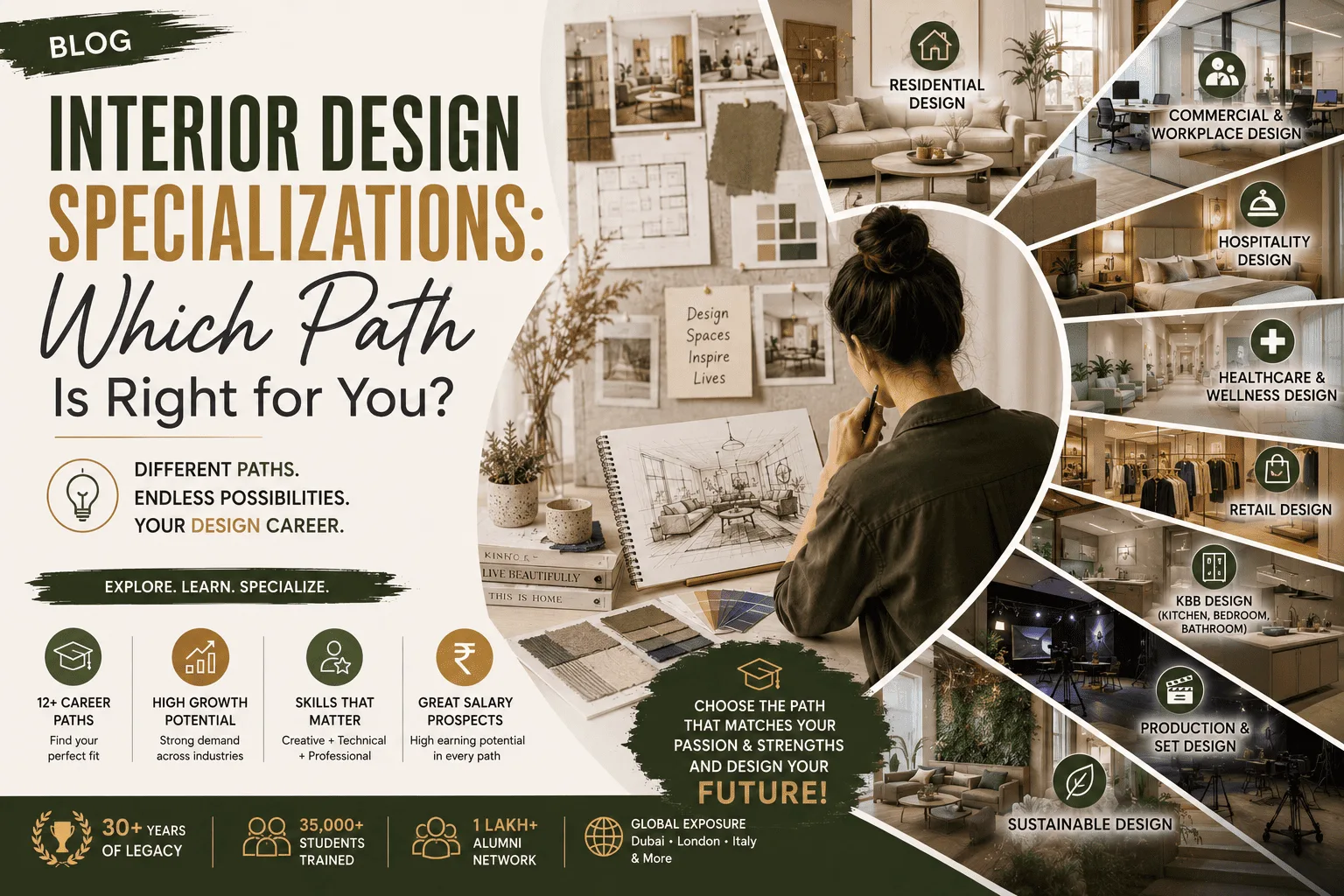
If you have been looking into interior design specializations and feeling overwhelmed by the options, you are not alone. NIF Global Jaipur works with hundreds of students every year who feel exactly the same way. Interior design is not one single career. It is a field with over 12 distinct paths, each with its own set of skills, opportunities, and income potential. The earlier you understand this, the smarter your decisions will be.
What Are Interior Design Specializations?
Think of interior design specializations like choosing a stream after Class 10. You don’t just “do science.” You pick physics, biology, or computer science based on what excites you. Interior design works the same way. You start with the basics and then move into a specific direction based on your strengths and interests. Some designers work on homes. Others design hospitals, hotels, film sets, or even private jets. Each of these paths needs a different kind of training, knowledge, and personality. The good news? You don’t have to figure it all out on day one. Understanding your options now puts you way ahead of most students your age.
Which Interior Design Specializations Are Most In Demand?
Here are the most sought-after paths in the field today:
- Residential design is the most common starting point. You work with families and individuals to design their homes, choosing layouts, colors, furniture, and lighting. The client is usually the person who lives in the space, which makes communication and listening skills just as important as design skills.
- “Commercial and workplace design” means designing offices, coworking spaces, and corporate environments. Companies today invest heavily in how their offices look because it directly affects employee happiness and productivity. This is one of the fastest-growing sectors in the interior design career space right now.
- Hospitality design covers hotels, restaurants, cafes, spas, and lounges. It is one of the most glamorous paths and one of the most technically demanding. Every detail, from the height of a bar counter to the angle of a chair back, affects how guests feel and how much money the business makes.
- Healthcare and wellness design is about designing hospitals, clinics, dental offices, and wellness centers with patients in mind. The newest trend here is biophilic design, which uses natural materials, plants, and calming colors to help people heal faster. This is one of the fastest-growing niches globally.
- Retail design is where interior design meets branding. You design stores that pull customers in, guide them through the space, and make them want to stay and spend. It combines architecture, graphic design, and psychology.
- KBB Design, which stands for Kitchen, Bedroom, and Bathroom, has grown so large it is now its own sector. It is highly technical, requiring knowledge of plumbing, electrical systems, and building safety codes. Designers in this space are always in demand.
- Production and set design are for those who want to take their skills into the world of film, television, and theater. You create the visual world that viewers see on screen. It is creative, fast-paced, and has some of the strongest salary potential in the field, reaching up to Rs. 23 LPA in India.
- Sustainable design focuses on eco-friendly, energy-efficient interiors using recyclable materials and green systems. With climate awareness growing, this path is only going to get more important and more valuable.
How Do You Choose the Right Path?
This is the question most students are afraid to ask, and it is also the most important one when planning an interior design career. Here is a simple way to think about it:
If you love meeting people and understanding how they live, residential or hospitality design suits you. If you are detail-oriented and love solving technical puzzles, look at KBB or Healthcare Design. If you are drawn to big brands, storytelling, and visual impact, retail or production design might be your path. If you care about the environment and want your work to have a larger meaning, sustainable design is worth exploring seriously.
Most students do not know their answer yet, and that is completely fine. What matters is that you expose yourself to these areas early, through your education and internships, so you can make an informed choice rather than a random one.
At NIF Global Jaipur, students are introduced to all major interior design specializations during their foundation years before being guided toward their strongest direction. With over 35,000 students trained and a legacy of 30-plus years in design education, NIF Global Jaipur has seen every type of student, from the one who always knew what they wanted to the one who discovered their passion entirely by accident during their first studio project.
Interior Designer Salary in India: What Can You Actually Earn?
For students exploring design courses in Jaipur and across India, the salary data is genuinely encouraging.
The Indian interior design market is growing at 7.40% annually, and demand for designers is expected to rise by 13% over the next decade. Globally, the job market is projected to grow by nearly 20%.
Here is what an interior designer salary in India looks like across different specializations:
Residential and spatial designers can earn up to Rs. 20 LPA. Lighting designers average up to Rs. 15 LPA. Exhibition designers earn up to Rs. 10 LPA. Production designers can reach Rs. 23 LPA. Those who go independent and run their own design studio often earn significantly more.
The field rewards those who build a strong portfolio and a clear design identity early. Your specialization matters, but so does how well you develop and present your work.
Start Before You Have All the Answers
Interior design is not a single career. It is a wide field of specializations, and the right one for you depends on your curiosity, your strengths, and the kind of problems you want to spend your life solving. The best time to start exploring is right now.
Visit the NIF Global Jaipur interior design course page to find the program that fits where you are today and where you want to go.
FAQ’s
Q1. What are the most important skills for interior design beginners?
NIF Global Jaipur recommends starting with space planning, hand sketching, and SketchUp. These three skills for interior design build a strong foundation quickly. Pair them with basic communication practice, such as presenting your ideas to others, and you will be ahead of most beginners within your first year.
Q2. Do I need to know software to become an interior designer?
Yes, software is now an essential part of professional interior design practice. Clients expect to see 3D visuals of their space before work begins, and employers expect graduates to be comfortable with tools like SketchUp and AutoCAD. NIF Global Jaipur teaches these as core parts of its interior design programs, not as optional extras.
Q3. Is interior design a good career option in India right now?
Absolutely. India’s interior design market is projected to grow from USD 35 billion in 2026 to USD 65 billion by 2031. Residential interiors are the fastest-growing segment. There is real, sustained demand for trained designers across cities of all sizes, from metros to tier-2 and tier-3 towns.
Q4. What interior design courses does NIF Global Jaipur offer?
NIF Global Jaipur offers interior design programs from foundation certificates, open from Class 10, through advanced specialization and degree-level qualifications. All programs are accredited by NSDC, Skill India, and Medhavi Skills University, with faculty who bring real industry experience to every class.
Q5. Can I start learning interior design skills without any prior experience?
Yes, no prior design experience is needed to begin. NIF Global Jaipur’s foundation programs are built specifically for students who are starting from scratch. What matters most at the start is curiosity, observation, and a willingness to practice. Everything technical can be learned with the right guidance.