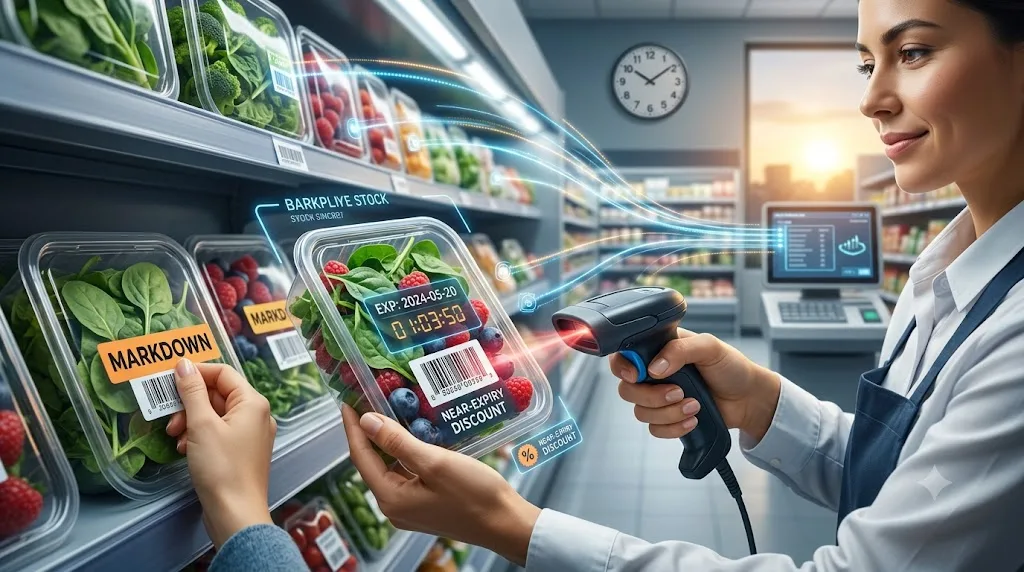
Food waste is a significant and costly challenge for retailers. Spoilage, missed expiry dates, and inefficient inventory practices reduce revenue and hinder sustainability. To meet rising regulatory and consumer demands for transparency, retailers are leveraging the evolving capabilities of the UPC barcode.
Once a simple price-lookup tool, the UPC barcode is now essential for food safety, supply chain traceability, and waste reduction. Integrated with modern scanners and inventory platforms, barcodes help retailers make faster, more informed decisions about perishable goods. This article explores this transformation and its impact on the future of retail operations.
Key Takeaways
- UPC barcodes have evolved into a critical infrastructure for food safety and waste management.
- Real-time barcode scanning enables automated expiry tracking, reducing human error and improving shelf management.
- Dynamic markdown workflows triggered by barcode scans help retailers move near-expiry stock before it becomes waste.
- Barcode-driven traceability accelerates product recalls and strengthens food safety compliance.
- Emerging technologies, such as GS1 Digital Link and AI-powered analytics, are expanding the role of barcodes in retail.
- Retailers investing in integrated barcode scanning and inventory management systems are better positioned to reduce waste, cut costs, and meet rising consumer expectations.
From Checkout Tool to Food Safety Infrastructure
Understanding the future of the UPC barcode requires recognizing its evolution. The first commercial scan in 1974 at a Marsh Supermarket in Ohio aimed to speed up checkout. Today, barcodes remain the universal product identifier, supported by much more advanced systems.
A single UPC barcode scan now updates inventory in real time, triggers reorder alerts, logs expiration data, and supplies valuable information to analytics platforms. While the barcode itself remains largely unchanged, the supporting infrastructure has transformed it into a powerful data collection tool.
This evolution is especially important in food retail, where perishability demands constant visibility and rapid response. Modern barcode-based systems address these operational challenges.
The Food Waste Problem in Retail: Why Technology Matters
Before examining how barcodes address food waste, it is important to understand the scale of the problem. Retailers across all segments face significant financial and environmental consequences from unsold food. Products that spoil before purchase result in direct losses of acquisition costs, labor, and floor space, and contribute to sustainability challenges that draw regulatory scrutiny and public attention.
Food waste in retail stems from several interconnected causes: inaccurate demand forecasting, poor shelf rotation, inadequate expiry-date monitoring, and slow response to near-expiry stock. Many of these are fundamentally data issues. Without real-time visibility into inventory, receipt dates, and expiry dates, retailers are forced to manage reactively rather than proactively.
Barcode-driven inventory management offers clear advantages. Scanning products throughout the supply chain generates continuous data, enabling timely and informed decisions. These benefits over traditional inventory methods are significant and measurable.
Traditional vs. Barcode-Driven Inventory Management
The table below shows how barcode-integrated workflows differ from traditional inventory approaches across key operational areas:
Criteria Traditional Inventory UPC Barcode-Driven System Expiry Monitoring Manual checks; prone to human error Automated scanning with real-time alerts Stock Visibility Periodic counts; delayed data Continuous, real-time inventory updates Markdown Decisions Based on estimation or staff memory Data-triggered, automated pricing workflows Supplier Recall Speed Slow; requires manual record search Near-instant batch-level identification Waste Reporting Inconsistent; often post-event Automated logging with actionable analyticsHow UPC Barcode Scanners Enable Smarter Expiry Management
Managing expiration dates in food retail is labor-intensive. Without automation, staff must manually check dates, rotate stock, and remove expired products, increasing the risk of human error and potential waste or food safety issues.
Automated Expiry Alerts and Shelf-Life Tracking
Modern UPC barcode scanner systems integrated with inventory software automate expiration management. When products are scanned at receiving, their expiration dates are logged. The system monitors this data and alerts managers as products approach their sell-by dates, enabling timely markdowns, product relocation, or removal before spoilage.
Automated expiry tracking reduces manual checks and provides an auditable record of shelf-life management. For multi-location retailers, centralized expiry data helps teams identify trends, address underperforming stores, and standardize waste-reduction practices.
Dynamic Markdown Workflows Triggered by Barcode Data
Dynamic markdown pricing, which automatically lowers prices on products nearing expiration, is an effective strategy to reduce food waste. Success depends on speed, consistency, and accurate inventory data.
Barcode-driven systems enable this by linking expiry tracking to pricing workflows. When a product enters its markdown window, the system updates prices, generates label instructions, and logs the event for reporting. Retailers using automated markdowns report reduced write-offs and improved margin recovery.
Traceability, Recalls, and Food Safety Compliance
Beyond day-to-day waste reduction, UPC barcodes serve a critical function in food safety compliance and traceability. When a food safety incident occurs, the ability to quickly identify and remove affected products from shelves is not just a regulatory obligation but a consumer safety imperative.
Accelerating Product Recalls with Barcode Traceability
Traditional recall processes that rely on manual records are often slow and incomplete. Identifying affected batches, store locations, and remaining units is time-consuming, increasing risks to consumers and reputational harm to retailers and brands.
Barcode-driven traceability links each scan to detailed records, including supplier, batch number, delivery date, storage location, and status. During a recall, the system quickly identifies all affected units, enabling faster product removal, accurate customer notifications, and comprehensive regulatory compliance.
Meeting Regulatory Requirements in Food Retail
Regulatory frameworks governing food safety are becoming increasingly stringent in many markets. In the United States, the Food Safety Modernization Act (FSMA) places significant requirements on traceability and record-keeping for food businesses. Similar regulations exist across the European Union and other major markets, with a growing emphasis on digital record-keeping and rapid response capabilities.
Retailers who integrate barcode scanning and traceability into operations can meet regulatory requirements with minimal added effort. Automated data capture makes compliance reporting an efficient part of daily operations rather than a separate administrative task.
Key Applications of UPC Barcodes in Food Retail Operations
Barcode-enabled systems have practical applications throughout retail operations, from the receiving dock to checkout. The table below summarizes the most impactful use cases:
Application How UPC Barcodes Help Business Benefit Expiration Tracking Scan-triggered alerts flag products nearing their sell-by dates Reduces spoilage; enables timely markdowns Inventory Management Real-time stock data synced across store and warehouse systems Prevents overstocking perishables Dynamic Pricing Barcode scan triggers automated markdown workflows Moves near-expiry stock before it becomes waste Supplier Traceability Links product scans to sourcing and batch records Faster recalls; stronger food safety compliance Consumer Transparency QR-enhanced UPC codes link shoppers to product origin data Builds trust; supports sustainability goalsThe Role of GS1 Standards and Emerging Barcode Technologies
The UPC barcode follows the GS1 global standards framework, which standardizes product identification across industries and countries. Understanding GS1 standards is essential for retailers who want to maximize the value of their barcode infrastructure as the industry adopts more data-rich formats.
GS1 Digital Link: Expanding What a Barcode Can Carry
GS1 Digital Link is a new standard that enables barcodes to include web-based links along with traditional identifiers. A single scan can direct users to comprehensive online product information, such as nutritional data, sourcing, certifications, and allergen warnings.
This capability is significant for food safety, offering consumer transparency beyond static labels and allowing real-time updates to product information without changing packaging. Adopting GS1 Digital Link enables retailers to meet consumer demand for transparency and comply with evolving labeling regulations.
AI-Powered Analytics Layered on Barcode Data
UPC barcode scan data is structured and time-stamped, making it ideal for AI analytics. Retailers can use this data to improve demand forecasts, optimize orders by location and season, and predict which products are likely to generate waste.
This shift transforms barcode data from a historical record into a tool for predictive decision-making. Retailers can move from reactive waste management to proactive planning, order closer to demand, adjust shelf allocation in real time, and address issues before they result in losses.
Practical Steps for Retailers Looking to Reduce Food Waste Through Barcodes
Implementing or upgrading barcode-driven food waste management can be done incrementally. Retailers of any size can take practical steps to achieve meaningful results. The following recommendations provide a starting point.
Audit Your Current Scanning and Inventory Infrastructure
Before investing in new systems, conduct a thorough audit of current barcode scanning and inventory workflows. Assess whether expiry dates are captured at receiving, whether inventory data is accessible in real time, and whether markdowns are data-driven. Identifying gaps will highlight key areas for improvement.
Integrate UPC Scanning with Inventory Management Software
The greatest benefit comes from integrating barcode scanning with inventory management software. Automatic data flow into a centralized system turns scans into actionable intelligence. Choose platforms that support scanner integration, real-time stock visibility, and automated alerts for expiry and stock levels.
Establish Automated Markdown and Waste Logging Workflows
After integrating barcode data with inventory systems, configure automated workflows for markdowns and waste logging. Set markdown triggers, automate pricing and label updates, and ensure all waste events are logged with product details for consistent, auditable reporting.
Train Staff and Establish Consistent Scanning Practices
Technology is effective only when used consistently. Train staff on scanning procedures, system alerts, and response protocols. Ensure products are scanned at every handoff, alerts are addressed promptly, and exceptions are documented. Fostering scan discipline is as important as the technology itself.
Conclusion: The Barcode's Expanding Role in a Sustainable Retail Future
The UPC barcode has been a retail standard for five decades, but its most significant impact may still be ahead. As food retail faces increasing regulatory, consumer, and sustainability pressures, precise tracking and management of perishables is now a key competitive advantage.
Retailers who integrate UPC barcode scanners with inventory management and analytics are building more responsive and responsible operations. Reducing food waste delivers financial benefits, supports sustainability, and demonstrates operational maturity valued by today’s consumers.
Looking ahead, the combination of barcode standards, digital connectivity, and AI-powered workflows will further expand possibilities. GS1 Digital Link, advanced scanners, and predictive analytics are already transforming supply chain management. The barcode is now an entry point to operational intelligence, with significant potential for reducing food waste.