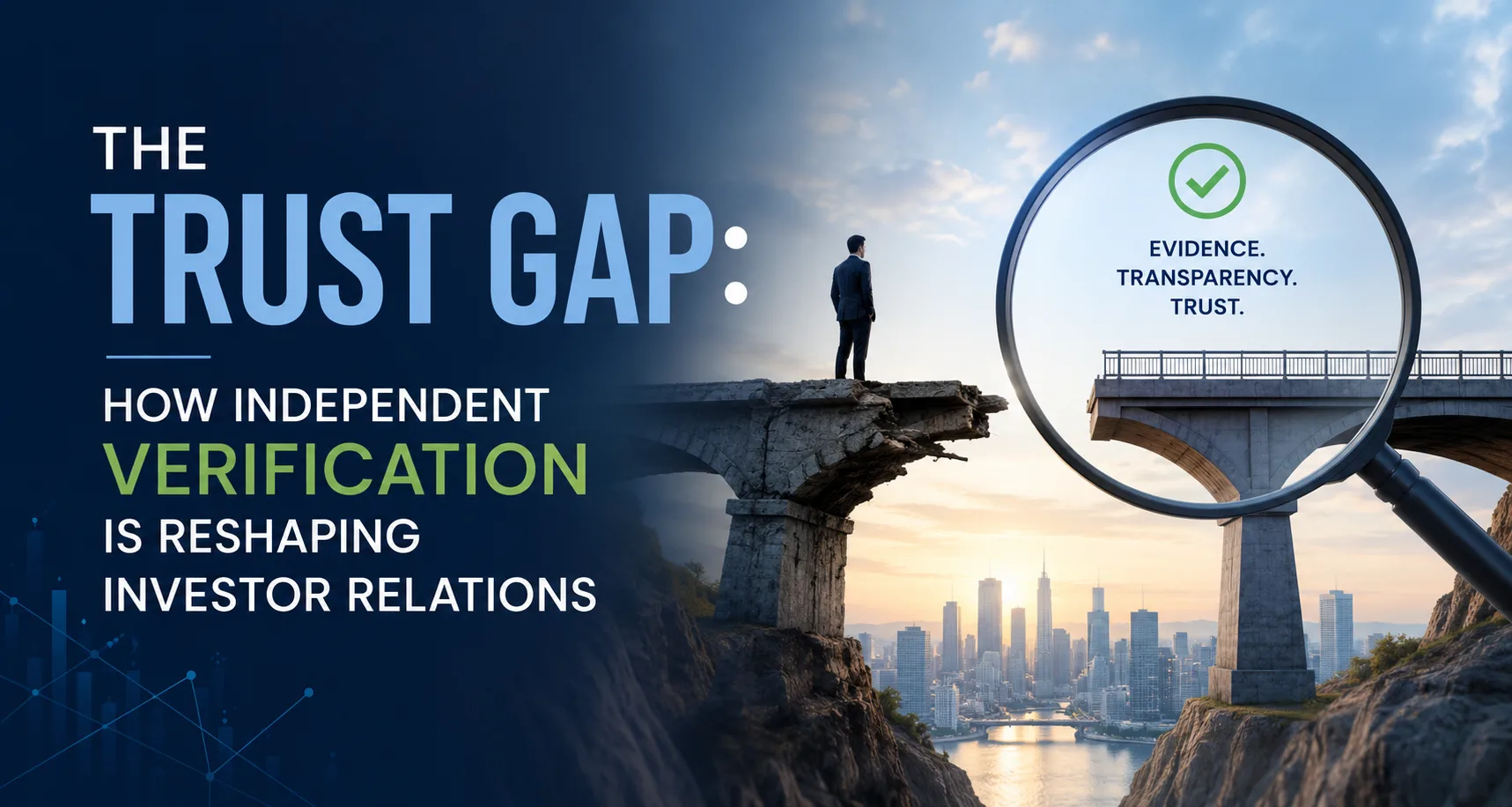
Investor confidence in sustainability reporting is under visible strain. Bold climate commitments are no longer sufficient to impact valuation and capital allocation decisions.
The emergence of ESG assurance and net zero verification demonstrates a fundamental change in what people expect. Financial markets require proof that sustainability claims will maintain their value under financial examination.
This situation has developed into a credibility assessment that determines how investors engage with companies, what capital costs they face, and what their reputation becomes over time.
Understanding the ESG Trust Gap: What It Is and Why It's Widening
Among 857 assessed climate leaders from 50 countries and 13 sectors, 34% have restated their climate targets, and of those restatements, 44% reflected reduced ambition or delayed timelines. [1]. Organizations need to report their climate risks because only 17% of them do this, and 8% of businesses have board control over their capital distribution for climate transition initiatives [1].
The trust gap begins at the point where people become ambitious, while they fail to take responsibility for their actions.
Investors will doubt the effectiveness of governance practices when financial connections stay unclear, and organizations change their targets. Greenwashing fear has evolved from a minor reputational issue into a fundamental component of institutional risk assessment.
Regulatory disclosure alone does not guarantee confidence. The absence of structured net-zero verification creates vulnerability to challenges against claims.
How Investors Are Actually Using ESG Assurance Data in Decision-Making
The Global Investor Survey 2025 by PwC surveyed 1,074 investment experts who work in 26 nations and handle investment portfolios worth more than 50 billion US dollars. [2] The investors requested three specific requirements, which included decision-making metrics that need external validation and documentation of their connection to business strategies and capital distribution.
The statement confirms that ESG assurance has developed from being an optional improvement to becoming a fundamental requirement.
The assurance status of a project now determines which screening filters and valuation inputs will be used. Companies with independently verified disclosures experience more constructive engagement postures.
The market offers a premium that enables better comparison between products. Assured data allows investors to benchmark across sectors with greater confidence, which decreases their analytical difficulties during portfolio construction.
The Net Zero Verification Credibility Crisis: Why Claims Alone No Longer Suffice
An unverifiable net-zero claim requires specific boundaries, interim targets, and financial distribution information to be considered valid. The transition narratives need transparent assumptions because their current state makes them seem unfeasible to execute.
The transition pathways that rating agencies and index providers examine now undergo increased verification scrutiny. The sustainability-linked financing eligibility and index inclusion process is affected by weak or unverified commitments.
The global increase in climate-related lawsuits creates a new trend that leads to independent verified disclosures that protect organizations by showing their strong governance systems and accurate data processes.
Businesses use net zero verification to protect themselves from reputational damage and financial risks that result from their environmental commitments.
What Effective ESG Assurance Actually Looks Like in an Investor Relations Context
Organizations achieve successful risk management when their operational processes align with their risk control frameworks. The scope must reflect investor materiality, not just regulatory minimums.
The integration of best practices by IR teams into their financial reports and capital markets presentations enables them to demonstrate control processes instead of making unverified claims.
The board placement brings high credibility to the organization. Investors view climate strategy as an operational strategy when directors manage sustainability reports and capital distribution processes.
The assurance process needs to assess future metrics whenever possible. The investors now demand information about transition preparation, together with details about past emissions.
From Trust Gap to Trust Advantage: The Strategic Opportunity in ESG Assurance
Seventy percent of companies reporting under ISSB or CSRD frameworks state that their sustainability reporting generates significant or moderate strategic business value beyond compliance [3]. Most early disclosures, however, remain concentrated on risk and impact instead of demonstrating full opportunity assessment [3].
The information shows that people now think about this matter differently. ESG assurance functions as more than a financial expense for organizations. The system functions as a tool that organizations use to extract operational insights from their structured data systems.
The assured data leads to better capital distribution decisions, enhanced communication with stakeholders, and decreased investor relations problems. The market shows a scarcity of trust, which makes credibility more valuable.
The early adopters who implement net zero verification will create stronger connections with investors before the upcoming regulatory changes take effect.
Conclusion
The ESG trust gap exists as a real, measurable phenomenon that affects financial investments. Investor doubts have increased because of weak governance signals and restated targets.
Serious climate commitments need independent ESG assurance and structured net-zero verification to establish their credibility. Companies must back their sustainability commitments with verifiable financial evidence, not just narrative claims.
Ready to close the trust gap? Earthood's independent ESG assurance and net zero verification services help organizations move from unverified claims to credible, investor-grade disclosures. Partner with Earthood to strengthen your investor relations and build the climate credibility your stakeholders demand.