
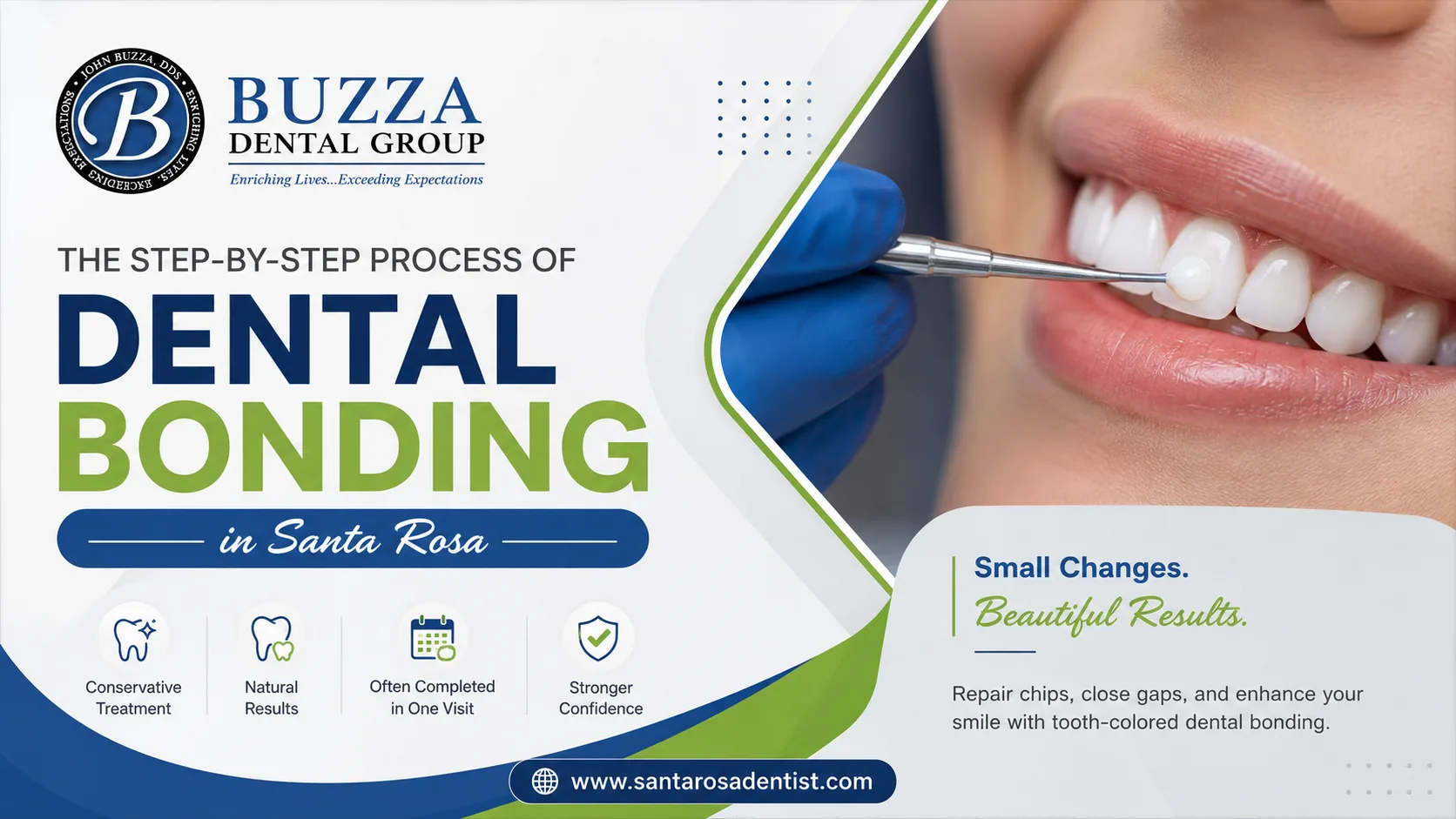
Dental bonding Santa Rosa is a conservative restorative and cosmetic treatment that uses tooth-colored composite resin to repair minor chips, reshape teeth, close small spaces, or improve the appearance of discoloration. Unlike veneers or crowns, bonding generally requires little or no removal of healthy tooth structure and can often be completed in a single visit.
For patients in Santa Rosa and surrounding Sonoma County communities, the appeal is straightforward: dental bonding can address relatively small aesthetic or structural concerns without committing to a more extensive restoration. However, the material, technique, tooth condition, bite, and patient's oral-health habits all influence the result. Understanding what happens during the procedure helps patients determine whether bonding is appropriate for their specific concern.
Key Takeaways
- Dental bonding uses tooth-colored composite resin that is adhesively attached to the tooth.
- The process typically involves shade selection, tooth preparation, resin placement, curing, shaping, and polishing.
- Bonding is often suitable for minor chips, gaps, shape irregularities, and selected discoloration.
- It is generally more conservative than porcelain veneers or dental crowns.
- Longevity depends on factors such as bite forces, oral hygiene, material selection, and the location of the restoration.
What Is Dental Bonding?
Dental bonding is a direct restorative procedure in which a dentist applies composite resin to the tooth and shapes it to achieve the desired function or appearance. The material is hardened with a curing light and then refined and polished.
Because the composite is placed directly onto the tooth, the dentist can make highly localized changes. For example, a small chipped edge can be rebuilt without preparing the entire visible surface for a veneer.
Dental bonding may be considered for:
- Minor chips or cracks
- Small spaces between teeth
- Slightly irregular tooth shapes
- Selected areas of discoloration
- Teeth that appear short or uneven
- Certain small cavities or restorative defects
Clinical guidelines also recognize direct composite as a viable option for various restorative indications and tooth-shape corrections when appropriate adhesive and contamination-control techniques can be achieved.
The Step-by-Step Dental Bonding Process
1. Examination and treatment planning
The first step is determining whether bonding addresses the underlying problem rather than simply covering it.
A dentist examines the tooth, surrounding gums, bite, existing restorations, and overall oral health. If decay, significant structural damage, or another underlying condition is present, that issue may need to be treated first.
This distinction matters because bonding is best suited to problems that can be predictably managed with a relatively conservative composite restoration.
2. Selecting the composite shade
For visible teeth, shade matching is an important part of the procedure.
The dentist selects a composite resin that blends with the surrounding tooth structure. The goal is not merely to choose a generic “white” material but to create a restoration that integrates visually with the patient's existing teeth.
Shade selection can become particularly important when bonding is being used on a front tooth or alongside other cosmetic dentistry.
3. Preparing the tooth surface
The tooth is cleaned and prepared so the composite can adhere effectively.
Depending on the procedure, the dentist uses an etching and adhesive protocol to create the conditions necessary for bonding. The exact adhesive system and technique can vary, but contamination control is critical because moisture or other contaminants can compromise adhesive performance.
Unlike many crown procedures, dental bonding usually does not require extensive removal of healthy enamel.
4. Applying the composite resin
The composite begins as a moldable material. The dentist places it directly onto the prepared tooth and builds the desired shape.
This is where the procedure becomes highly individualized. The dentist can add small amounts of material to recreate a chipped edge, modify tooth contours, or close a limited space.
Rather than simply covering the tooth, the composite is sculpted to reproduce appropriate anatomy and proportions.
5. Curing the material
Once the composite has been positioned correctly, a dental curing light hardens it.
This converts the moldable resin into a firm restoration that is bonded to the tooth. Cleveland Clinic describes curing as a standard stage of dental bonding after the composite has been shaped.
Depending on the amount and location of composite being placed, the dentist may build and cure the restoration incrementally.
6. Shaping and refining
After curing, the dentist evaluates the restoration's contour and relationship with neighboring teeth.
Excess material can be removed, and the composite can be refined to achieve a natural shape. For teeth involved in biting, the dentist also needs to consider the patient's occlusion—the way upper and lower teeth contact one another.
This step is particularly important when treating a chipped front tooth or modifying tooth length. A restoration that looks good but interferes with the bite may be exposed to unnecessary forces.
7. Polishing and final evaluation
The final stage involves polishing the composite to create a smoother surface and evaluating the appearance and function.
The dentist may check:
- Color integration
- Tooth proportions
- Surface smoothness
- Bite contacts
- Contact with neighboring teeth
- Overall symmetry
The finished result should complement the natural tooth rather than appear like an isolated piece of material.
How Long Does Dental Bonding Last?
There is no universal lifespan for dental bonding because clinical longevity varies considerably with the type of restoration, location, material, technique, and patient factors.
A 2026 umbrella review of systematic reviews found that longevity of direct dental restorations is influenced by material class, adhesive strategy, and patient risk profile. It reported more than 90% five-year survival for conventional composite restorations in the populations and indications analyzed, although those findings should not be interpreted as a guarantee for an individual cosmetic bonding case.
Front-tooth bonding can also be affected by habits such as biting hard objects, nail biting, or using teeth as tools. Regular dental examinations allow a dentist to identify wear, marginal problems, or small defects before they become larger concerns.
Dental Bonding vs. Veneers and Crowns
Bonding is not automatically the best alternative to every cosmetic or restorative treatment.
Porcelain veneers Santa Rosa CA are thin, custom-made restorations designed primarily to alter the visible surface of teeth. They may be considered when a patient wants broader changes in color, shape, or appearance.
Dental crowns Santa Rosa CA cover a much greater portion of a tooth and are generally used when a tooth requires more substantial structural protection or restoration.
Bonding is typically more conservative because composite can be added directly to the tooth. The appropriate choice depends on how much healthy tooth structure remains, the size and location of the defect, bite forces, cosmetic goals, and the expected functional demands.
What About Tooth-Colored Fillings?
Dental bonding and tooth colored fillings Santa Rosa CA use similar composite-resin technology, but their purposes can differ.
A tooth-colored filling primarily restores tooth structure lost through decay or damage. Cosmetic bonding may instead modify tooth shape, close a small gap, or repair a minor visible defect.
In some cases, the distinction overlaps because composite resin can serve both restorative and cosmetic purposes.
How Can Patients Protect Dental Bonding?
Good maintenance begins with normal preventive dental care.
Patients should:
- Brush twice daily with fluoride toothpaste.
- Clean between teeth regularly.
- Attend recommended dental examinations.
- Avoid biting hard non-food objects.
- Address teeth grinding or clenching with a dentist.
- Follow any specific instructions provided after treatment.
Composite restorations can also develop staining or surface changes over time. The risk varies by material and individual habits, so maintenance should be considered part of the treatment decision rather than an afterthought. Recent research continues to examine the clinical complications and longevity factors associated with direct composite restorations.
Frequently Asked Questions
Is dental bonding painful?
Dental bonding is generally considered a minimally invasive procedure, and anesthesia may not be necessary for every case. If bonding is being combined with treatment for decay or another procedure, the dentist may recommend local anesthesia depending on the circumstances.
Can bonding fix a chipped tooth?
Yes. Minor chips are one of the common applications for composite bonding. The dentist can add resin to the damaged area, sculpt the missing contour, cure the material, and polish the restoration to blend with the tooth.
Is dental bonding reversible?
Bonding is generally considered more conservative and reversible than porcelain veneers because it typically requires little alteration of the natural tooth. However, removing or replacing an existing bonded restoration should still be performed by a dental professional.
Can bonding close gaps between teeth?
Small spaces between teeth can sometimes be closed with composite resin. Suitability depends on the size and location of the gap, tooth proportions, bite, gum health, and the reason the space exists.
Is bonding better than porcelain veneers?
Neither is universally better. Bonding is generally more conservative and easier to modify, while porcelain veneers can provide a durable, highly customized cosmetic surface. The choice depends on the patient's tooth structure, goals, bite, and long-term treatment plan.
Conclusion
The dental bonding Santa Rosa process is relatively straightforward, but its success depends on much more than applying tooth-colored resin. Proper diagnosis, shade selection, adhesive technique, composite placement, bite evaluation, finishing, and maintenance all contribute to the final result.
For patients considering bonding, the most useful first question is not simply whether the procedure is available, but whether composite resin is the right material for the specific tooth and problem. A personalized evaluation can help distinguish cases appropriate for bonding from those better suited to veneers, fillings, crowns, orthodontic treatment, or another restorative approach.
For additional information about dental bonding and related treatment options in Santa Rosa, patients can review the practice's dedicated dental bonding resource.