Cat nutrition is a subject where popular belief and biological reality diverge sharply. Walk through any pet store and you'll find bags of grain-free kibble marketed as "natural," wet food in pouches decorated with garden vegetables, and supplement stacks that look like they were designed for a human gym-goer. None of this maps cleanly onto what cats actually need.
This is not a guide about which brand to buy. It's a breakdown of the underlying biology, what the evidence says about feeding cats well, and where the most common mistakes are made.
The Obligate Carnivore Biology
The designation "obligate carnivore" is functional, not aesthetic. Cats' metabolic pathways are permanently calibrated for animal protein. Unlike dogs — who are facultative carnivores and can adapt to a range of dietary inputs — cats cannot shift their metabolism in response to different macronutrient ratios.
A widely cited study on feral cat dietary self-regulation found that cats naturally calibrate their intake to approximately 52% protein, 36% fat, and 12% carbohydrate by metabolisable energy. This mirrors the macronutrient composition of small prey animals. Commercial dry cat food typically inverts this, with carbohydrates comprising 30–50% of formula energy.
Adult cats also require two to three times the protein intake of most other adult mammals. Their liver enzymes responsible for protein catabolism run at maximum rate continuously, unlike in most animals where these enzymes down-regulate during low-protein intake. Cats cannot adapt to low-protein diets by conserving amino acids. They simply deplete them.
The Nutrients Cats Cannot Synthesise
Three nutrients are categorically unavailable from plant sources in the form cats require:
Taurine is the most clinically significant. Cats lack the enzyme activity to synthesise taurine from its precursors at sufficient levels. Taurine deficiency causes dilated cardiomyopathy (DCM), a progressive weakening of the heart muscle, and central retinal degeneration leading to blindness. Both conditions were common in cats before taurine was mandated in commercial cat food in the 1980s following a major epidemic of feline DCM.
Preformed Vitamin A cannot be converted from beta-carotene in cats — they lack the intestinal enzyme beta-carotene dioxygenase. While dogs and humans can convert plant-based carotenoids into retinol, cats cannot. They require preformed vitamin A from animal liver. Deficiency leads to skin disorders, night blindness, reproductive failure, and growth retardation.
Arachidonic Acid (AA) is an omega-6 fatty acid that cats cannot synthesise from linoleic acid. It is essential for reproduction, platelet function and inflammatory processes. It is found only in animal fat and not in plant oils.
Protein Quality and Source Selection
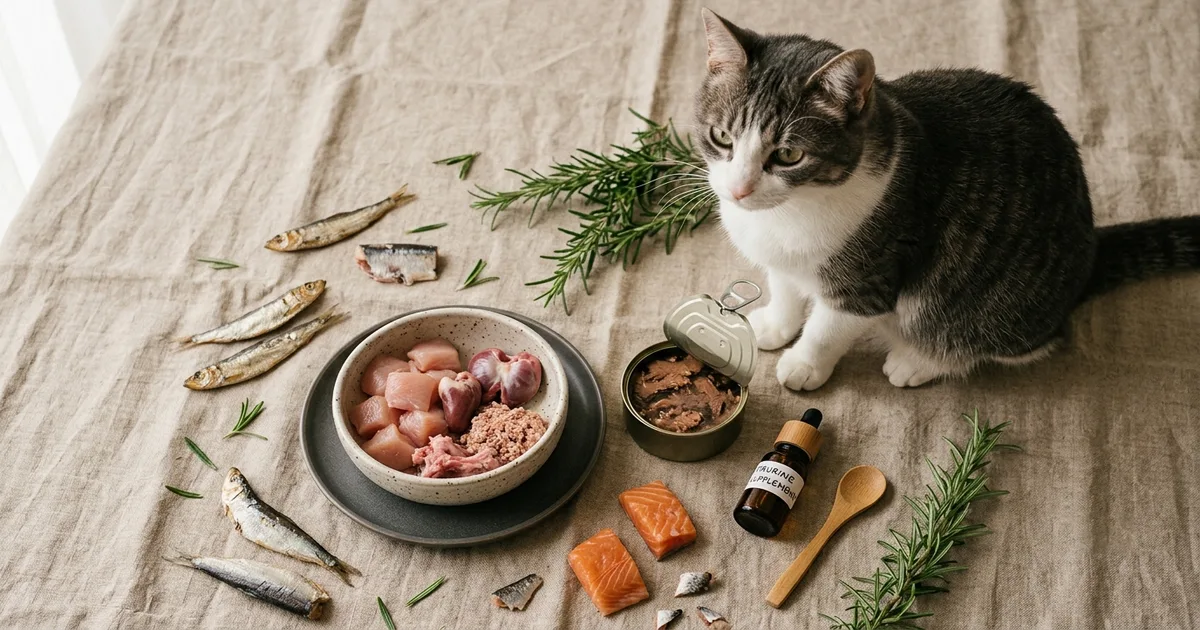
Not all animal protein is equivalent. Digestibility, amino acid profile, and bioavailability vary significantly between protein sources. Chicken and turkey are broadly well-tolerated, lean, and high in bioavailable essential amino acids including lysine and methionine. They represent the most common primary proteins in veterinary-recommended commercial formulas.
Fish, especially salmon, are also a good source of protein and a rich source of EPA and DHA omega-3 fatty acids. These long chain fatty acids help maintain skin integrity, coat quality and retinal function. But fish as a staple in the diet is not without its disadvantages. Some species accumulate mercury to high levels; thiamine is destroyed in raw fish, and there is a risk of nutritional imbalances at high feeding rates.
Fish should complement a diet rather than define it.
Beef is a nutritionally dense protein but ranks as one of the most common food allergens in cats, alongside chicken and fish. Food allergies can develop to any protein after sustained exposure — a phenomenon that surprises many owners who assume long-term tolerance equals permanent tolerance.
What the Evidence Says About Wet vs. Dry Food
Cats evolved in arid environments and obtained most of their water from prey. Their thirst drive is correspondingly weak compared to dogs. A cat eating dry food exclusively may consume as little as half the moisture intake of a cat eating wet food, even if water is freely available. This matters clinically because chronic mild dehydration is a primary risk factor for feline lower urinary tract disease (FLUTD) and chronic kidney disease (CKD), two of the most prevalent conditions in domestic cats.
A 2016 review in the Journal of Feline Medicine and Surgery noted that increased water intake was consistently associated with reduced risk of urolithiasis and urinary tract infections. Wet food is the most reliable mechanism for increasing water intake in cats, as most cats will not consistently drink from a bowl to compensate for low-moisture food.
Dry food is not categorically inferior. Its lower moisture content increases caloric density, which aids portion control. Kibble also creates mild abrasive contact with tooth surfaces during chewing, though the dental benefit is modest compared to dedicated dental formulas.
The evidence-supported recommendation for most cats: wet food as the dietary foundation, dry food as a supplement for convenience and structure. For cats with existing urinary or kidney disease, wet food should be the priority.
Diagnosing and Managing Food Allergies
Food allergy is an immune-mediated reaction to a specific dietary protein, distinct from food intolerance, which is a non-immunological adverse response. Clinically, the two often present similarly: gastrointestinal signs (vomiting, diarrhoea), dermatological signs (pruritus, particularly periocular, periauricular, and facial regions), and behavioural changes linked to chronic discomfort.
The critical diagnostic challenge is that food allergies in cats are perennial, not seasonal. This distinguishes them from environmental allergies but means owners often don't identify food as the cause, especially when symptoms are intermittent.
The WSAVA and major feline medicine authorities are unambiguous: serum allergy testing and intradermal testing are unreliable for food allergy diagnosis in cats. The only validated diagnostic approach is a strict dietary elimination trial using a novel protein or hydrolysed protein diet, conducted under veterinary supervision for a minimum of 8 to 12 weeks, followed by challenge with the original diet to confirm the reaction.
Supplements: When They’re Necessary and Why They Matter
Nutritionally complete commercial cat meals that fulfill AAFCO criteria are formulated. Supplementation is usually not necessary for a healthy adult cat consuming a single, well-formulated diet.
There are gaps in several situations: homemade diets without a professional balance, rotation feeding of items with different taurine levels, senior cats with changed nutrient absorption, and cats with special diseases that have an effect on nutrient metabolism.
In these cases, targeted supplementation with taurine, marine-sourced omega-3 fatty acids (EPA and DHA, not ALA from flaxseed), and preformed vitamin A may be appropriate. The key qualification is species-specific formulation. Dosages calibrated for dogs are not appropriate for cats. Several dog supplements also contain xylitol or other ingredients toxic to cats.
For cat owners considering supplementation, KittySupps provides a curated range of cat-specific, third-party tested products formulated for feline physiology rather than adapted from broader pet supplement lines.
The Practical Bottom Line
Cat nutrition comes down to a small number of well-evidenced principles: animal protein as the dietary foundation, moisture intake as a non-negotiable health factor, awareness of key nutrients that cannot be synthesised, and vigilance for signs of food allergy.
The biology is not especially complicated once understood. The challenge is that cat food marketing is designed to appeal to human aesthetics — fresh vegetables, natural ingredients, holistic formulas — rather than to communicate feline nutritional science. Reading past the packaging to the label, and knowing what each element means, is the skill that matters.