
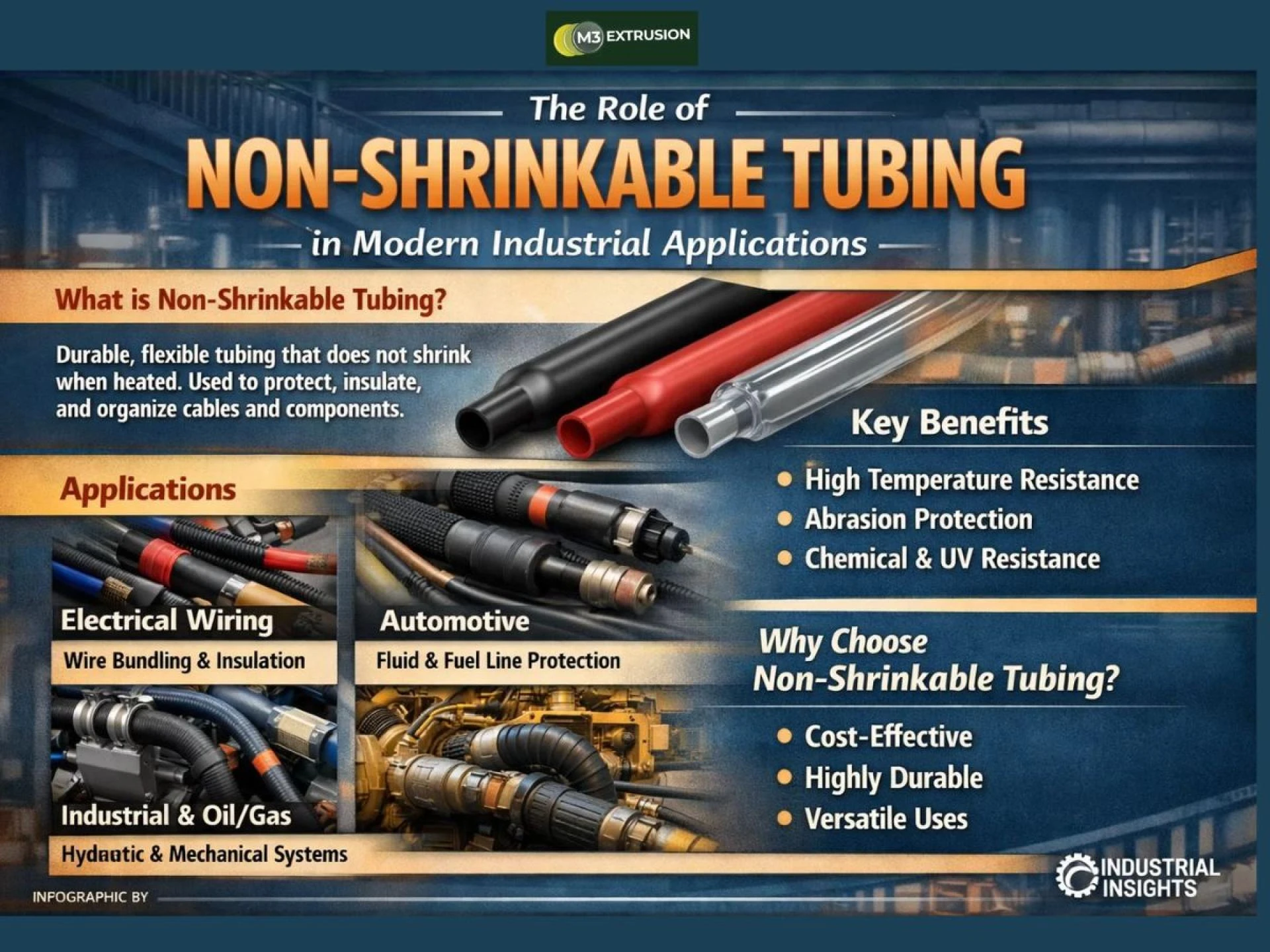
In many industrial environments, protecting cables, pipes, and mechanical parts is not optional. It is a basic safety and performance requirement. This is where non-shrinkable tubing in India plays a critical role. Unlike heat-shrink products, this tubing keeps its original size and shape, offering stable protection in fixed installations and demanding conditions.
Industries today rely on non-shrinkable tubing for safety, insulation, and long-term reliability. Its use is growing across electrical, automotive, construction, and heavy manufacturing sectors where consistency matters more than flexibility.
What Is Non-Shrinkable Tubing?
Non-shrinkable tubing is a rigid or semi-rigid protective tube that does not change size when exposed to heat. It is manufactured through extrusion and supplied in fixed diameters and wall thicknesses.
Direct answer
Non-shrinkable tubing is used where dimensional stability is required and heat shrink behaviour could affect performance or safety.
Common materials include:
- PVC
- Polycarbonate
- Polyethylene
- Engineering grade plastics
These materials are selected based on insulation needs, mechanical strength, and environmental exposure.
Why Non-Shrinkable Tubing Is Important in Industrial Settings
Industrial systems often operate continuously and under stress. Components must stay protected without relying on heat activation or post installation processing.
Key reasons industries prefer non-shrinkable tubing
- Maintains fixed diameter and length
- Supports predictable assembly processes
- Provides consistent insulation and protection
- Reduces installation time and errors
In India, manufacturing plants favour solutions that reduce rework and downtime. This makes non-shrinkable tubing in India a practical choice for long production runs.
Common Industrial Applications of Non-Shrinkable Tubing
Electrical and Power Systems
Used for cable insulation, wire bundling, and terminal protection. Non-shrinkable tubing prevents abrasion and electrical leakage in control panels and switchgear.
Automotive and Transport
Applied in wiring harnesses, sensor protection, and fuel line routing. Its stable shape helps maintain spacing and reduces vibration related damage.
Construction and Infrastructure
Supports conduit protection, edge guarding, and embedded cable systems. Fixed size tubing simplifies installation in concrete and metal structures.
Machinery and Equipment
Protects moving parts, pneumatic lines, and mechanical joints from dust, moisture, and wear.
Non-Shrinkable Tubing for Industrial Safety
Industrial safety standards require materials that behave predictably. Non-shrinkable tubing for industrial safety supports this need by offering stable protection without heat dependency.
How it improves safety
- Eliminates risks linked to improper heat application
- Prevents deformation in high temperature zones
- Maintains clearance between electrical components
- Reduces chances of insulation failure
For plants following ISO and internal safety audits, fixed dimension tubing supports compliance and repeatable safety outcomes.
Benefits of Using Non-Shrinkable Tubing in India
1. Consistent Performance in Local Conditions
Indian industrial environments often face heat, dust, and humidity. Non-shrinkable tubing holds shape and strength under these conditions.
2. Faster Assembly and Installation
Since no heating step is required, installation becomes quicker and easier for technicians.
3. Cost Control Over Long Runs
Reduced labour time and fewer installation errors help control overall production costs.
4. Reliable Supply for Bulk Production
Manufacturers prefer tubing that can be supplied in bulk with consistent dimensions for repeat use.
How Non-Shrinkable Tubing Is Manufactured
The tubing is produced through an extrusion process where molten plastic is shaped through a die and cooled to retain its form.
Manufacturing factors that affect performance
- Material grade and formulation
- Wall thickness tolerance
- Inner and outer diameter accuracy
- Surface finish
Industrial buyers often request tubing based on drawings or technical data to ensure compatibility with existing systems.
Choosing the Right Non-Shrinkable Tubing
Selecting the correct tubing depends on application and environment.
Consider these points before selection
- Electrical insulation requirement
- Exposure to heat, oil, or chemicals
- Mechanical stress and movement
- Required length and diameter consistency
Direct answer
For industrial use, non-shrinkable tubing should be chosen based on function first, not appearance.
Use Case Example from Indian Manufacturing
In a mid-size electrical panel manufacturing unit in western India, switching from heat shrink to non-shrinkable tubing reduced installation time by nearly 20 percent. The fixed size tubing also lowered rejection rates caused by uneven shrinkage, improving overall production efficiency.
This reflects why demand for non-shrinkable tubing in India is increasing among OEMs and system integrators.
Supporting Industrial Production with Custom Tubing
Some applications require tubing with specific dimensions, colours, or material properties. Custom extrusion allows manufacturers to meet these needs without compromising safety or performance.
M3 Extrusion supplies non-shrinkable tubing produced to technical specifications for industrial applications. The focus remains on dimensional stability, bulk supply, and repeat production support for manufacturing environments.
Frequently Asked Questions
What is non-shrinkable tubing used for in industry?
Non-shrinkable tubing is used to protect cables, pipes, and components where fixed dimensions are required. It provides insulation, abrasion resistance, and mechanical protection without changing size, making it suitable for electrical panels, machinery, and infrastructure systems.
Why is non-shrinkable tubing preferred over heat shrink in some cases?
Non-shrinkable tubing is preferred when heat application is not practical or safe. It avoids risks related to uneven shrinking, saves installation time, and ensures consistent spacing and insulation in sensitive industrial assemblies.
Is non-shrinkable tubing suitable for high-temperature environments?
Certain grades of non-shrinkable tubing are designed to handle elevated temperatures. Material selection is important, and industrial grade plastics are commonly used to maintain performance under heat exposure without deformation.
How is non-shrinkable tubing supplied in India?
Non-shrinkable tubing in India is commonly supplied in standard lengths or cut to requirement. Bulk supply is available for repeat manufacturing and long term industrial use, supporting consistent production needs.
Can non-shrinkable tubing be customised?
Yes, non-shrinkable tubing can be customised by diameter, wall thickness, material type, and colour. Customisation is often based on drawings or technical specifications to match specific industrial applications.
Conclusion
Non-shrinkable tubing has become an essential component in modern industrial systems. Its ability to provide stable protection, improve safety, and support efficient assembly makes it a practical choice across industries. As manufacturing standards continue to rise, the role of non-shrinkable tubing in India will only become more important for safe and reliable industrial operations.