Cloud-native development has become a defining approach for modern software delivery. Organizations across industries are embracing containers, microservices, continuous integration, and automated infrastructure to improve agility and scalability. However, adopting cloud-native DevOps is not just a technical shift—it requires operational maturity, cultural change, and sustained expertise.
For many companies, especially those with complex legacy environments or limited in-house resources, external support plays a critical role. This is where Managed IT services become a strategic enabler rather than a simple outsourcing model.
Below is an in-depth look at how managed service providers help organizations successfully adopt and scale cloud-native DevOps practices in the IT industry.
Understanding Cloud-Native DevOps in the Enterprise Context
Cloud-native DevOps combines cloud-first architectures with DevOps principles such as collaboration, automation, and continuous improvement. Instead of deploying monolithic applications on fixed infrastructure, teams build loosely coupled services that can be deployed independently and scaled dynamically.
For enterprises, this transition often introduces challenges that go beyond tooling. Legacy systems may not integrate cleanly with container platforms. Security and compliance requirements can slow down automation initiatives. Teams accustomed to traditional IT operations may struggle with shared responsibility models. As a result, cloud-native DevOps adoption requires not only modern platforms but also consistent operational processes, governance, and skills development.
Managed service providers bring experience from multiple cloud-native transformations. They understand common pitfalls, proven reference architectures, and realistic adoption paths. By aligning DevOps practices with business goals, they help enterprises move from experimentation to production-grade environments without disrupting ongoing operations.
How Managed IT Providers Enable Cloud-Native DevOps Adoption
Managed IT providers act as an extension of internal teams, offering structured support across infrastructure, platforms, and processes. Their involvement typically begins with an assessment phase, where existing systems, workflows, and constraints are evaluated. This assessment forms the basis for a cloud-native roadmap that balances innovation with risk management.
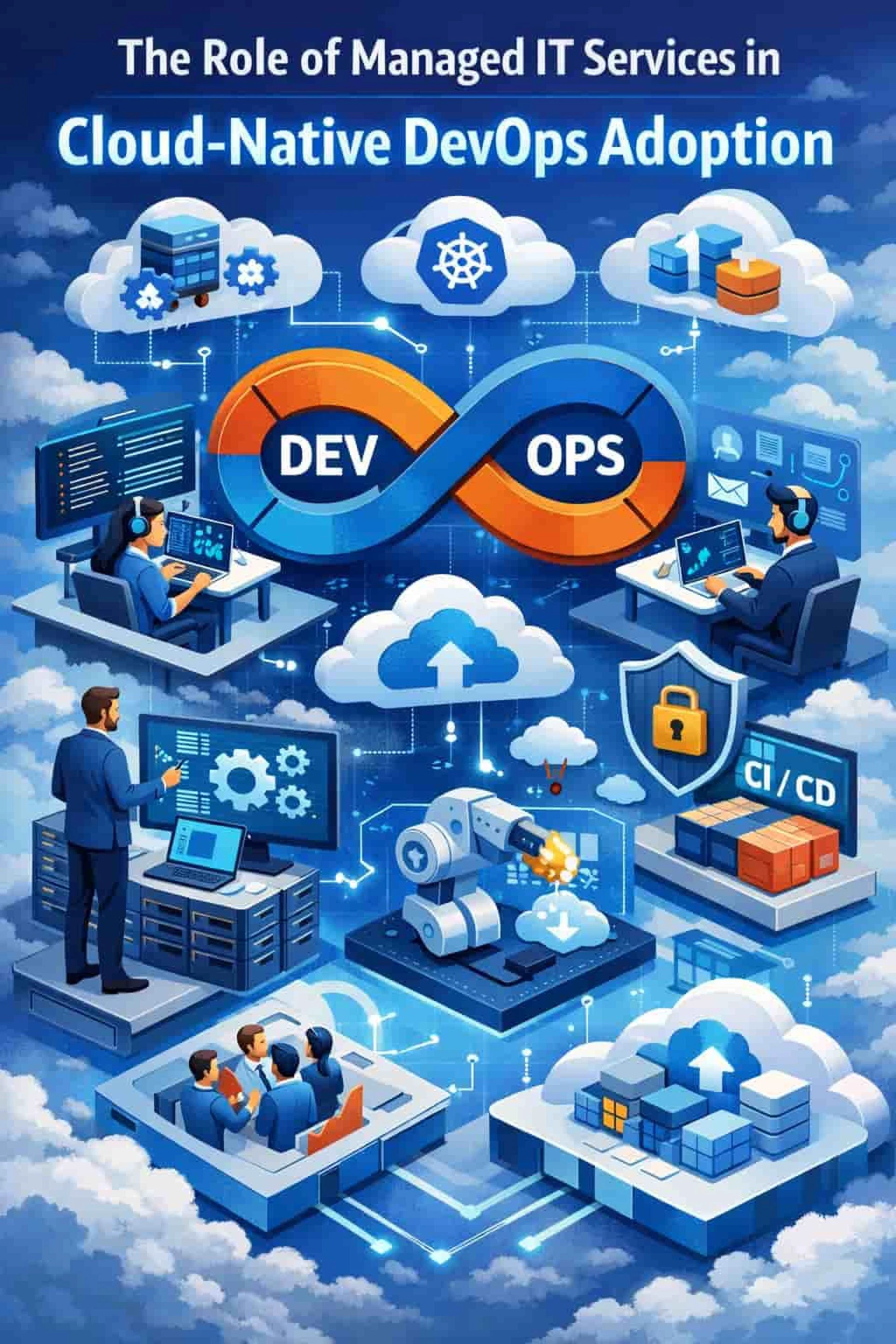
One key contribution is platform engineering. Managed providers design and operate standardized environments for container orchestration, CI/CD pipelines, and cloud infrastructure. Instead of each development team building its own toolchain, a shared platform reduces complexity and accelerates onboarding. This approach allows developers to focus on application logic while operational concerns are handled consistently.
Another critical area is automation. Providers implement infrastructure-as-code, automated testing, and deployment pipelines that support rapid iteration without sacrificing stability. Automation also improves auditability and repeatability, which are essential in regulated industries. Over time, these practices help organizations achieve predictable release cycles and faster time to market.
Equally important is knowledge transfer. Managed providers do not simply “run” systems; they collaborate with internal teams through documentation, workshops, and shared responsibility models. This ensures that cloud-native DevOps capabilities mature internally rather than remaining dependent on external support.
Operational Benefits of Managed IT Services in DevOps Environments
Once cloud-native DevOps practices are in place, ongoing operations determine long-term success. Managed service providers deliver value by ensuring that platforms remain reliable, secure, and cost-effective as usage grows.
Availability and performance are top priorities. Providers offer 24/7 monitoring, proactive incident response, and capacity planning. In cloud-native environments where failures are expected and tolerated, rapid detection and recovery are essential. Managed operations teams bring established runbooks and experience handling distributed systems at scale.
Security is another major concern. Cloud-native architectures increase the attack surface due to their dynamic nature. Managed providers integrate security controls into the DevOps lifecycle, including vulnerability scanning, policy enforcement, and identity management. This “security by design” approach reduces risk without slowing down development teams.
Cost optimization also becomes more manageable with external expertise. Cloud-native environments can scale rapidly, sometimes leading to unexpected expenses. Managed providers analyze usage patterns, optimize resource allocation, and recommend architectural changes that balance performance with cost efficiency. This financial governance helps organizations maintain control as adoption expands.
DevOps Tooling, Automation, and Governance at Scale
As organizations grow their cloud-native footprint, consistency becomes a challenge. Different teams may adopt different tools, workflows, or deployment strategies, leading to fragmentation. Managed providers address this by defining reference architectures and governance frameworks that support flexibility within clear boundaries.
Tooling standardization is a common focus area. Providers select and maintain CI/CD platforms, container registries, monitoring solutions, and configuration management tools that integrate seamlessly. While teams retain autonomy over application design, shared tooling ensures interoperability and reduces operational overhead.
Governance in cloud-native DevOps does not mean rigid control. Instead, it emphasizes guardrails that enable safe innovation. Managed providers implement policies for access control, resource usage, and compliance that are enforced automatically through code. This approach aligns with modern DevOps principles by embedding governance into pipelines rather than relying on manual approvals.
In many cases, providers also help organizations adopt advanced practices such as GitOps, chaos engineering, and service mesh architectures. These techniques further improve resilience and observability but require specialized expertise. External support allows enterprises to adopt them incrementally and confidently.
Strategic Value of Partnering for Cloud-Native Transformation
Beyond technical execution, managed service providers contribute strategic value to cloud-native DevOps adoption. They help align technology initiatives with broader business objectives such as scalability, customer experience, and innovation speed.
For example, providers can support multi-cloud or hybrid strategies that reduce vendor lock-in while maintaining operational consistency. They can also advise on organizational models that encourage collaboration between development, operations, and security teams. This holistic perspective is particularly valuable in large IT organizations where change management is as important as technology selection.
Over time, the relationship often evolves from operational support to strategic partnership. Providers become trusted advisors who guide platform evolution, evaluate emerging technologies, and continuously refine DevOps practices. This long-term collaboration enables organizations to stay competitive in a rapidly changing IT landscape while maintaining stability and control.
It is worth noting that successful partnerships require clear expectations and shared accountability. Organizations must define goals, metrics, and communication models upfront. When done correctly, managed providers complement internal teams rather than replacing them, creating a balanced model that supports sustainable cloud-native growth.
Conclusion
Cloud-native DevOps adoption is a complex journey that extends beyond tools and infrastructure. It demands operational excellence, security awareness, and continuous improvement. Managed service providers play a crucial role in this process by offering expertise, standardized platforms, and reliable operations that accelerate adoption while reducing risk.
By supporting automation, governance, and ongoing optimization, managed providers enable organizations to realize the full benefits of cloud-native development. When combined with a clear strategy and strong internal collaboration, this approach creates a foundation for scalable, resilient, and innovative IT systems. In this context, DevOps solutions become not just a set of practices, but a sustainable operating model that supports long-term business success.