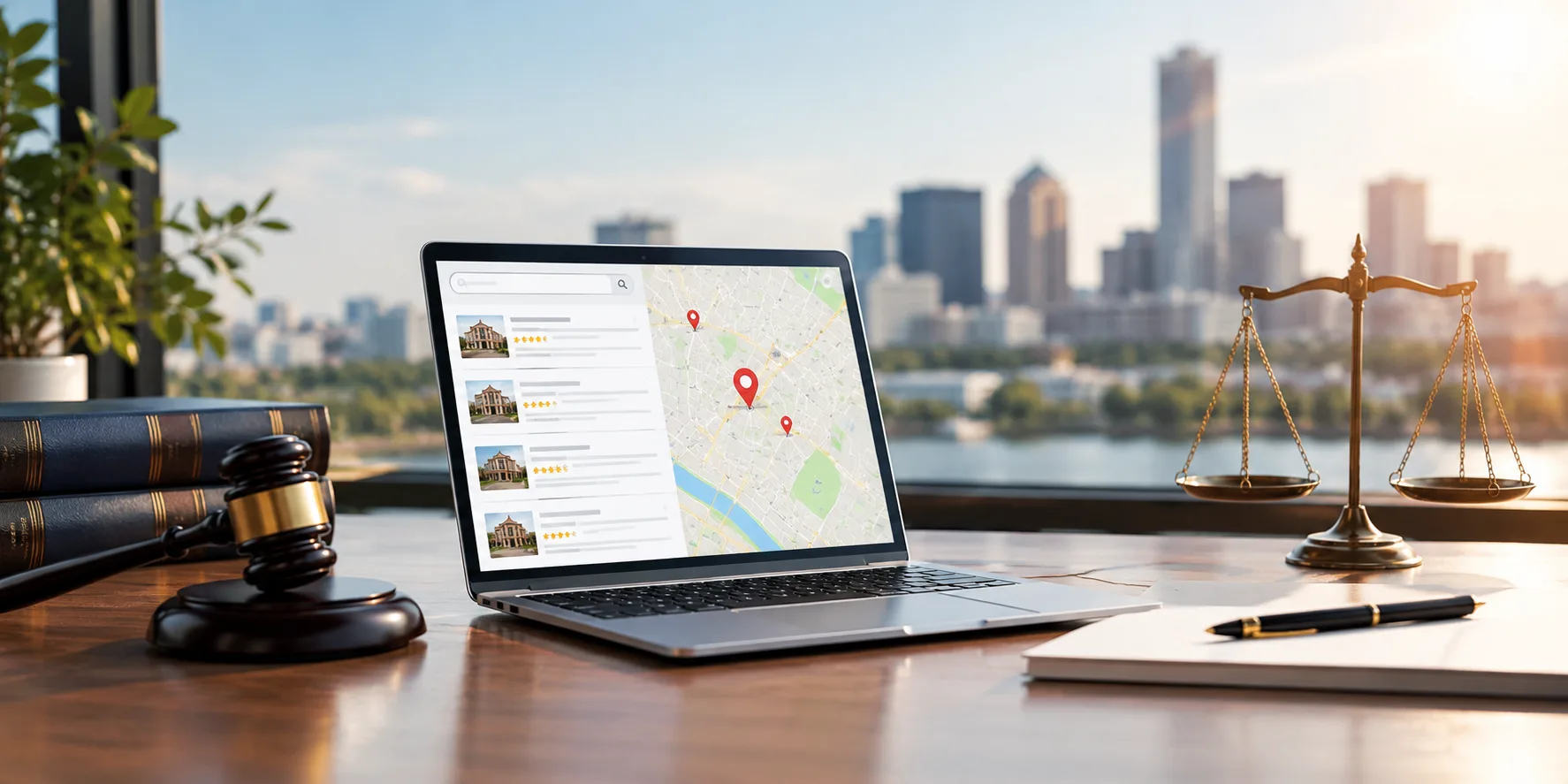
When someone needs a lawyer, the search often starts locally. People may search for “personal injury lawyer near me,” “divorce attorney in Dallas,” “workers’ compensation lawyer in Chicago,” or “family law firm near me.” These searches can produce traditional organic results, Google Maps listings, and the local 3-Pack.
For law firms competing in local markets, a strong online presence requires more than a well-designed website. Search engines need reliable information about the firm's identity, location, legal services, attorneys, and professional presence. Legal citations can help establish this information across relevant online sources.
What Are Legal Citations?
A legal citation is an online mention or profile that references a law firm's business information. These references can appear on legal directories, local business websites, professional organizations, review platforms, publications, and other authoritative resources.
A citation may contain information such as:
- Website URL
- Practice areas
- Business category
- Office hours
- Service areas
- Attorney profiles
- Professional credentials
- Reviews
- Business descriptions
For example, a personal injury law firm may have profiles on legal directories, local business websites, professional organizations, review platforms, and other authoritative resources. Each legitimate profile creates another online reference that can help people discover and understand the firm.
Structured and Unstructured Legal Citations
Legal citations can generally be divided into two types: structured and unstructured.
Structured citations usually appear in directory-style listings with specific fields for business name, address, website, category, description, and other business details.
Unstructured citations may appear in news articles, interviews, local publications, sponsorship pages, professional profiles, community resources, or other online content.
The value of a citation depends on several factors, including the quality, relevance, authority, accuracy, and context of the source. A smaller number of highly relevant and trustworthy citations can be more useful than hundreds of low-quality listings.
Why Legal Citations Matter for Local SEO
Local SEO helps businesses become visible when people search for services associated with a particular location.
For law firms, this is especially important because legal services are commonly associated with cities, counties, states, and communities. Potential clients may search for:
- Personal injury lawyer in Houston
- Family lawyer in Phoenix
- Divorce attorney near me
- Workers’ compensation attorney in Chicago
- Car accident lawyer in San Antonio
- Criminal defense attorney in Miami
Search engines need to understand what a business does and where it operates in order to provide relevant local results. Consistent information across legitimate online sources can help reinforce the firm's identity, location, services, and professional relationships.
The Importance of NAP Consistency
NAP refers to the core business identity information associated with a local business, traditionally including its name, address, and phone number.
For law firms, citation management should focus on keeping the firm's legitimate business information accurate and appropriately consistent across important websites and directories.
For example, if a firm's official information identifies it as:
Zealous Injury Lawyers
170 S Main St, Salt Lake City, UT 84101, United States
but major directories display an old address or substantially different business name, the firm's online information can become fragmented.
Common NAP Problems
Citation inconsistencies often occur after:
- Moving offices
- Rebranding
- Merging with another firm
- Changing websites
- Opening new locations
- Closing an office
- Changing ownership
- Updating practice areas
A citation audit can identify these problems and determine which information needs to be corrected.
How Citations Connect With Google Maps Visibility
Google explains that local search results are primarily influenced by relevance, distance, and prominence.
Relevance
Relevance refers to how closely a business matches what someone searches for.
A personal injury law firm should clearly and accurately communicate its legitimate practice areas across its website, Business Profile, and relevant professional listings.
Distance
Distance considers the relationship between the searcher and the business location or the location specified in the search.
Citations cannot eliminate geographic factors. A law firm should accurately represent its legitimate physical locations rather than attempting to create artificial geographic relevance.
Prominence
Prominence relates to how well-known a business is. Information from across the web, including directories, articles, links, and reviews, can contribute to how a business is understood.
A well-managed citation profile can therefore support the firm's broader local presence.
Legal Citations and the Google 3-Pack
The Google 3-Pack is the prominent local section that may appear for location-based searches.
For example, someone searching for “personal injury attorney in Denver” may see three local law firms alongside a map before traditional organic results.
Visibility in this section can place a law firm directly in front of people actively searching for legal services.
However, citation building should never be presented as a guaranteed way to reach the 3-Pack. No single optimization activity guarantees a particular local ranking.
Instead, citations should support a broader strategy that includes the firm's Google Business Profile, website, reviews, relevance, local authority, and overall online presence.
How to Build a Strong Legal Citation Profile
A successful citation strategy should prioritize quality over quantity.
Creating hundreds of irrelevant listings is generally less valuable than developing accurate profiles on authoritative and relevant sources.
Start With Major Business Sources
First, identify important platforms and data sources where the firm's information appears. Check whether the business name, address, website, categories, and other core details are accurate.
Focus on Legal Directories
Legal-specific resources are particularly relevant because they are directly connected to the legal industry.
Depending on the firm's location and practice areas, opportunities may include:
- Legal directories
- Attorney profiles
- Bar association resources
- Professional organizations
- Legal publications
- Local legal organizations
The goal is to create legitimate professional references rather than artificial listing volume.
Add Relevant Local Directories
Reputable local sources can provide additional geographic context, including:
- Chambers of commerce
- Local business associations
- City business resources
- Regional publications
- Community organizations
- Local professional directories
The best opportunities will vary by market.
Citation Audits for Law Firms
A citation audit involves discovering, evaluating, and organizing a firm's existing online listings.
A professional audit should determine:
- Where the firm is listed
- Whether the business name is accurate
- Whether the address is current
- Whether the website link works
- Whether the listing is claimed
- Whether the profile is complete
- Whether the category is appropriate
- Whether duplicate profiles exist
- Whether the directory is relevant
Create a Master Business Record
Before correcting citations, establish one authoritative version of the firm's information.
This record can include:
- Official business name
- Primary address
- Website
- Primary category
- Secondary categories
- Practice areas
- Attorney information
- Business hours
- Legitimate service areas
This master record becomes the reference point for future citation management.
Common Legal Citation Problems
Old Office Addresses
After relocating, a law firm may continue to have outdated directory listings. Important profiles should be updated or resolved according to each platform's procedures.
Duplicate Profiles
Duplicate listings can create confusion. Before creating a new profile, determine whether an existing listing can be claimed, corrected, merged, or otherwise resolved.
An outdated listing can prevent potential clients from finding the correct firm information and can create inconsistencies across important sources.
Inconsistent Business Names
Law firms should avoid unnecessary variations of their legitimate business name. Adding keywords or locations to the official name simply to influence rankings is not a sound citation strategy.
Incomplete Profiles
Where appropriate, profiles should include accurate website information, practice areas, descriptions, attorney details, business hours, location information, and other legitimate details.
Legal Citations, Organic SEO, and Website Authority
Local SEO should work together with organic SEO.
A strong law firm website should provide:
- High-quality practice-area pages
- Useful location pages
- Attorney profiles
- Helpful legal resources
- Clear internal linking
- Consistent business information
- Strong technical SEO
- Mobile-friendly design
- Appropriate structured data
- Clearly organized services and locations
Citations can reinforce the same business identity, services, and location information presented on the firm's website.
Legal Citations and AI Search
Search is becoming increasingly conversational. Instead of searching for “lawyer Dallas,” a user may ask an AI search system:
“Which personal injury law firms serve clients in Dallas?”
AI-powered search experiences need to interpret entities, locations, services, relationships, and information available across the web.
A law firm's online presence should clearly communicate:
- Who the firm is
- Where it is located
- What legal services it provides
- Which attorneys work there
- Which communities it serves
- Which website represents the firm
Think of the firm's digital identity as a connected entity:
Law Firm → Attorneys → Location → Practice Areas → Website → Legal Directories → Local Sources → Reviews
Consistent information across these sources can make the firm's digital identity easier for search systems and users to understand.
How to Optimize Legal Citations
An effective citation strategy should:
Prioritize quality: Focus on authoritative and relevant sources.
Maintain accuracy: Keep business information current.
Use appropriate categories: Select categories that genuinely describe the firm.
Avoid keyword stuffing: Use the firm's legitimate business name.
Resolve duplicates: Correct or merge duplicate profiles where appropriate.
Document citations: Maintain a spreadsheet with listing URLs, business information, status, corrections, and verification dates.
Citation Strategy for Multi-Location Law Firms
Multi-location firms require additional attention.
Each legitimate office should have its own accurate address, website information, and local presence.
For example, a firm with offices in New York City, Brooklyn, and Queens should not mix location information between offices.
Each location should be managed independently while maintaining consistent overall brand information.
What Legal Citation Building Should Not Be
Effective citation management is not about submitting a law firm to every directory available.
It should not rely on:
- Spam directories
- Irrelevant websites
- Fake business profiles
- Keyword-stuffed names
- Duplicate listing creation
- Unverified information
- Mass automated submissions
- Artificial reviews
The focus should remain on accuracy, relevance, authority, and long-term maintainability.
A Practical Legal Citation Workflow
A professional citation campaign can follow seven steps:
Step 1: Research
Discover existing listings and relevant citation opportunities.
Step 2: Audit
Review business information, duplicates, categories, URLs, and profile completeness.
Step 3: Prioritize
Separate authoritative legal and local sources from low-value or irrelevant directories.
Step 4: Correct
Fix inaccurate information on important existing listings.
Step 5: Build
Create legitimate profiles on relevant legal, professional, local, and industry-specific platforms.
Step 6: Verify
Confirm that corrected information is live and publicly visible.
Step 7: Monitor
Regularly check important listings for future changes, duplicates, and inaccuracies.
Final Thoughts: Make Legal Citations Part of a Complete Local SEO Strategy
Legal citations can play an important supporting role in a law firm's local SEO foundation. They help establish consistent information about the firm's identity, location, website, services, and professional presence across relevant online sources.
However, citations should never be treated as a standalone ranking shortcut.
The strongest strategy combines accurate citations with a properly managed Google Business Profile, useful legal content, authoritative practice-area pages, legitimate reviews, technical SEO, relevant local authority, structured data, and a trustworthy website.
For law firms seeking greater visibility across Google Maps, the local 3-Pack, organic Google results, and AI search experiences, citation management can provide an important layer of consistency and credibility.
The goal is not simply to have the largest number of directory listings. The goal is to build a clean, accurate, relevant, and authoritative digital footprint that clearly communicates who the law firm is, where it operates, and what legal services it provides.
To learn more details, contact us
Legal Law Attorney
Whatsapp:+8801323-325922
Visit our website https://localseocitation.com/