

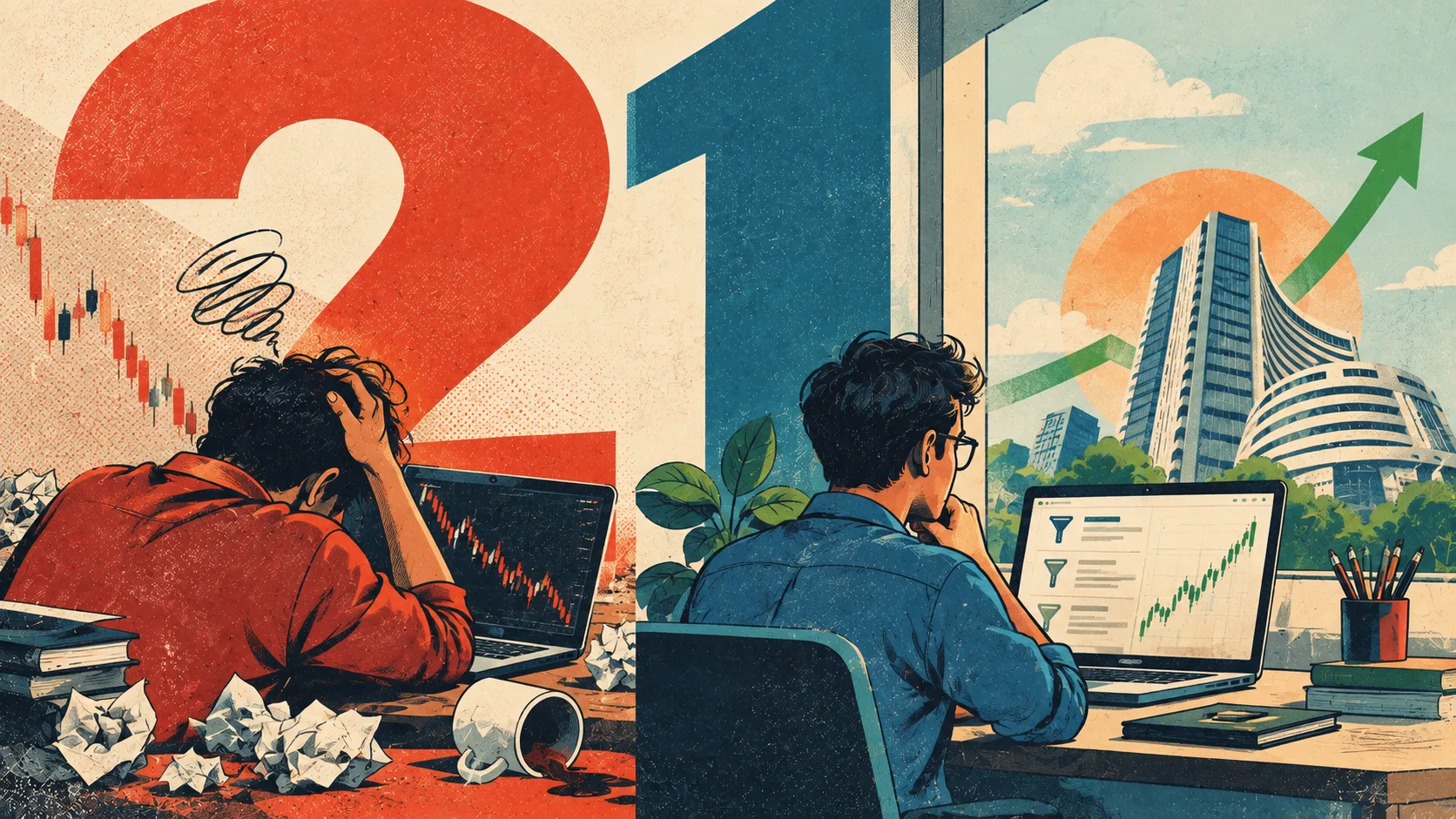
Two numbers, released months apart by the same regulator, describe two sides of the same market. In late 2025, the Securities and Exchange Board of India reported that roughly 91 percent of individual futures and options traders lost money in FY25, with aggregate net losses of about Rs 1,05,603 crore. A year later, its FY26 update showed losses easing slightly to about Rs 91,685 crore, but the share of traders losing money still sat at close to 88 percent, even as the number of active individual F&O traders fell by about 20 percent, from 98.1 lakh to 78.6 lakh.
At the same time, the number of Indians entering the stock market has kept climbing. Total demat accounts in the country crossed 23 crore by mid-2026, and NSE unique client codes went past 26 crore in June 2026. More people are showing up to invest. Fewer of them, proportionally, appear willing to keep guessing their way through it.
Read together, these numbers point to a quieter, less discussed shift beneath the headlines about IPO booms and index levels: a growing preference among retail investors for rule-based methods, built around screening and predefined criteria, over discretionary, instinct-led trading.
The cost of guessing, in the regulator's own data
SEBI's studies on individual F&O traders are among the most detailed data sets available on how retail India actually performs when trading. The pattern across four consecutive years of analysis has been strikingly consistent.
SEBI also found that among traders who lost money for two consecutive years and kept trading, close to 90 percent lost again the following year. In other words, losses were not concentrated among a handful of unlucky first-timers. They were a recurring feature for a large section of repeat participants, a pattern the regulator's own researchers have flagged as consistent with reactive, discretionary decision making rather than a defined, testable approach.
New investors keep arriving anyway
None of this has slowed the pace at which new investors are entering the market. If anything, participation at the account level has accelerated.
- Total demat accounts crossed 11 crore only in December 2022, after 25 years of market history.
- By August 2024, that number had reached 17.1 crore.
- It crossed 23 crore by June 2026, and touched roughly 23.4 crore by July 2026, according to depository data from CDSL and NSDL.
- NSE unique client codes, which track trading accounts across brokers, crossed 26 crore in June 2026, adding roughly 1 crore accounts in under four months.
The two trends, rising participation alongside persistent F&O losses, are not contradictory. They describe two different behaviors happening in the same investor base. A large and growing number of people are opening accounts and investing. A smaller, though still significant, subset is trading derivatives on instinct and losing money doing it. The interesting question is what happens in between, and increasingly, that is where screening tools have found an opening.
What a growing number of investors are reaching for instead
A stock screener, in its simplest form, lets an investor set specific, measurable conditions, a price above a moving average, a return on equity above a threshold, a stock trading near a 52-week high on above average volume, and get a filtered list of stocks that meet them, rather than scanning the market by feel.
The demand for this kind of tool has grown quickly and visibly. When brokerage platform FYERS launched an AI-assisted screener builder called FIA in December 2025, users created more than 100,000 custom screens in the tool's first week alone. Established platforms such as Tickertape now offer over 200 filter parameters across more than 4,600 listed Indian stocks, alongside pre-built screens for specific strategies. Screening features that combine technical and fundamental conditions, and increasingly let users backtest a screen against historical data before acting on it, have moved from a niche feature for advanced traders to a standard expectation across most retail investing apps and platforms, including scan-based tools built specifically for the Indian market.
The appeal is straightforward. A screen forces a decision to be written down, in advance, as a testable rule, rather than justified after the fact. That does not make a screen inherently profitable. A poorly designed screen can lose money as reliably as a poorly reasoned hunch. What it does change is the process: a rule can be reviewed, backtested against history, and refined, in a way that a gut feeling about a stock generally cannot.
Reading the shift
A few things are worth stating plainly, without overstating the case.
First, correlation is not causation. The decline in active F&O traders is at least partly a direct, mechanical result of SEBI's own regulatory changes, including higher lot sizes and fewer weekly expiries, introduced specifically to curb speculative retail activity. Some of the drop in participation reflects rules changing, not just minds changing.
Second, screener adoption and F&O losses are not measuring the same population. Many screener users are equity investors who were never trading options in the first place. The rise of one and the moderation of the other are parallel trends in the same broad market, not necessarily a story of the same individuals switching from one behavior to the other.
Third, and more durable, is the direction of travel across both data sets. Regulatory pressure has made undisciplined derivatives trading more expensive and less accessible. Screening and rule-based tools have become dramatically easier to use, backtest, and act on than they were even two years ago. Whether or not the same individuals are involved, the retail investing environment as a whole is visibly tilting toward defined, repeatable criteria and away from unstructured speculation, at a pace that is unlikely to reverse given how deeply screening features are now embedded into everyday investing apps.
Conclusion
The data does not suggest Indian retail investors have collectively become disciplined overnight. SEBI's numbers make clear that a meaningful share of active traders, particularly in derivatives, continue to lose money and continue trading anyway. What has changed is the range of tools available to the investors who do want a more structured approach, and the visible scale at which those tools are now being used. A screen is not a guarantee. It is, at minimum, a record of what an investor actually believed before the outcome was known, which is more than a hunch can offer.
This article is for informational purposes only and does not constitute investment advice. Trading and investing in securities, including equity derivatives, are subject to market risk. Past participation trends or losses reported in regulatory studies do not indicate individual outcomes or future performance.