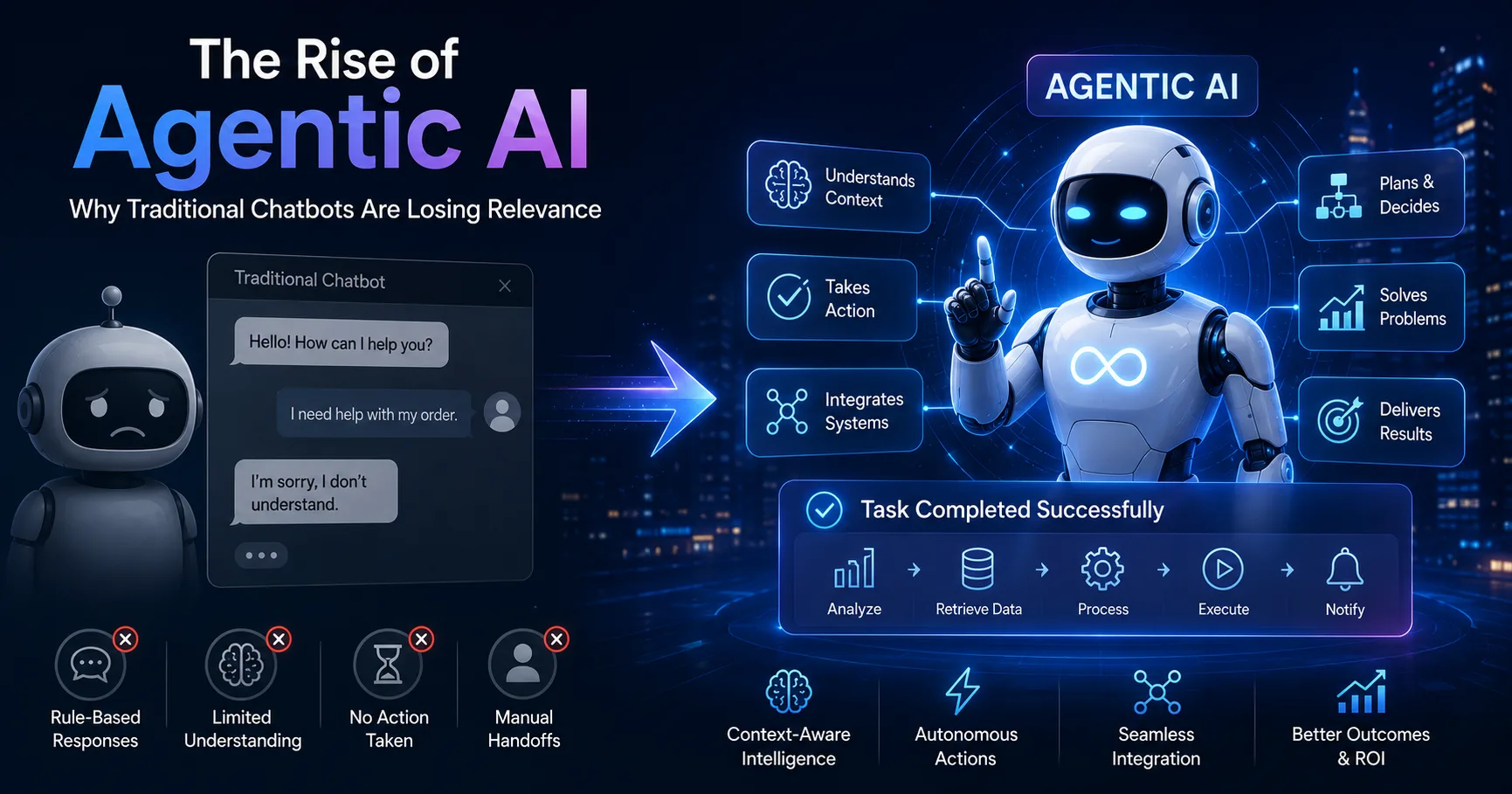
For years, businesses believed chatbots represented the future of artificial intelligence. Companies rushed to add automated chat windows to websites, customer support systems, and mobile apps. At the time, it felt innovative.
But in 2026, the conversation around enterprise AI has changed completely.
Modern businesses no longer want AI systems that simply answer questions. They want intelligent systems that can think through problems, make decisions, coordinate workflows, and complete tasks independently. This shift is driving the rapid rise of Agentic AI.
Across industries, enterprises are moving away from basic chatbot models and investing in autonomous AI systems capable of operating more like digital teams than software tools.
From Chatbots to Autonomous AI Systems
Traditional chatbots were designed to react. They waited for a user to ask a question and then generated a response based on predefined logic or language models.
Agentic AI works very differently.
These systems can:
- Analyze situations in real time
- Plan multi-step actions
- Coordinate with other AI agents
- Monitor workflows continuously
- Access business tools and databases
- Execute tasks without constant human input
The difference is not small. It represents a major shift in how businesses use artificial intelligence.
Instead of acting like assistants, AI systems are starting to behave more like autonomous operational teams.
Why Businesses Are Moving Beyond Chatbots
Most enterprises have realized that simple conversational AI is no longer enough for complex business environments.
Modern organizations need systems that can handle:
- Operational workflows
- Compliance monitoring
- Financial analysis
- Logistics coordination
- Enterprise reporting
- Customer intelligence
- Real-time decision making
Chatbots can answer questions. Agentic AI systems can complete entire workflows.
That distinction is changing enterprise technology strategies across the world.
The Rise of Multi-Agent AI Infrastructure
One of the biggest advancements in AI Development is the emergence of multi-agent AI systems.
In these environments, multiple specialized AI agents work together simultaneously.
For example:
- One AI agent gathers data
- Another analyzes patterns
- Another evaluates risk
- Another generates reports
- Another executes tasks automatically
This distributed intelligence allows businesses to process operations faster and more efficiently than traditional automation systems.
Many enterprise AI systems now operate as coordinated AI ecosystems rather than standalone applications.
Agentic AI Is Reshaping Enterprise Automation
Companies are already using agentic AI infrastructure in real business operations.
Some examples include:
Financial Compliance Systems
AI agents analyze transactions, monitor regulations, and identify compliance risks in real time.
Logistics and Supply Chain Operations
Autonomous AI systems process shipping data, optimize delivery routes, and manage inventory workflows.
Healthcare Intelligence Platforms
AI agents help identify diagnostic anomalies and process clinical information faster.
Enterprise Document Processing
AI workflows can review, categorize, and process thousands of documents daily with minimal manual oversight.
Customer Operations
AI systems manage customer interactions, escalation workflows, and support automation simultaneously.
This new generation of AI is transforming how enterprises operate internally.
Why Private AI Infrastructure Matters
As AI systems become more autonomous, businesses are becoming increasingly concerned about security and data ownership.
Many enterprises do not want sensitive operational data flowing through third-party AI APIs.
This is why private AI infrastructure is becoming a major priority.
Organizations are investing in:
- On-premise AI systems
- Air-gapped infrastructure
- Private Large Language Models
- Enterprise-grade security
- Sovereign AI environments
Private infrastructure gives companies greater control over their data, workflows, and AI intelligence.
How Kraftors AI&R Is Building Agentic AI Systems
Kraftors AI&R is among the companies developing enterprise-grade agentic AI infrastructure for businesses across industries.
The company focuses on building multi-agent AI systems capable of automating complex operational workflows within secure enterprise environments.
Its AI Development services include:
- Agentic AI architecture
- Multi-agent workflow systems
- Enterprise AI Development
- Private LLM infrastructure
- AI automation solutions
- Generative AI systems
- AI infrastructure consulting
- Intelligent document processing
According to the company, some enterprise deployments have achieved:
- 70% faster document processing
- Sub-200ms inference latency
- Millions of automated transactions processed
The company emphasizes secure, scalable, and enterprise-focused AI infrastructure rather than consumer-facing chatbot products.
Why Agentic AI Is Becoming the Future of Enterprise Technology
The next phase of enterprise AI will not be defined by who has the most entertaining chatbot demo.
It will be defined by which organizations build intelligent systems capable of:
- Operating autonomously
- Scaling efficiently
- Protecting enterprise data
- Managing complex workflows
- Supporting real-time decision making
Businesses that adopt advanced agentic infrastructure early may gain a significant operational advantage over competitors still relying on traditional automation systems.
The Future of Enterprise AI
Industry experts believe agentic AI will become a foundational part of enterprise operations over the next decade.
Future developments may include:
- Fully autonomous operational systems
- AI-driven enterprise management
- Multi-agent collaboration networks
- Real-time autonomous analytics
- Self-improving AI workflows
- Human-AI hybrid operations
As enterprise AI continues evolving, the role of traditional chatbots may become increasingly limited.
Final Thoughts
The rise of Agentic AI represents one of the biggest shifts in modern enterprise technology. Businesses are moving beyond reactive chatbots and investing in intelligent AI systems capable of planning, reasoning, and executing tasks independently.
For enterprises focused on long-term scalability and automation, agentic infrastructure is quickly becoming a strategic advantage rather than an experimental technology.
Companies like Kraftors AI&R are helping shape this transition by building secure and scalable AI systems designed for the next generation of enterprise operations.