Introduction
AI agent development services proposals land on your desk with a number at the bottom. That number means nothing without understanding what is behind it. Two vendors can quote the same price and deliver wildly different things.
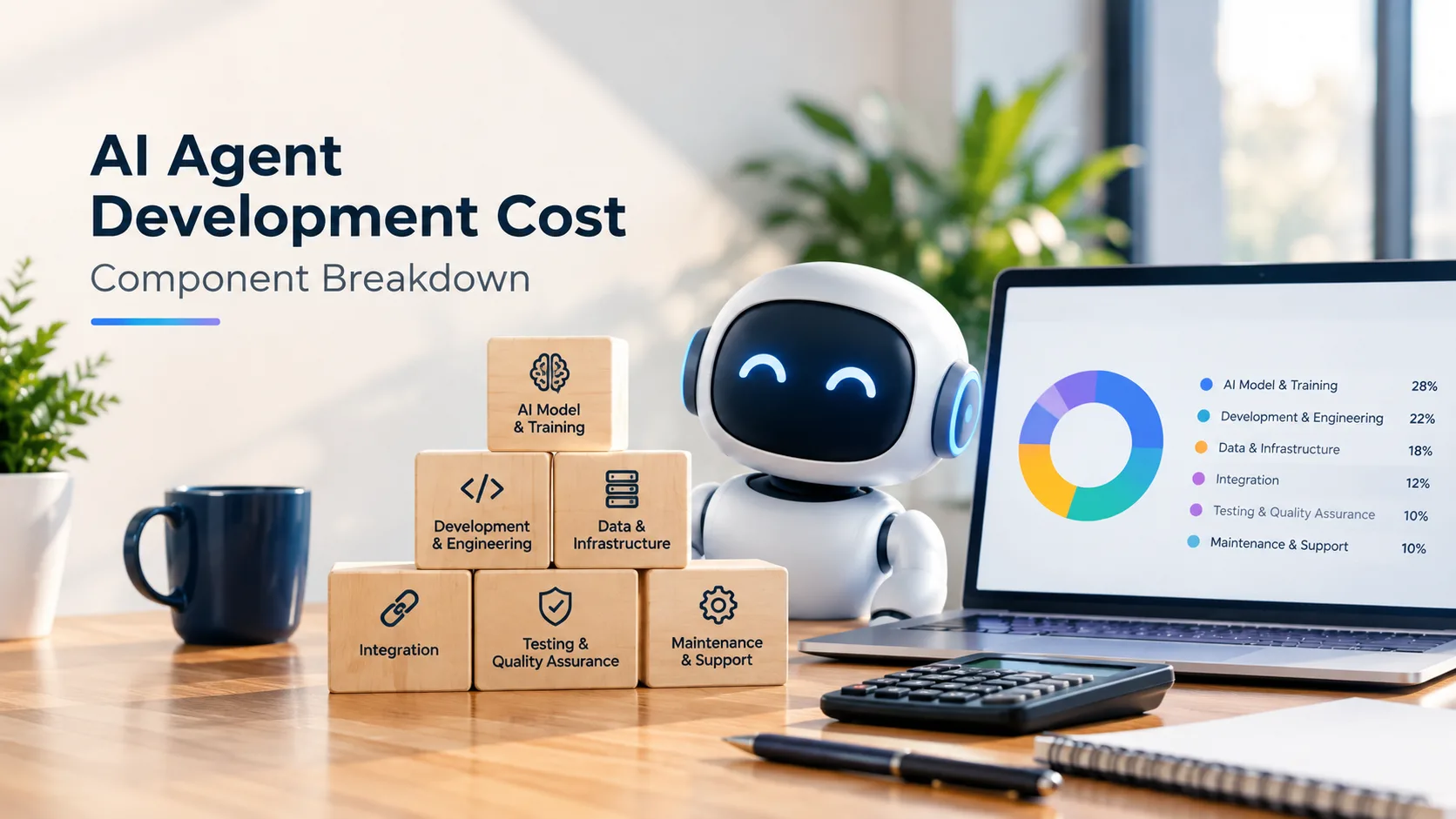
This piece walks through six cost layers of a custom AI agent build and gives you directional ranges to sanity-check the next proposal you receive. All figures are illustrative. Treat them as starting points and verify against your own vendor quotes.
Component 1: Model Selection and LLM Costs
Your first decision is hosted vs. self-hosted.
Hosted models (OpenAI, Anthropic, Google) charge per token. A simple agent processing 1,000 tasks a day on a GPT-4-class model can run 500 to 3,000 USD per month in API costs, depending on prompt length and retry rate. Smaller models cut that by 80 to 90 percent but may not handle complex reasoning.
Self-hosted open-source models (Llama, Mistral, Qwen) eliminate per-token costs but require GPU infrastructure. This makes sense at high volume or when data residency rules prohibit external providers.
Most teams start hosted to validate the workflow, then optimize. A generative AI development company should model both scenarios in the proposal so you are not surprised at scale.
Component 2: Tool Layer and Integrations
Tools are how agents act. Each tool (CRM read/write, email send, database query) needs a schema, input validation, error handling, and rate limits.
Simple agents with 2 to 3 tools cost less. Complex agents with 8 to 12 tools touching Salesforce, Stripe, Zendesk, and internal APIs cost more, because each integration has its own auth model and failure modes.
Integration work often accounts for 30 to 50 percent of total build cost. It is the part most likely to be underestimated. If you hear "we just need to connect to your CRM," ask which CRM, which version, and which API endpoints.
Component 3: Prompt Engineering and Workflow Design
This is not "writing a good prompt." It is designing the decision tree: what the agent reads first, what it checks next, when it acts, when it escalates.
This includes system prompt design, few-shot example curation, retrieval pipeline setup, and the orchestration logic that chains tool calls. For simple single-step agents, this is a small cost. For multi-step agents with branching logic and domain-specific reasoning, it takes weeks. AI agent development solutions with domain expertise bring pre-built patterns that shorten this phase.
Component 4: Evaluation Harness
The eval harness separates a demo from a production system. It is a test suite of 50 to 200+ cases that runs every time a prompt changes, a model updates, or a tool behavior shifts.
Building it means defining success criteria, creating test cases with known-good outputs, setting up automated scoring, and wiring it into the development workflow. Teams that skip this ship agents that degrade silently.
The first 50 test cases are the hard part. Expanding to 200 is incremental. When you hire AI agent developers, ask to see their eval setup, not just their demo.
Component 5: Infrastructure and Observability
A production agent needs a runtime environment, logging that captures every tool call with inputs and outputs, alerting for failures and cost spikes, rate limiting, and PII detection if the agent handles customer data.
Serverless setups have low fixed cost but can spike under load. Container-based setups have predictable costs but higher baseline spend. #NUMBERS
Most AI agent development services include infrastructure in the initial build but often underquote the monitoring work. Ask explicitly what observability is included.
Component 6: Ongoing Maintenance
This is the cost everyone forgets. Model providers update silently. A prompt that worked on one version may fail on the next. Tool APIs change schemas. New edge cases surface as usage grows.
Budget 20 to 30 percent of the original build cost per year. That covers weekly eval runs, monthly prompt reviews, quarterly tool audits, and incident response. #NUMBERS
Teams that hire AI developers in India for the build often keep a smaller retainer for ongoing maintenance, which works if the vendor documents everything for handoff.
How the Components Stack Up
A narrow single-workflow agent with 3 to 4 tool integrations and a basic eval harness lands in the lower range. A multi-workflow agent with 10+ integrations, a full eval suite, and observability pushes toward the upper end.
The prototype-to-production piece in this series quoted 25,000 to 150,000 USD for the initial build. This breakdown shows why: a simple agent with hosted models and few tools sits near 25,000. A complex agent with custom infrastructure and deep integrations pushes toward 150,000 or beyond. #NUMBERS
An AI agent consultant can help map your requirements to each component and identify where to invest vs. where to cut.
How to Read a Vendor Proposal
When you get a quote from an AI agent development company, check whether it breaks out these six components. If it is a single line item, ask for the breakdown.
Which model tier are they assuming, and what are the projected per-task costs at your volume? How many tool integrations are scoped? What is the eval plan? What observability is included? What does post-launch maintenance cover?
If a vendor cannot answer these, the proposal is probably a guess.
Conclusion
The cost of a custom AI agent is not one number. It is six components that scale independently based on workflow complexity, integration count, compliance requirements, and how seriously you take evaluation and maintenance.
Map your workflow to these six layers. Get component-level quotes from at least two vendors. Compare not just total cost but where each vendor spends the budget.
Need help mapping your agent requirements to a realistic budget? Talk to our team for a component-level scoping session.
Frequently Asked Questions
1. What is the typical cost range for building a custom AI agent?
Directional range: 25,000 to 150,000 USD for the initial build. Ongoing costs add 20 to 30 percent annually. Verify against vendor quotes.
2. What is the most expensive component of an AI agent build?
Usually the tool layer and integrations, accounting for 30 to 50 percent of total cost. Complex integrations with legacy systems or custom APIs drive the number up. #NUMBERS
3. How much do LLM API costs add per month?
For a hosted frontier model processing 1,000 tasks per day, expect 500 to 3,000 USD per month. Smaller models cut this significantly. Self-hosted models shift cost to infrastructure.
4. Should I use a hosted model or self-host?
Start hosted to validate the workflow. Move to self-hosted only when volume, cost, or data residency justifies the infrastructure investment. Most agents never need to switch.
5. What does an evaluation harness cost to build?
The first 50 test cases are the bulk of the work. Expanding to 200 is incremental. Cost depends on how many task types and edge cases your agent handles. This is not optional for production.
6. How much should I budget for ongoing maintenance?
20 to 30 percent of the original build cost per year. This covers eval runs, prompt reviews, tool audits, model version testing, and incident response.
7. Why do vendor quotes vary so much?
Because "AI agent" means different things to different vendors. Some quote a chatbot with tool access. Others quote a fully evaluated, observable, production-grade system. Ask for the component breakdown.
8. Can I reduce cost by hiring AI agent developers offshore?
Yes. Many teams hire AI developers in India for the build and keep prompt design and eval ownership in-house. The savings are real if the vendor has domain experience and documents the build for handoff.
9. What is often missing from vendor proposals?
Ongoing maintenance, model cost projections at scale, observability setup, and the eval harness. If these are absent, the proposal is incomplete.
10. How do I compare two AI agent development services proposals?
Break each into the six components listed in this article. Compare scope, assumptions, and what is explicitly excluded. The lowest total price often hides the most missing pieces.