
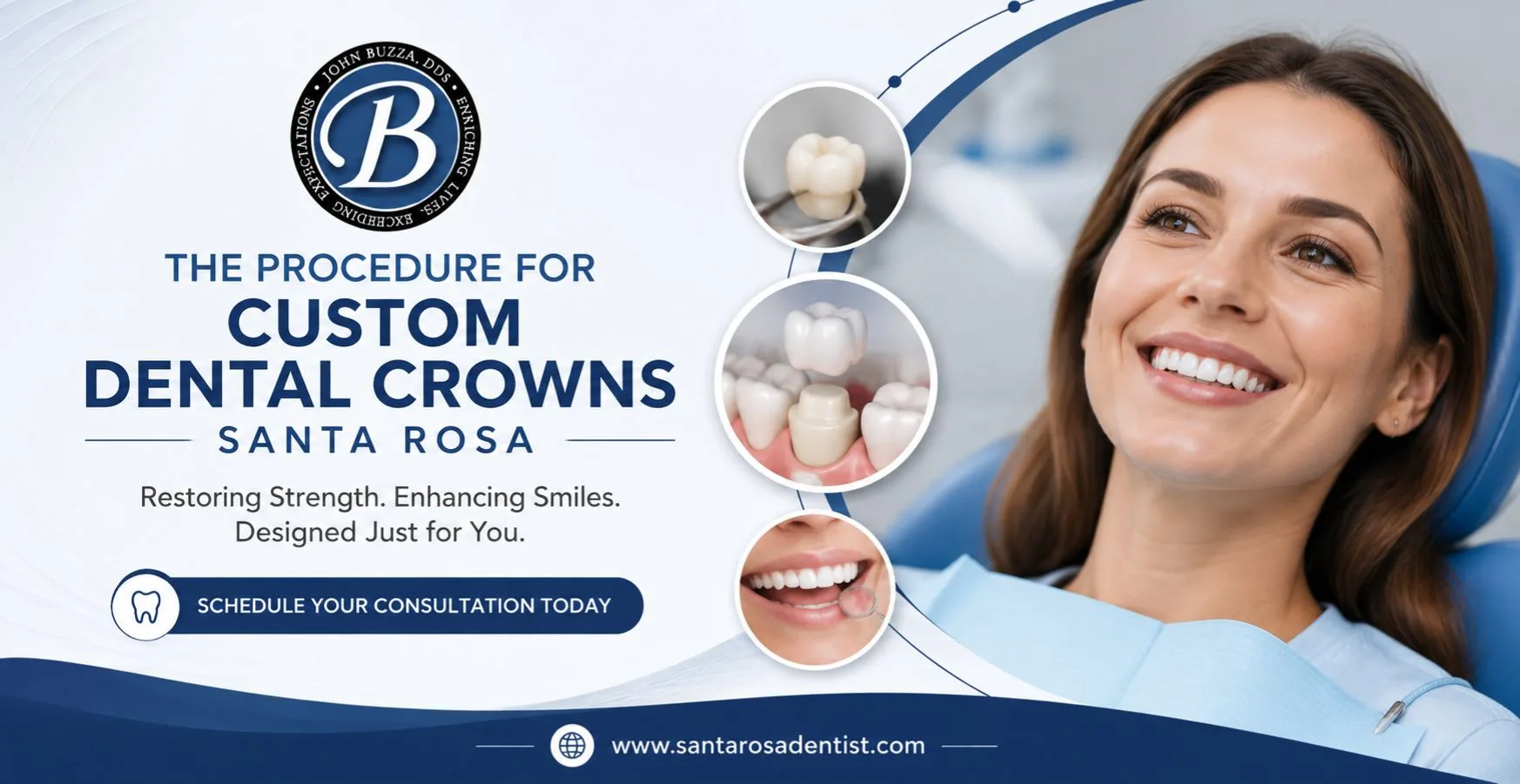
A damaged tooth does not always need extraction or an extensive replacement. When decay, cracks, chips, or wear have compromised a tooth's structure, a custom crown can restore its shape, strength, appearance, and function. For patients considering dental crowns Santa Rosa, understanding the procedure is essential because crown treatment involves diagnosis, tooth preparation, temporary protection, precise fitting, and final placement.
Buzza Dental Group describes dental crowns as protective caps placed over natural teeth and notes that crown treatment generally involves two office visits. The practice also offers porcelain crowns, which can provide a natural-looking option for both front and back teeth.
When Are Dental Crowns Santa Rosa Appropriate?
A crown is generally considered when a tooth requires more protection or restoration than a conventional filling can provide.
Buzza Dental Group specifically identifies extensive decay, broken teeth, cracked teeth, chipped teeth, and worn teeth among situations where crowns may be used. Crowns can also be placed over dental implants.
Crown Versus a Filling
A filling replaces a localized area of lost tooth structure. A crown covers the tooth more extensively.
For example, a relatively small cavity may be appropriately restored with a filling. When damage is extensive enough that the remaining tooth requires additional protection, a crown may be considered instead.
The decision should follow a clinical examination rather than the patient's preference for a particular restoration.
Step 1: Examination and Treatment Planning
The first stage is determining whether the tooth can be predictably restored with a crown.
The dentist evaluates the affected tooth, surrounding tissues, existing restorations, and the amount of remaining healthy structure. Diagnostic imaging may also be used when necessary to evaluate areas that cannot be assessed visually.
Treatment planning should answer several questions:
- Is a crown actually necessary?
- How much healthy tooth structure remains?
- Is there active decay?
- Is the tooth cracked or fractured?
- Is the gum tissue healthy?
- Does the tooth require additional treatment first?
- What crown material is appropriate?
Buzza Dental Group states that it selects crown material according to the patient's situation and identifies porcelain as one option.
Step 2: Preparing the Tooth
Once a crown is determined to be appropriate, the affected tooth is prepared to accommodate the restoration.
According to Buzza Dental Group's published procedure, decay affecting the tooth is removed during the first visit. The tooth is then shaped, and a temporary crown is placed.
Preparation is a critical part of the process because the final restoration must fit comfortably and function correctly with neighboring teeth.
The dentist also considers the patient's bite. A crown that looks attractive but interferes with normal occlusion can create unnecessary discomfort or functional problems.
Step 3: Temporary Crown Placement
The temporary crown protects the prepared tooth while the final restoration is being completed.
It also allows the patient to leave the first appointment with the tooth covered rather than exposed.
During this period, patients should follow the dental team's instructions regarding cleaning and eating. If the temporary crown becomes loose or damaged, contacting the dental office is preferable to attempting a permanent repair at home.
Step 4: Creating and Checking the Final Crown
The final restoration must correspond closely with the prepared tooth and surrounding dentition.
Fit is important because the crown needs to meet the neighboring teeth properly and function within the patient's bite.
Buzza Dental Group also describes its use of high-powered microscopes as part of its precision dentistry approach, stating that magnification is used to improve the precision of dental restorations and their fit and finish.
This highlights an important distinction: customization is not simply about selecting a tooth shade. It also involves dimensional accuracy, contacts with adjacent teeth, bite relationships, and the visual characteristics of the restoration.
Step 5: Permanent Crown Placement
At the second appointment, the temporary crown is removed and the final restoration is evaluated.
Buzza Dental Group states that the dentist checks the new crown's fit before cementing it into place.
The final stage focuses on ensuring that the restoration is appropriately positioned and functions with the patient's bite.
Patients should mention any unusual discomfort, bite interference, or persistent sensitivity after placement so the dental team can evaluate the issue.
Porcelain Crowns Versus Other Cosmetic Options
Material selection depends on the clinical situation and the desired result.
Buzza Dental Group identifies porcelain crowns as a natural-looking option that can be used on both front and back teeth.
However, a crown should not automatically be selected simply because the patient wants a cosmetic improvement.
Porcelain Veneers Santa Rosa CA
Porcelain veneers Santa Rosa CA are primarily used to modify the visible front surface of suitable teeth. They can address selected cosmetic concerns while generally requiring less coverage than a full crown.
A crown may be more appropriate when the tooth itself needs substantial structural protection.
Tooth Colored Fillings Santa Rosa CA
Tooth colored fillings Santa Rosa CA can be an appropriate option for cavities or localized areas of tooth damage where sufficient healthy structure remains.
The practical distinction is straightforward: a filling repairs a portion of the tooth, while a crown covers and protects the tooth more extensively.
How Crowns Compare With Dentures
Dentures Santa Rosa CA address missing teeth rather than simply restoring a damaged natural tooth.
A crown can restore a compromised tooth that remains present and suitable for restoration. A denture, by contrast, replaces multiple missing teeth or an entire arch depending on the type.
Therefore, the choice is not normally between a crown and denture for the same clinical situation. The appropriate solution depends on whether the tooth can be preserved and restored.
Buzza Dental Group offers both crowns and dentures as part of its broader restorative services.
How to Protect a New Dental Crown
A crown restores the tooth, but it does not eliminate the need for preventive dental care.
Patients should:
- Brush and clean between teeth consistently.
- Attend recommended dental examinations.
- Avoid using teeth to open packages or bite hard objects.
- Address persistent discomfort promptly.
- Follow specific care instructions provided by the dental team.
The tooth underneath the crown remains susceptible to oral health problems, particularly around the crown's margins. Good home care and professional monitoring therefore remain important.
Common Mistakes Patients Should Avoid
Choosing a Crown Without a Full Evaluation
Not every damaged tooth needs a crown. A less extensive restoration may be appropriate when enough healthy structure remains.
Treating Appearance as the Only Consideration
A crown must function correctly as well as look natural. Bite, fit, tooth condition, and surrounding tissues all influence treatment planning.
Ignoring Existing Oral Health Problems
Active decay or gum problems may need attention before definitive restorative treatment.
Delaying Treatment for a Damaged Tooth
A cracked, broken, or extensively damaged tooth should be evaluated promptly. Waiting can allow the underlying problem to progress and potentially complicate restoration.
Why Precision Matters in Custom Crown Treatment
A crown is a small restoration, but its fit has significant functional consequences.
Buzza Dental Group's precision dentistry approach uses high-powered microscopes to facilitate close-up work on dental restorations.
For patients comparing providers for dental crowns Santa Rosa, useful questions include:
- How is the tooth evaluated before crown preparation?
- Which materials are appropriate for the tooth's location?
- How is crown fit assessed?
- How are bite relationships checked?
- What happens if the tooth needs additional treatment?
- What maintenance will be required afterward?
These questions provide more useful information than comparing crown prices alone.
Conclusion
The procedure for dental crowns Santa Rosa involves considerably more than placing a cap over a damaged tooth. Diagnosis determines whether a crown is appropriate, preparation creates the foundation, the temporary crown protects the tooth, and the final restoration must be carefully evaluated for fit, appearance, and function.
Buzza Dental Group describes a two-visit crown process involving decay removal, tooth preparation, temporary protection, final crown fitting, and cementation. Patients considering treatment can review the practice's Dental Crowns Santa Rosa service and discuss their specific tooth condition with the dental team before deciding on a restoration.
Frequently Asked Questions
1. How many visits are needed for a dental crown?
Buzza Dental Group describes its crown procedure as generally requiring two office visits. The first involves tooth preparation and a temporary crown, while the second involves checking and cementing the final restoration.
2. Why would a dentist recommend a crown instead of a filling?
A crown may be recommended when tooth damage is too extensive for a conventional filling to provide adequate restoration and protection. The appropriate choice depends on how much healthy tooth structure remains.
3. Are porcelain crowns suitable for front teeth?
Porcelain crowns can provide a natural-looking restoration and Buzza Dental Group states that porcelain crowns can be used on both front and back teeth. Material selection should still be based on the individual clinical situation.
4. Can a dental crown restore a cracked tooth?
A crown may be used to restore and protect a suitably restorable cracked tooth. However, the severity and location of the crack must first be evaluated because not every cracked tooth can be successfully restored.
5. How are veneers different from dental crowns?
Veneers primarily cover the visible front surface of suitable teeth for cosmetic enhancement, while crowns cover the tooth more extensively and are commonly used when greater structural restoration or protection is required.
6. Can crowns be placed over dental implants?
Yes. Buzza Dental Group specifically notes that crowns can be used to cover dental implants. The implant and surrounding tissues must first be evaluated to determine whether the restoration is appropriate.
7. What should I do if my temporary crown comes loose?
Contact your dental office promptly for guidance and evaluation. Avoid attempting to permanently reattach the restoration yourself, particularly if the underlying tooth is exposed or uncomfortable.