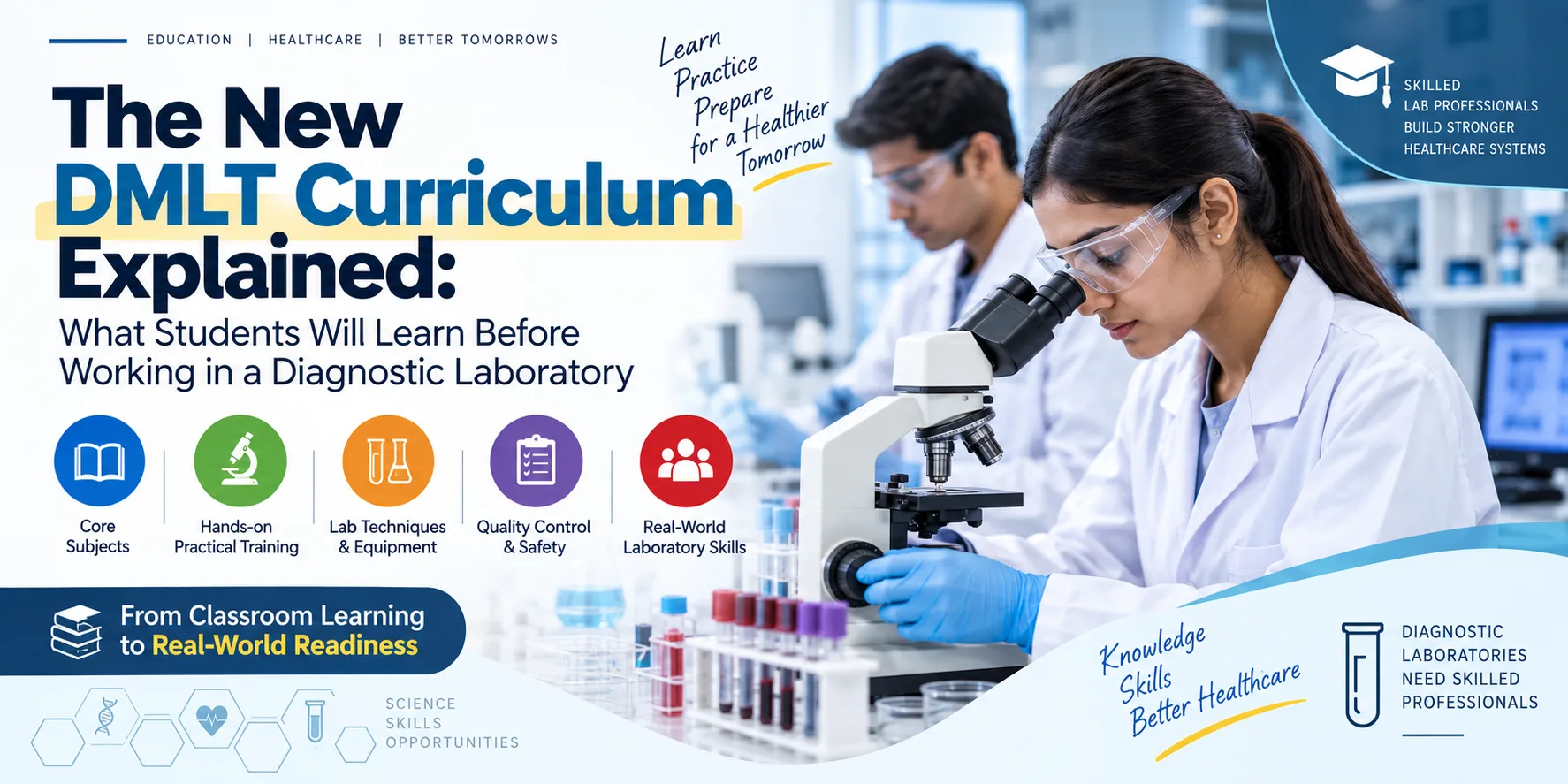
Choosing a diploma in medical laboratory technology is not simply about learning how to perform laboratory tests. Students entering this field need to develop scientific knowledge, practical skills, safety habits, professional behaviour, and an understanding of how diagnostic laboratories operate.
In 2026, medical laboratory education in India is also entering an important stage of curriculum development. The National Commission for Allied and Healthcare Professions (NCAHP), under the Ministry of Health and Family Welfare, released a competency-based curriculum for the Diploma in Medical Laboratory Technology (DMLT) in July 2026.
The new framework is designed to move laboratory education beyond conventional theory and place greater emphasis on practical competencies, quality, patient safety, and professional responsibilities.
So, what does this change mean for students?
What Is DMLT?
DMLT stands for Diploma in Medical Laboratory Technology.
It is a professional programme designed to prepare students for laboratory-related responsibilities in healthcare settings. Medical laboratory professionals support diagnostic services by working with specimens, laboratory procedures, equipment, documentation, quality systems, and other processes involved in testing.
According to the Ministry of Health and Family Welfare, the new national DMLT curriculum is a two-year programme designed for students who have completed Class XII Science with Physics, Chemistry, and Biology from a recognised board.
However, students should always check the current admission rules of the institution they are considering because course eligibility and admission procedures can vary depending on the programme and regulatory framework.
Why Has the Curriculum Changed?
Healthcare is becoming increasingly dependent on diagnostic information.
Blood tests, biochemical investigations, microbiological examinations, pathology procedures, and other laboratory investigations can provide healthcare professionals with important information for diagnosis and patient management.
As laboratory practices evolve, education also needs to keep pace.
The new NCAHP framework uses a competency-based education model. Instead of focusing only on whether students can remember theoretical information, the approach places emphasis on whether they can apply their knowledge and demonstrate appropriate professional skills.
The framework considers four broad areas:
- Knowledge
- Skills
- Values
- Attitudes
This creates a more practical connection between classroom learning and professional laboratory work.
Understanding the Three Stages of Laboratory Testing
One of the important concepts students need to understand is that laboratory testing is not a single activity.
The process can broadly be viewed through three stages:
1. Pre-Analytical Stage
This is everything that happens before the actual examination of the specimen.
It can include patient identification, test request verification, specimen collection, labelling, transportation, storage, and sample preparation.
An error during this stage can affect the quality or reliability of the eventual result.
For example, a sample may be collected in the wrong container, labelled incorrectly, or transported under unsuitable conditions.
This is why students in a laboratory technician course need to learn careful specimen-handling procedures.
2. Analytical Stage
The analytical stage involves performing the actual laboratory investigation.
Depending on the department and test, this can involve different techniques, instruments, reagents, microscopy, automated systems, and other laboratory processes.
Students need to understand not only how procedures are performed but also the scientific principles behind them.
3. Post-Analytical Stage
The work continues after the test has been performed.
The post-analytical stage can involve reviewing or validating results according to established procedures, reporting, documentation, record management, and communication through appropriate channels.
Together, these three stages show why laboratory professionals need a broad understanding of the complete testing workflow.
What Subjects Can Students Expect?
The exact structure depends on the programme and institution, but medical laboratory education generally brings together several scientific and technical areas.
Students may encounter subjects and practical areas related to:
- Anatomy and physiology
- Clinical biochemistry
- Haematology
- Microbiology
- Pathology
- Immunology
- Histopathology
- Blood banking
- Laboratory instrumentation
- Laboratory safety
- Biomedical waste management
- Quality assurance
- Professional ethics
These subjects are interconnected.
For example, learning about blood components in theory becomes more meaningful when students later understand how blood samples are collected, processed, examined, and documented in a laboratory.
Practical Skills Are Becoming More Important
A student can understand the theory behind a diagnostic test without necessarily being ready to perform the associated laboratory procedure.
Practical education bridges that gap.
During laboratory training, students may gradually become familiar with activities such as:
- Handling laboratory specimens
- Preparing samples
- Using laboratory equipment
- Following standard procedures
- Maintaining laboratory records
- Applying safety protocols
- Observing quality-control practices
- Managing laboratory work areas
- Communicating within a healthcare team
The exact practical exposure depends on the programme and training institution.
This is why students comparing a medical laboratory technology course should not look only at the course duration or qualification. They should also ask how much practical training is included.
Quality Control Is a Core Part of Laboratory Education
One of the biggest misconceptions about laboratory work is that the technician's responsibility ends when the test is completed.
In reality, quality is connected to the entire process.
Laboratories need systems that help ensure procedures are performed consistently. Students therefore need to understand concepts related to quality assurance and quality control.
This can involve learning how to:
- Follow standard operating procedures
- Handle reagents correctly
- Monitor equipment
- Identify possible sources of error
- Maintain appropriate documentation
- Follow established quality-control procedures
- Report problems through the correct channels
These practices help create a structured working environment.
Patient Safety Starts Inside the Laboratory
Although laboratory technicians may work behind the scenes, their work is connected to patient care.
A laboratory report can influence clinical decisions, which makes accuracy and responsible handling of specimens important.
Safety education can include areas such as:
- Personal protective equipment
- Infection prevention
- Safe specimen handling
- Sharps safety
- Laboratory waste management
- Chemical safety
- Workplace hygiene
- Emergency procedures
Students should therefore understand that laboratory safety is not simply another examination topic. It is part of everyday professional practice.
Technology and Laboratory Instruments
Modern laboratories use a wide range of equipment and technology.
Depending on the area of work, students may encounter automated analysers, microscopes, centrifuges, laboratory information systems, specialised testing equipment, and other technologies.
Learning to operate equipment is only one part of the process.
Students also need to understand appropriate procedures, equipment limitations, maintenance requirements, quality checks, and documentation.
This is particularly relevant as laboratories continue to incorporate greater levels of automation and digital record management.
Communication Is Also a Professional Skill
Laboratory work is often associated with science and equipment, but communication is another important part of the profession.
Laboratory professionals may interact with:
- Patients
- Doctors
- Nurses
- Pathologists
- Other laboratory professionals
- Administrative teams
- Healthcare support staff
Clear communication can help prevent misunderstandings and support efficient laboratory workflows.
Professional behaviour, confidentiality, teamwork, punctuality, and responsibility are therefore relevant alongside technical knowledge.
What Should Students Check Before Enrolling?
The introduction of a national competency-based framework makes it even more useful for students to examine the details of a programme before admission.
Here are some questions worth asking:
Is the programme aligned with the current curriculum?
Students should ask the institution which curriculum and regulatory requirements apply to the programme.
How much practical training is available?
Find out whether students receive regular laboratory practice rather than relying mainly on classroom instruction.
Is there clinical or laboratory exposure?
Practical exposure can help students understand how real diagnostic laboratories operate.
What facilities are available?
Ask about laboratory equipment, practical rooms, safety facilities, and the range of procedures students can observe or practise.
What are the exact eligibility requirements?
Do not rely on generic information from social media or unofficial websites. Check the current admission requirements directly with the institution.
What happens after the course?
Students should research the types of laboratory environments and roles associated with their qualification and understand any further education or registration requirements that may apply.
How the 2026 Changes May Affect Students
The new DMLT curriculum is part of a wider effort to standardise allied and healthcare education in India.
In September 2026, the Ministry of Health and Family Welfare also reported that the University Grants Commission had notified new and restructured allied and healthcare degrees under the NCAHP regulatory framework. The ministry said the broader reforms are intended to improve uniformity in course nomenclature, entry qualifications, education, and professional standards.
For students, the significance is not simply the introduction of a new syllabus.
It indicates a wider movement toward competency-based allied healthcare education, where practical training and clearly defined professional competencies are given greater importance.
Final Thoughts
A diploma in medical laboratory technology can involve much more than learning individual laboratory tests.
Students need to understand the complete journey of a specimen—from collection and preparation to analysis, quality control, documentation, and reporting.
The 2026 NCAHP competency-based DMLT curriculum places this complete workflow within a broader framework of knowledge, skills, values, attitudes, quality assurance, patient safety, and professional ethics.
For students considering this field, the most useful approach is to look beyond the course name. Compare the curriculum, practical training, laboratory facilities, eligibility requirements, clinical exposure, and current regulatory framework before making an admission decision.
The role of laboratory professionals continues to evolve with healthcare technology. Building strong practical foundations during education can help students understand the responsibility involved in producing reliable laboratory information and working as part of a modern healthcare team.