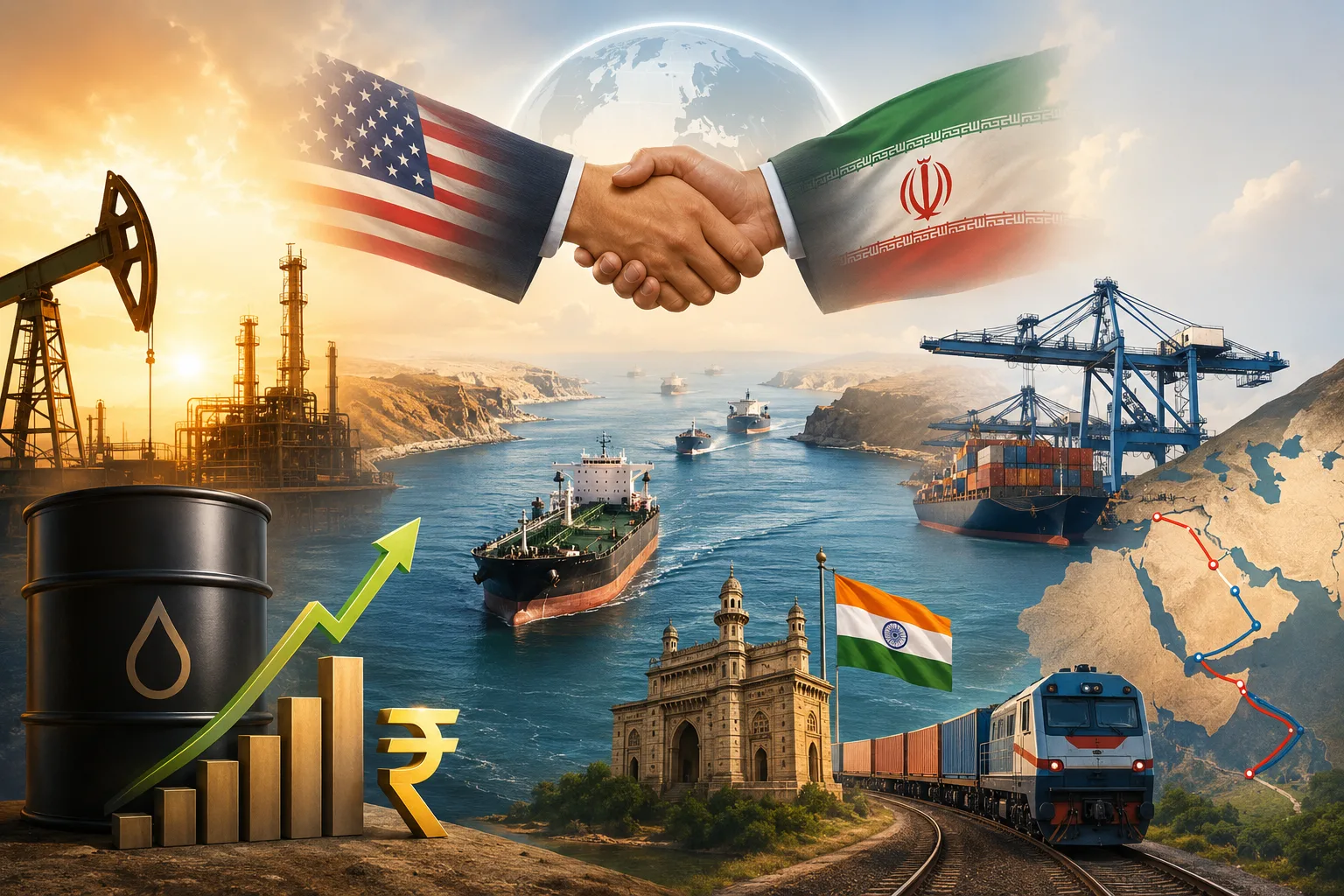
The finalization of the US-Iran peace agreement in Switzerland, concluding a volatile 107-day conflict that severely disrupted global energy markets, marks a critical structural pivot for emerging economies. While the treaty signals a cessation of hostilities and a projected $145 billion reconstruction roadmap for Iran, its most immediate, measurable impact is being felt across the balance sheets of South Asian trade ecosystems.
For India, a nation structurally dependent on hydrocarbon imports to sustain its domestic growth, the stabilization of the Middle East is not merely a diplomatic victory, it is an essential fiscal relief mechanism.
1. The Crude Oil Correction and India’s Fiscal Calculus
The immediate financial byproduct of the peace announcement was a sharp correction in global energy benchmarks. Brent crude fell 4.76% to settle at $83.17 a barrel, while West Texas Intermediate (WTI) mirrored the decline, dropping to $80.75.
Global Crude Price Correction (Post-Agreement)
├── Brent Crude: $83.17 / barrel (▼ 4.76%)
└── WTI Crude: $80.75 / barrel (▼ ~4.8%)
For the Indian economy, where crude oil consistently dictates the health of the national currency and domestic inflation, this price correction yields several critical macro benefits:
- Shrinking the Current Account Deficit (CAD): Early economic projections suggest the drop in crude prices could slash India’s oil import bill by up to $15 billion. This reduction directly eases the systemic pressure on the Indian Rupee (INR), allowing for a more stable foreign exchange reserve framework.
- Mitigating Retail Fuel Pressures: During the 107 days of active conflict, domestic petrol and diesel prices in India escalated by Rs 7.4 and Rs 7.58 per litre, respectively. While Oil Marketing Companies (OMCs) continue to navigate significant cost-revenue gaps incurred during the peak of the crisis, a sustained baseline of $83 per barrel provides federal finances the breathing room to phase out temporary tax reductions and subsidies without squeezing the consumer.
- Inflation Cooling: Lower logistical and transportation inputs gradually cool wholesale and retail inflation, offering the Reserve Bank of India (RBI) greater flexibility in managing domestic interest rates.
2. Unblocking the Hormuz Chokepoint: Restoring Energy Security
The geopolitical centerpiece of the US-Iran agreement is the formal reopening of the Strait of Hormuz and the easing of naval restrictions on Iranian ports. The maritime corridor is arguably the world's most critical energy artery, facilitating the movement of roughly 20 percent of global petroleum liquids.
Pre-War Supply Architecture: India’s vulnerability to the conflict was acute. Prior to the disruption, New Delhi routed over 40 percent of its crude oil imports and between 70 and 90 percent of its natural gas requirements through this narrow passage.
While India actively pursued supply diversification during the crisis, sourcing alternative volumes from alternative global suppliers, the absolute reliance on the Persian Gulf remains irreplaceable in the medium term. However, the operational restoration of the Strait will not be instantaneous. Global shipping syndicates, insurance underwriters, and maritime logistics firms face a multi-week lag characterized by:
- Comprehensive de-mining operations across the shipping lanes.
- Assessing and repairing damaged energy export infrastructure, refineries, and deep-water depots targeted during regional drone and missile skirmishes.
- Re-establishing institutional trust between international merchant fleets and regional maritime security forces.
3. The Revival of Strategic Infrastructure: Chabahar and the INSTC
Beyond the immediate relief of cheaper energy imports, the stabilization of Iran unlocks paralyzed, long-term trade infrastructure projects vital to India’s geopolitical positioning in Central Asia.
+-----------------------------------------------------------------------+
| STRATEGIC TRANSPORTATION REVIVAL |
+-----------------------------------------------------------------------+
| CHABAHAR PORT PROJECT | INSTC ROUTE |
| • Investment: $500 Million | • Connectivity: India-Russia |
| • Current Status: 70% Complete | • Transit Time: Reduced by 40%|
| • Operational Target: 2027 | • Cost Savings: ~$1,000 / Cont.|
+-----------------------------------------------------------------------+
The Chabahar Port Gateway
The $500 million Chabahar Port project, which bypasses land-route restrictions through Pakistan, has long been a pillar of India's Eurasian trade strategy. Progress had slowed under the weight of secondary sanctions and heightened regional warfare risks. With the formal suspension of energy and petrochemical sanctions under the new peace framework, the project, currently 70 percent complete, is back on track to become fully operational by 2027.
The International North-South Transport Corridor (INSTC)
Similarly, the International North-South Transport Corridor (INSTC) receives an immediate logistical boost. This multi-modal transit network connecting Indian ports to Central Asia and Russia is projected to:
- Reduce overall shipping transit times by 40 percent.
- Lower container freight costs by up to $1,000 per container compared to traditional maritime routes via the Suez Canal.
4. Rebuilding Bilateral Trade Ecosystems
Historically, India-Iran bilateral trade peaked above $17.5 billion before stringent international sanctions severely curtailed economic interactions. While approximately 90 percent of that volume comprised crude oil purchases, a normalized post-war economy opens avenues for non-oil trade diversification.
With Iran entering a prolonged phase of post-war domestic reconstruction, Indian exports, which previously hovered around $3.38 billion, have significant headroom to expand. Key sectors poised to benefit from renewed trade agreements include industrial machinery, agricultural commodities (particularly rice and tea), pharmaceuticals, and infrastructure engineering services.
5. The Multi-Polar Geopolitical Challenge
While the macroeconomic markers point toward a net positive outcome for India, the geopolitical landscape requires delicate diplomatic navigation. The regional peace process faces immediate structural threats that could disrupt economic assumptions:
- The Northern Front Friction: Major regional actors remain highly skeptical of the treaty. Continued military positioning in southern Lebanon and ongoing operations against non-state actors like Hezbollah present an ever-present risk of a sudden escalatory flashpoint that could instantly re-ignite energy market volatility.
- The Balancing Act: New Delhi must balance its critical strategic, defense, and technology partnerships with Israel alongside its deep energy and civilizational ties with Iran.
- A Multi-Polar Middle East: The post-war landscape is no longer mediated by a single external power. India must simultaneously manage its economic alignment with the United States, Iran, Saudi Arabia, and the United Arab Emirates (UAE) all of whom remain foundational to India’s long-term energy architecture and foreign direct investment (FDI) inflows.
Conclusion
The US-Iran peace deal of 2026 offers India a vital window of economic relief, characterized by a projected $15 billion reduction in import liabilities, cooled inflationary pressures, and the resurrection of critical continental trade routes like Chabahar and the INSTC. However, because global energy security remains fundamentally tethered to the physical security of the Middle East, India’s long-term fiscal stability will depend entirely on how permanently these regional powers can transition from a state of armed truce to sustained diplomatic coexistence.