Workplaces face serious day-to-day risks at oil and gas sites across the UAE, Saudi Arabia, Oman, and Kuwait. A routine shift can quickly turn into a tragedy because of a single mistake at a drilling site or refinery.
Organisations invest significant resources in HSE video, safety policies, signage, and toolbox talks. However, workplace incidents continue to occur. Workers may overlook critical details or struggle to understand extensive health and safety procedures written in languages they are not familiar with.
Energy production comes with several operational risks. Offshore platforms, refineries, and desert drilling rigs operate under demanding conditions every day. High temperatures, heavy machinery, and exposure to toxic gases require constant attention and strict adherence to safety procedures.
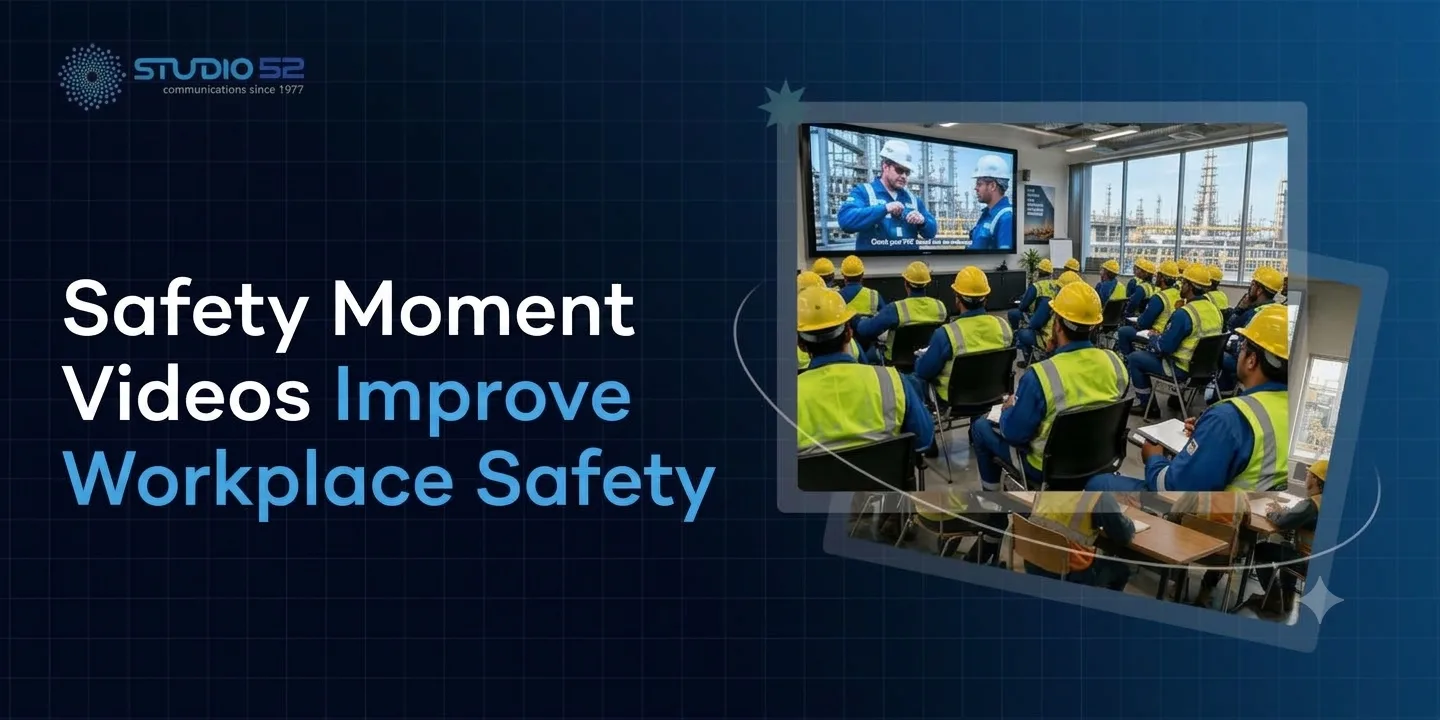
This is where an oil and gas safety moment video can make a real difference. These concise, visually engaging videos communicate one clear safety message at a time. They can be easily incorporated into shift briefings, pre-job checks, and daily toolbox sessions.
In this blog, we explore how these videos work, the science behind their effectiveness, and why more Gulf-based companies are adopting them to protect their workforce and strengthen workplace safety.
What Is a Safety Moment Video
A safety moment video is a short training clip, typically lasting two to five minutes, that focuses on a specific workplace hazard or safety rule.
Instead of lengthy training modules or comprehensive courses, workers receive one focused message presented in a simple and understandable format. This simplicity makes the information easier to follow and remember.
Workplace safety videos of this format are designed to capture attention quickly. They often begin with a realistic workplace scenario, such as a worker approaching a confined space or someone preparing to open a valve without the required permit. The video demonstrates the potential consequences and explains the correct procedure.
These videos are commonly used during toolbox talks, pre-shift briefings, safety inductions, and refresher training sessions. They are suitable for frontline workers, contractors, and new employees alike.
In the Gulf region, where workforces often include people from different countries, visual videos available in Arabic or English can help overcome the language barriers associated with written safety manuals.
Why Traditional Safety Communication Sometimes Falls Short
Safety managers continuously look for effective ways to reduce workplace incidents. However, workers may lose concentration during morning safety briefings, while lengthy manuals often remain unread in office bookshelves. Meanwhile, employees at remote locations continue to work in potentially hazardous environments.
Many companies follow a standard process: print a safety manual, conduct a briefing, and collect attendance signatures. Although this approach supports compliance requirements, it does not always translate into safer behaviour on site.
- Lengthy manuals can be difficult to understand when workers are reading in their second or third language.
- Classroom sessions may struggle to maintain attention in hot outdoor environments.
- Repeated briefings on familiar topics can become routine, causing workers to disengage.
- Invisible hazards, such as gas leaks and pressure build-up, are difficult to demonstrate in real-life conditions.
- Shift workers arriving at different times may miss important safety sessions.
- New contractors may have limited time to complete detailed safety orientations.
These challenges do not mean HSE teams are failing in their responsibilities. Instead, they highlight the limitations of relying on traditional communication methods alone. Written procedures explain what workers should do, while Oil and gas safety videos demonstrate how to perform tasks correctly. This visual difference can be critical when workers need to recall procedures under pressure.
How Safety Moment Videos Can Strengthen Oil & Gas Workplace Safety
Safety training videos help bridge the gap between written instructions and practical understanding. By combining visual demonstrations with spoken explanations, they make important safety information easier to understand and retain.
Here are some ways these videos can strengthen safety across the oil and gas industry:
- Workers can observe the exact sequence of a safe procedure instead of relying only on written descriptions.
- Animated hazards demonstrate dangerous situations that cannot be filmed safely, such as internal pressure events.
- Short video formats help maintain attention throughout the session and minimise distractions.
- Consistent video content ensures procedures are presented uniformly, reducing the risk of missed steps or inconsistent explanations.
- Multilingual voiceovers help communicate essential safety information to workers from different backgrounds.
- Digital delivery through an LMS or mobile device allows workers to access training before or after their shifts.
Sample data based on typical results in adult learning research.
From Gas Leaks to Confined Spaces: Safety Topics Worth Turning Into Videos
Nearly every high-risk activity in the oil and gas industry can benefit from a focused safety video. Some hazardous situations are too dangerous to film in real working conditions, making animation a practical way to demonstrate them.
- Confined space entry and permit requirements
- H₂S gas detection and emergency response
- Working at height and fall prevention
- Hot work permits and ignition control
- Fire and explosion emergency procedures
- Crane and lifting operations
- Lockout and tagout (LOTO) procedure
- PPE selection and correct usage
- Chemical spill containment
- Offshore evacuation and muster drills
- Plant vehicle and pedestrian safety
- Pipeline pressure and valve safety
Each topic can be developed into a focused industrial safety video that workers can watch in under five minutes. These short visual lessons reinforce essential procedures and help employees recall important safety practices after the briefing.
What Makes an Oil & Gas Safety Moment Video Truly Effective?
Not every safety video produces the same results. The most effective videos share several essential qualities that help improve understanding and encourage safer workplace behaviour.
- One clear message per video: Avoid information overload by focusing on a single safety objective.
- Realistic scenario opening: Present situations that workers can recognise from their daily responsibilities.
- Accurate PPE and procedures shown on screen: Ensure every detail reflects actual site requirements and safety standards.
- Plain language throughout: Explain complex safety topics using simple, easy-to-understand words.
- Professional voiceover in Arabic or English: Support clear communication across diverse Gulf workforces.
- A clear do and don’t contrast: Demonstrate both incorrect actions and the appropriate safety measures.
- Short runtime: Keep videos between two and five minutes for effective use during toolbox sessions.
Studio52’s safety video production team works closely with HSE professionals to develop accurate, engaging content that prioritises technical correctness alongside visual quality.
Why Short, Scenario-Based Safety Videos Can Make a Difference
Short, scenario-based videos demonstrate how workers encounter and respond to familiar workplace hazards. Rather than presenting safety rules as abstract instructions, they use relatable situations to explain the problem and demonstrate the correct response.
Scenario-based learning can improve employee engagement by connecting safety procedures with realistic workplace experiences. A typical video follows these steps:
Step 1: Real Field Scenario
Step 2: Near-Miss Hazard
Step 3: Correct Action Shown
Step 4: Safe Outcome Achieved
For example, a worker may watch a colleague handling a pressurised pipe fitting. The video demonstrates the potential consequences of skipping a pressure check before showing the correct isolation procedure.
Reduce workplace safety risks with an effective HSE Induction Video. Strengthen employee awareness, communicate essential safety procedures, and create safer workplaces with professional video solutions tailored to your organisation.
This storytelling approach helps workers connect emotionally with the situation and remember the correct response. When they encounter similar tasks on the rig floor, the visual example can serve as a useful reminder. Concise safety training videos can deliver these lessons effectively in under two minutes without significantly interrupting daily operations.
2D vs. 3D Animation: Which Works for Oil & Gas Safety Videos?
Both 2D and 3D safety animation formats can deliver effective results in the oil and gas industry. The most suitable option depends on the complexity of the subject, the level of technical detail required, and the intended learning outcome.
Feature/Criteria2D Animation3D AnimationVisual RealismStylised graphics and character illustrationsPhotorealistic equipment and life-like environment renderingTechnical DepthDemonstrates surface actions and simple workflowsIllustrates internal valve flows, pressure drops, and structural cutsProduction TimeFaster delivery turnaroundsRequires detailed CAD asset modellingCost EfficiencyLower production investmentHigher investment for complex technical detailsEquipment detailLimited to simplified representationsDetailed replicas of valves, rigs, and vesselsWorker engagementHigh, with clear visual storytellingVery high, with immersive and realistic visualsBest suitedGeneral rules, slip or trip hazards, and office safetyComplex machinery, subsurface geology, and piping internalsUsing custom safety animation for oil and gas industry applications allows companies to demonstrate hazardous internal processes that workers cannot directly observe. For instance, 3D graphics can illustrate how explosive gases may ignite inside a pipe, helping employees understand otherwise invisible hazards and their potential consequences.
How Companies Can Measure the Impact of Safety Moment Videos
Investments in workplace safety videos should be evaluated through measurable outcomes. Tracking employee understanding, workplace behaviour, and incident trends can help organisations determine whether their safety communication efforts are delivering meaningful improvements.
The following metrics can help monitor video performance:
Performance MetricsWhat It Tells YouHow To ApplyPre- and post-quiz scoresKnowledge gain per workerConduct a five-question quiz before and after each video sessionNear-miss trend trackingChanges in incidents related to a covered topicCompare monthly incident records before and after the video rolloutLMS completion ratesNumber of workers who completed the trainingMonitor progress through your learning management system dashboardObservation auditsChanges in workplace behaviourAsk supervisors to verify whether employees follow the correct proceduresWorker feedback surveysClarity and usefulness of the videoCollect responses through a short, three-question form after each toolbox sessionIncident cost comparisonFinancial impact of safer behaviourCompare incident-related costs year on yearCompanies in Saudi Arabia and the UAE increasingly need documented HSE training records to support internal reviews and regulatory audits. Video completion records and LMS reports can provide useful evidence of training participation and completion.
The Future of Safety Communication in the Oil & Gas Industry
Safety communication across the Gulf region is evolving rapidly. Companies are increasingly adopting digital-first training methods that allow workers to access safety information through mobile phones, tablets, and site kiosks instead of relying exclusively on printed manuals and static posters.
Emerging approaches include:
- Mobile-ready safety videos for remote desert facilities and offshore locations.
- QR codes placed on equipment that direct workers to relevant safety training videos.
- Interactive animated safety modules with integrated quizzes.
- AI-assisted scenario development to support faster and potentially more cost-effective video production.
- Multilingual training in Arabic, Urdu, Hindi, Tagalog, and English for diverse Gulf workforces.
- Incident reconstruction videos that turn previous near-misses into practical learning opportunities.
Contractors and organisations working with ADNOC, Saudi Aramco, OQ, and KPC may incorporate digital safety resources into their HSE management practices, depending on their specific requirements. Companies that build structured digital safety video libraries can strengthen training consistency and support a more proactive safety culture.
The future of safety training videos in this region extends beyond compliance. It is about ensuring that every worker, regardless of language, experience, or shift, has access to consistent, understandable, and relevant safety training.
Conclusion
Oil and gas operations across the UAE, Saudi Arabia, Oman, and Kuwait involve hazards that written guidance alone cannot eliminate. Manufacturing & Industrial safety videos provide energy companies with a practical way to communicate critical safety procedures and protect workers on site. These videos deliver focused messages, demonstrate hazards that cameras cannot safely capture, and help multilingual teams understand essential precautions.
The investment in effective safety communication can be modest compared with the potential costs of a serious workplace incident. Consistent training helps organisations build safer working environments and reinforce essential safety practices across every shift.
Ready to Build Your Safety Video Library?
Studio52 produces customised safety moment videos for oil and gas companies across the UAE, Saudi Arabia, Oman, and Kuwait. From 2D and 3D animation to multilingual voiceovers and LMS-ready delivery, our solutions help organisations communicate safety procedures effectively.
UAE: +971 44541054
Saudi Arabia: +966 12 4220506
Email: [email protected]