
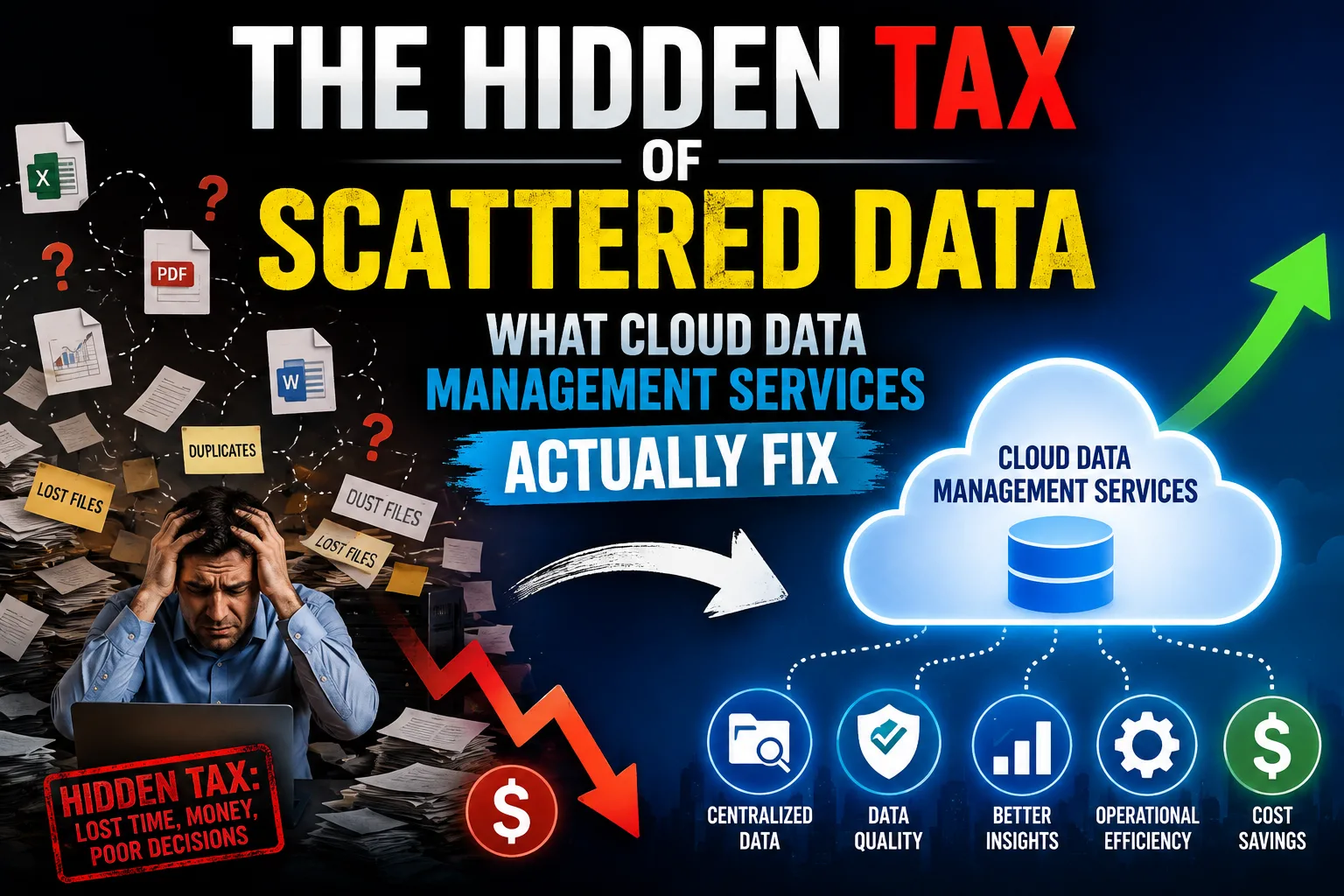
Ask a finance lead how much revenue the company booked last quarter and you will get an answer. Ask three different teams and you may get three answers. Nobody is lying. Each team pulled the figure from a different system, applied a different rule, and trusted a different spreadsheet.
That gap is a tax. You pay it in meeting time spent debating whose number is right, in analysts who clean the same columns every month, and in decisions that wait for a report that never quite becomes final. Most companies never see this cost on a budget line, which is exactly why it survives for years.
Cloud data management services exist to remove that tax. This post looks at where it comes from, what it costs in daily practice, and what a sensible fix looks like.
Where the tax comes from
Data rarely becomes messy through neglect. It becomes messy through growth. A CRM arrives for sales, a separate tool for support, an ERP for operations, and a marketing platform bought by a team that needed results quickly. Each purchase made sense on its own day. Together they form a landscape where the same customer exists under four spellings and the same product carries three different codes.
Then the cloud enters the picture. Many businesses move workloads to the cloud and assume the problem is solved. But moving data is not the same as managing it. Copying a disorganized warehouse into a cloud account gives you a disorganized warehouse with a monthly invoice. The mess is perfectly portable.
This is the point many teams miss. The cloud gives you room, speed and elasticity. It does not give you order. Order has to be designed.
Three symptoms worth recognizing
You do not need an audit to spot a data tax. Look for these signs.
1. The same question has several answers. When customer counts, margins or inventory levels differ between dashboards, the cause is almost never the dashboard. It is duplicate and inconsistent records upstream, combined with business rules that were never written down in one place.
2. Storage that nobody owns. Old exports, abandoned test tables and copies of copies pile up. They cost money to hold and create risk, because nobody can say with confidence whether they contain sensitive information. When a team asks "can we delete this?", the honest answer is often silence.
3. Governance that lives in people's heads. One senior analyst knows which table is reliable. One engineer knows why a pipeline fails every first of the month. Access rules exist as verbal agreements. This works until that person changes roles, and then the business discovers how much of its data practice was folklore.
If two of these sound familiar, the problem is structural, and no single tool will fix it.
What good cloud data management services actually do
A capable provider does not start by recommending a platform. It starts by asking what decisions your people struggle to make, and works backward. In practice, the work tends to fall into four moves.
Map before you move. Inventory the sources, the owners, the formats and the flows. This is unglamorous, and it is where most surprises appear. Teams often find that a "critical" feed has no consumers, or that a forgotten feed supports a regulatory report.
Unify the layers. Instead of forcing every system into one giant table, a unified data platform connects sources into a consistent structure, so that one definition of "customer" or "order" serves every team. This is also where choices such as a warehouse, a lakehouse or a mix of both get made, based on workload rather than fashion.
Govern by design. Access control, lineage, quality checks, encryption and compliance monitoring are built into the platform from the beginning. Bolting them on later is slower, more expensive and usually incomplete. Good governance should feel like guardrails on a mountain road, not a toll booth.
Automate the routine. Once definitions and rules are settled, refreshes, validations and alerts can run without a person babysitting them. This is where the analyst time that was lost to cleaning data finally comes back.
A realistic way to sequence the work
The most common mistake in a cloud data management solution is ambition without order. A company tries to modernize everything at once, the program stretches over many months, and enthusiasm fades before anyone sees a benefit.
A more durable approach is to begin with one decision.
Pick the report that leadership trusts least. Trace every number on it back to its sources. Fix those sources, document the rules, and automate the refresh. You now have a working slice of the future platform, a visible win, and a template for the next slice.
This approach has a quiet advantage. It forces the conversation about ownership early. Someone has to be named as the owner of "revenue" or "active customer", and that decision, more than any technology choice, is what makes data trustworthy.
From there, expand outward in priority order: the next high-value report, the next noisy source system, the next compliance requirement. Each step reuses the foundation from the last.
What this looks like in different industries
The shape of the problem changes with the sector, though the cause rarely does.
In healthcare and pharmaceuticals, legacy analytics platforms often sit on aging infrastructure that is costly to maintain and hard to extend. Dream IT's work on migrating a legacy Hadoop analytics platform to Microsoft Fabric OneLake is a good example of this pattern: the value lay in consolidating storage and analytics onto a modern, unified foundation instead of patching the old one.
In travel and hospitality, the challenge is usually fragmented reporting across properties or regions, each producing its own view of performance. Centralizing that reporting on Microsoft Fabric and Power BI turns many local versions of the truth into one shared view.
Different industries, same lesson: structure first, insight second.
The case for acting sooner
Data debt behaves like financial debt. Small inconsistencies compound as more systems, teams and regions are added. Each new dashboard built on shaky foundations makes the foundation harder to change, because more people depend on it.
Where Dream IT fits
Dream IT is a Microsoft Solutions Partner, and its cloud data management services cover data governance, unified data platforms, Azure cloud solutions, cloud migration, and data warehouse and lakehouse design. The emphasis is on simplifying your data landscape one layer at a time, so your teams work from one clear picture instead of searching across silos.
If your organization is paying the hidden tax of scattered data, the best first step is small and specific: choose one report, trace it, and fix what you find. A good cloud data management company will help you do exactly that, and build outward from there.
Ready to find out what scattered data is costing you? Talk to the Dream IT team about a cloud data management assessment.