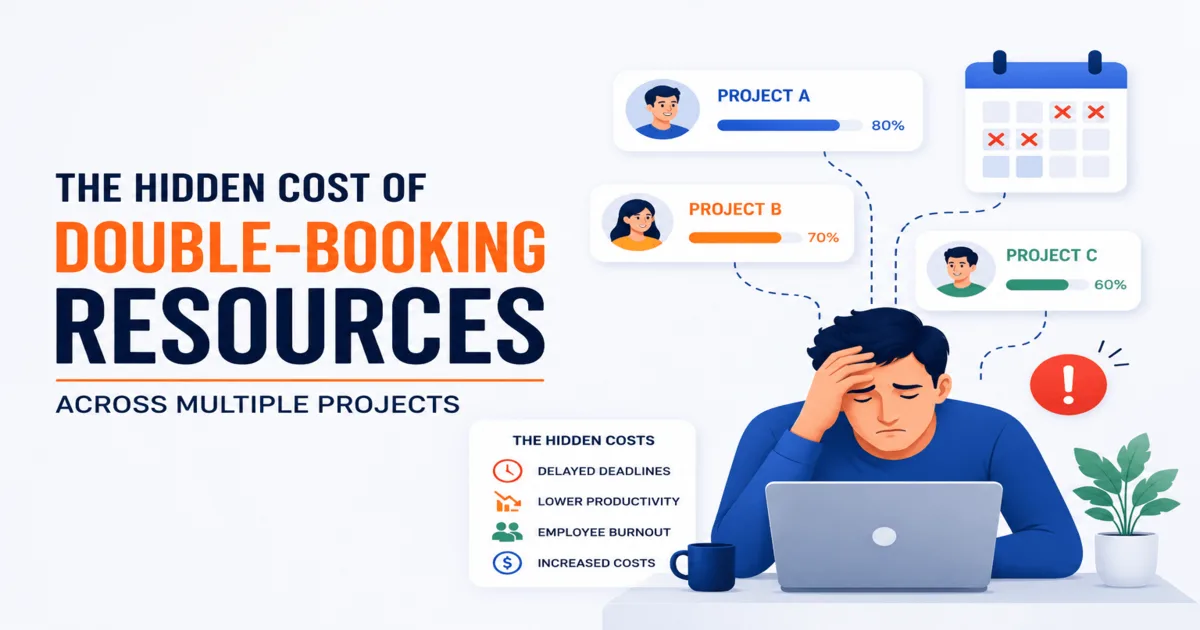
Every project manager has faced this scenario: a key developer is committed at 100% capacity to a product launch, yet simultaneously pulled into a critical client escalation on a different account. Both project plans look clean in isolation. In reality, the organization has created a silent crisis and no one realizes it until deadlines slip, quality drops, or the employee burns out.
Double-booking resources across multiple projects is one of the most persistent and costly problems in project-driven organizations. Yet because it often happens gradually and without intent, it routinely escapes notice until the damage is done. This article explores the root causes, real consequences, and practical solutions, including how modern resource management software supports smarter workforce planning.
What Is Double-Booking in Modern Project Environments?
Resource double-booking occurs when the same employee, team, or shared asset is assigned to multiple projects simultaneously in a way that exceeds their available capacity. In the context of project resource management, a resource allocated at 100% to Project A should not be concurrently assigned to Project B — yet this happens constantly in organizations that rely on informal communication, disconnected spreadsheets, or siloed planning tools.
In modern project environments, where professionals often work across distributed teams, hybrid engagements, and overlapping project timelines, the complexity of resource scheduling has grown significantly. A senior consultant may be listed as "available" in three different project plans maintained by three different project managers, none of whom have visibility into the others' commitments.
Double-booking is rarely a deliberate decision. It is most often the result of poor resource visibility, inadequate workforce planning systems, and the organizational pressure to say "yes" to every project simultaneously.
Understanding why double-booking occurs is the first step toward prevention. The most common causes include:
- Siloed project planning: Project managers operate in isolation, each building their own resource plans without access to a centralized view of overall resource utilization.
- Reliance on spreadsheets: Static spreadsheets cannot dynamically reflect real-time changes in resource availability, project scope, or team scheduling across the organization.
- Lack of a resource capacity planning process: Organizations approve projects without first confirming that sufficient, appropriately skilled resources are actually available to deliver them.
- Informal allocation practices: Resources are verbally committed or added to messaging channels rather than formally logged in a resource management system.
- Last-minute project additions: Urgent client demands or executive-sponsored initiatives displace existing commitments without adjusting timelines or staffing plans.
- Poor demand forecasting: Without resource forecasting, organizations cannot anticipate upcoming capacity gaps, leading to reactive and often conflicting assignments
The Real Costs: Impact Across the Organization
The consequences of double-booked resources extend far beyond individual projects. They ripple across timelines, finances, team culture, and client relationships.
1 Project Delivery Timelines
When a resource is split between two or more projects, the cognitive load of context-switching alone reduces effective productivity significantly. Research by the American Psychological Association has found that multitasking can reduce productivity by as much as 40%. In project delivery terms, this means tasks take longer, dependencies are missed, and milestone dates drift — often triggering cascading delays across dependent workstreams.
2 Employee Burnout and Morale
The human cost of resource overallocation is severe. Employees who are consistently double-booked face impossible choices about which commitments to prioritize, often working extended hours to meet competing expectations. Over time, this leads to chronic stress and decision fatigue, reduced job satisfaction, increased absenteeism, and diminished quality of work as energy and focus are stretched thin.
For organizations in consulting, IT services, or professional services where talent is the primary asset, losing experienced employees to preventable burnout carries enormous financial and operational consequences. Industry benchmarks estimate that replacing a single employee costs 50–200% of their annual salary when recruitment, onboarding, and lost productivity are factored in.
3 Client Satisfaction and Reputation
Double-booking places project commitments at risk. When delivery timelines slip or quality degrades because a team member was spread too thin, it is the client who bears the outcome. In consulting and IT services environments, where client relationships are built on trust and reliability, even a single project failure attributable to poor resource allocation can damage long-term account value.
📋 Real-World Scenario — IT Consulting
A mid-sized IT consulting firm simultaneously allocates its lead architect to a cloud migration engagement and a security audit for two different clients. Both projects slip by six weeks. One client escalates. The other quietly moves to a competitor at renewal. The firm loses not just revenue, but two reference accounts compounding the financial damage far beyond the original project margins.
4 Profitability
Resource double-booking directly erodes project profitability in several ways:
- Unplanned overtime costs: Overallocated employees often incur overtime pay or compensation time not budgeted into the project margin.
- Rework and quality defects: Work completed under cognitive overload is more likely to contain errors, requiring additional remediation effort.
- Scope creep and budget overruns: Timeline delays driven by resource conflicts frequently trigger contract amendments and cost overruns.
- Recruitment and onboarding costs: Burnout-driven attrition triggers replacement hiring, costing 50–200% of the departing employee's annual salary.
Real-World Scenarios: What Double-Booking Looks Like in Practice
Scenario 1 — Regional IT Services Firm
A regional IT services company has twelve project managers overseeing forty active engagements. Resources are tracked in individual project plans in a shared drive. A senior database administrator is listed at full capacity in three separate projects. Each PM believes they have priority. The DBA receives conflicting instructions from three managers, defaults to the most visible request, and leaves two projects in limbo. A client audit reveals the firm delivered only 68% of contracted hours with quality-compliant work. The firm absorbs a financial penalty and loses the renewal.
Scenario 2 — Corporate PMO, Financial Services
A corporate PMO launches five strategic initiatives simultaneously. A compliance analyst is formally assigned to all five. During a regulatory review, the analyst's deliverables across three projects are found to be incomplete or outdated — there was simply never enough time to do thorough work on any of them. The incident triggers an internal audit and a delay in a core product launch, costing the business an estimated three months of revenue opportunity.
6. Best Practices to Prevent Resource Conflicts
Preventing double-booking is fundamentally a process and visibility challenge. The following best practices represent the most effective organizational interventions:
Centralize Resource Allocation
Establish a single source of truth for all resource commitments across the project portfolio. No project should be able to formally allocate a resource without that allocation being reflected in a shared, organization-wide workforce planning system. This eliminates the siloed planning that enables double-booking to occur.
Implement Formal Resource Capacity Planning
Resource capacity planning—the practice of comparing available resource capacity against current and forecasted project demand—should be a prerequisite to project approval, not an afterthought. Before a project is greenlit, the PMO should confirm that required skills and headcount are available at the required time and utilization levels.
Build a Resource Forecasting Cadence
Resource forecasting extends visibility beyond the current period, allowing organizations to identify future capacity gaps before they become active conflicts. A rolling 12-week or quarterly forecasting cadence, reviewed at the portfolio level, enables proactive staffing decisions rather than reactive firefighting.
Define Clear Allocation Policies
Establish and enforce organizational rules around maximum resource allocation per individual (e.g., no single resource allocated above 80–85% to allow for meetings, training, and unplanned work). Define how conflicts between project priorities are escalated and resolved.
Improve Team Scheduling with Structured Check-Ins
Regular structured team scheduling reviews—at both the project and portfolio level—surface allocation conflicts early. These reviews should include actual hours logged versus planned, upcoming resource demand, and flags for individuals at or near capacity thresholds.
7. The Role of Resource Management Software in Preventing Double-Booking
Modern resource management software addresses the root causes of double-booking by replacing disconnected spreadsheets and informal processes with a unified, real-time view of resource utilization across the entire project portfolio.
Effective platforms provide:
- Real-time resource visibility: A consolidated view of who is allocated, at what percentage, and across which projects at any point in time.
- Capacity vs. demand dashboards: Visual representations of where resource supply meets or falls short of project demand, enabling proactive gap management.
- Conflict alerts and threshold warnings: Automated notifications when a resource is allocated beyond defined utilization thresholds, preventing overallocation before it is confirmed.
- Scenario planning: The ability to model alternative staffing arrangements before committing to a project plan, reducing the risk of structural conflicts.
- Integrated forecasting: Forward-looking demand modeling that accounts for project pipelines, skills requirements, and resource availability across future periods.
8. Actionable Recommendations: What Organizations Can Do Today
While technology plays a critical enabling role, process and leadership commitment are equally essential. Here are actionable steps organizations can implement immediately:
- Conduct a resource allocation audit: Map all current project resource commitments and identify any individuals allocated above 100% across the portfolio.
- Establish a PMO-led resource review process: Create a bi-weekly or monthly resource allocation review at the portfolio level, attended by key project and resource managers.
- Enforce a project intake process: Require resource capacity confirmation as a mandatory step before any new project is approved or staffed.
- Retire standalone spreadsheets: Transition resource tracking to a centralized workforce planning system with real-time data, rather than static files maintained in isolation.
- Train project managers on resource management fundamentals: Ensure PMs understand utilization thresholds, allocation policies, and the escalation path for resource conflicts.
- Create a resource conflict escalation protocol: Define clear ownership for resolving priority conflicts between projects, so overallocated employees are not left to navigate competing demands alone.
- Pilot resource forecasting for a 12-week horizon: Begin tracking upcoming resource demand against available capacity to build organizational muscle in proactive workforce planning.
Conclusion
Double-booking resources is not a minor scheduling inconvenience—it is a structural failure with measurable consequences for project delivery, profitability, client relationships, and the people organizations rely on most. The good news is that it is entirely preventable.
The organizations that excel at project resource management share a common characteristic: they treat resource capacity as a strategic asset, not an operational afterthought. They invest in the processes, governance, and technology including robust resource management software to maintain real-time visibility into how their workforce is committed across every project in their portfolio.
By combining disciplined resource capacity planning, proactive resource forecasting, and a culture of transparency around resource utilization, organizations can eliminate the hidden costs of double-booking and build a project delivery capability that is both high-performing and sustainable.