In March 2004, contract driller Patterson-UTI reported that weather had cost it about 120 drilling days, all from delays moving rigs. Against the 6,458 drilling days it logged that month, that works out to roughly 2%. The company noted the estimate excluded days lost when weather caused customers to delay preparing drilling locations (Petroleum News).
That data is old, and it points to weather, not roads. But anyone who’s worked a rig move knows how it actually plays out: the pad’s built, the crew’s booked, and the last few miles of lease road decide whether any of that matters. Roads aren’t the only reason a move slips dispatch; permits and equipment availability all play a part. Still, road condition tends to get assumed rather than checked. This article looks at how to spot road problems, match each one to the right fix, and measure whether anything actually improved.
Why Access-Road Reliability Matters to Oilfield Logistics
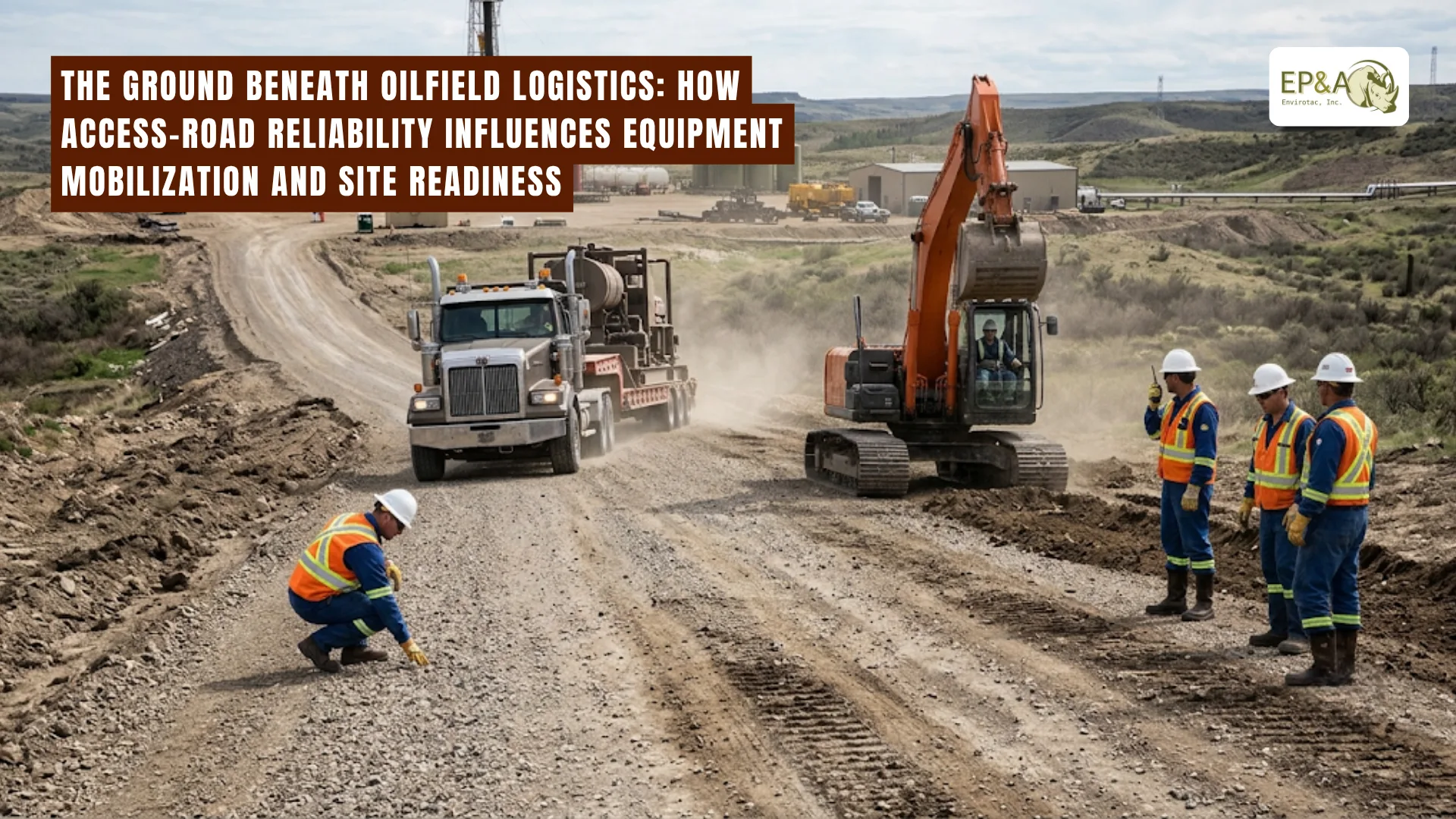
OSHA notes that rig equipment often travels over small roads that are sometimes poorly maintained and were never built for heavy trucks. It warns that soil at a new site may not be compacted enough to handle the load coming in and recommends confirming that the access road and pad are properly prepared before anything drives on them. That’s US guidance, so check what applies where you work.
Traffic can get heavy fast. On one unpaved forestry road in Clearfield County, Pennsylvania, maintained by the state Department of Conservation and Natural Resources, the surface had to carry up to 1,000 heavy vehicle trips a day (Tensar, Four Mile Road Subgrade Stabilization Project case study). A RAND and Carnegie Mellon study estimated that a single Marcellus well caused roughly $13,000 to $23,000 in wear on Pennsylvania state roads in 2011. That’s pavement damage, not delay cost, but it gives a sense of how hard one well can work a road.
The road, the route, and the receiving site are three separate things. A truck can make it to the lease entrance and still find the unloading area too soft or the staging space too tight. Review each one on its own.
Logging delays matters because rig moves are short. Nabors reported an average of 3.24 days per rig move in 2024. At that pace, one lost day eats up about a third of the entire move. Record delays by cause and you’ll know what the road actually cost you. Skip that step, and the road ends up blamed for everything or nothing.
The Road Conditions That Can Disrupt Equipment Mobilization
Different road problems call for different fixes, and lumping them together is where a lot of plans go wrong.
Dust and loose surface material
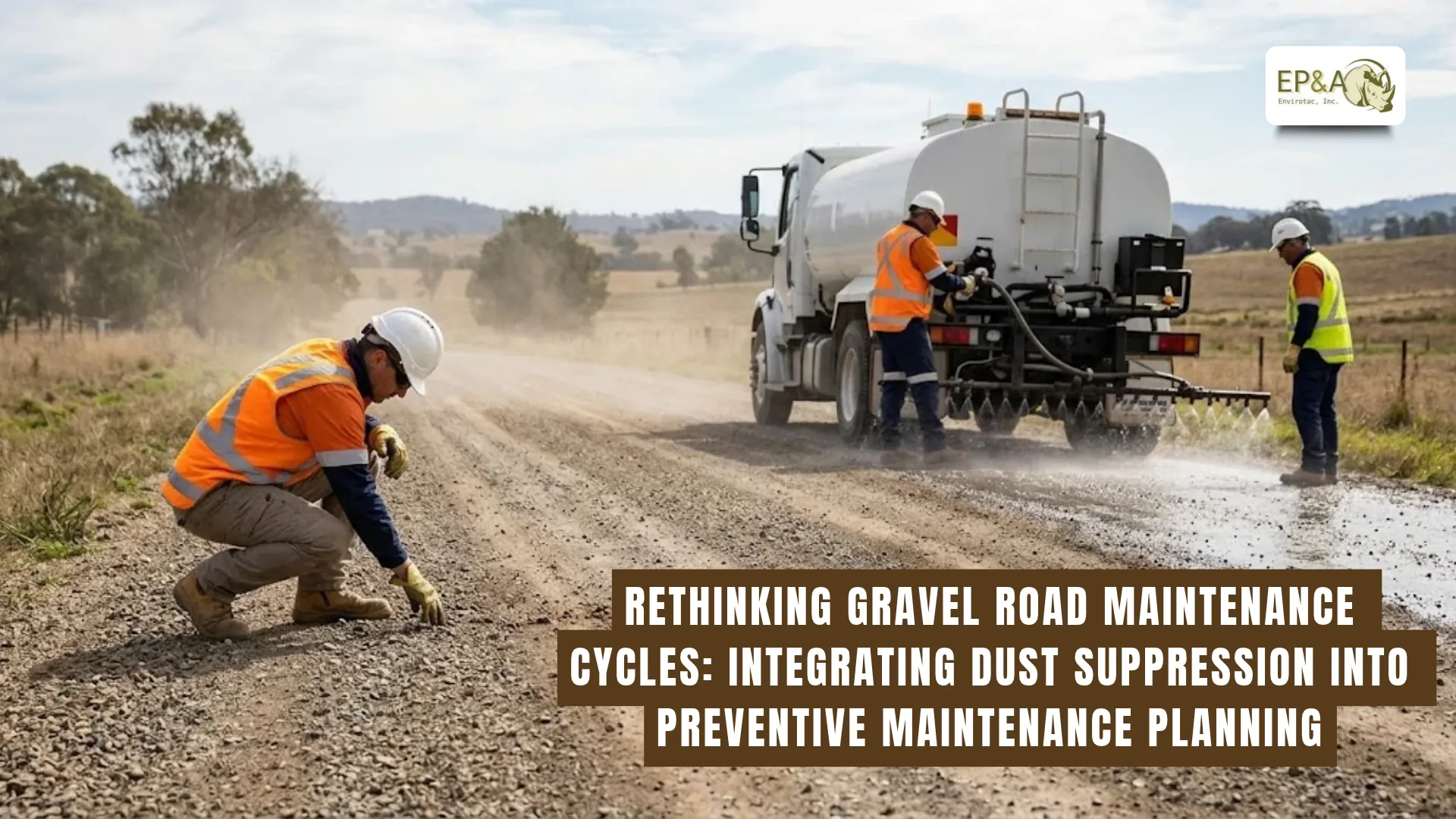
Traffic grinds down the surface and throws fines into the air. Those same fines help bind a gravel road together, which is why FHWA describes keeping them in place as closely linking dust control and road stabilization. FHWA also notes that many specifications cap fines at around 5%, based on the mistaken belief that this cuts down on dust. Strip the fines out, and you may end up with a looser road instead.
Treatments help, but the effect fades over time. In field tests at three surface coal mines in 1982, reported by the US Bureau of Mines the year after, chemical suppressants controlled roughly 40 to 60% of dust over the first two weeks. By week five, the thin data available pointed to under 20%. Watering every hour controlled about 40% of dust, and doubling that frequency pushed it to about 55% (US Bureau of Mines). In Colorado field tests run during the 1993 and 1994 dusty seasons, three suppressants cut dust by 50 to 70% and left 42 to 61% more aggregate on the road than an untreated section, at a net cost saving of 28 to 42% (Sanders et al., Journal of Transportation Engineering, 1997).
Studies don’t always agree, though. A study on two industrial roads in Spain, one paved and one unpaved, found that plain water washing outperformed calcium magnesium acetate at both (Amato et al.). Results depend on the road material, the product, and the conditions on site, so it’s worth running a trial before committing to anything.
Rutting, potholes, and recurring deterioration
These usually come from the material, repeated loading, and maintenance history working against each other. If a crew is patching the same spot every month, nobody has actually found the cause yet.
Drainage problems, standing water, and weak subgrade
Water moving across or under a road can undo good work fast. Threads on Reddit and Eng-Tips keep circling back to the same complaints: mud, potholes, truck wear, and waiting around. That tells you what operators gripe about, not how common any one problem actually is. If water or weak ground is behind the failure, dust suppression won’t fix it.
Grades, turning radius, width, clearance, and load capacity
A steep switchback stays a problem until someone changes the route or the transport plan. Judge it against the actual vehicle and load you’re moving, not some typical truck.
What Makes an Access Road Ready for Heavy Equipment?
Start with the equipment's configuration, loaded weight, and dimensions, and test the route against that, rather than the other way around.
Then look at the surface and the ground beneath it. Note any defects, soft spots, and how water drains. If you spot signs of structural or ground trouble, bring in a qualified engineer before choosing a treatment.
Finally, check the receiving site. Unloading space, staging, and positioning all belong in the same review as the road itself.
A Practical Pre-Mobilization Access-Road Checklist
For each planned movement, record:
Planned equipment: configuration, load, and dimensions
Route geometry: width, grade, turning radius, and clearance
Surface condition: loose material, potholes, rutting, erosion
Ground and drainage: soft spots, standing water, drainage issues
Dust and exposure: current conditions and controls
Receiving site: unloading area, staging space, positioning needs
Corrective actions: issue, owner, deadline, how it will be verified
Decision: proceed, proceed with agreed conditions, or hold.
The list doesn’t set universal limits for grade, width, or bearing capacity; that’s deliberate. Those depend on the route, the loads, and your site procedures, so it’s up to your site and engineering authorities to set them.
Choosing the Right Intervention for the Road Problem
Match the response to what is actually failing:
Dust on a serviceable road: check the surface material, traffic, moisture, and watering practice, then evaluate a treatment.
Loose material and recurring loss: review the aggregate, grading, and maintenance history. Regrading or replenishment may come first.
Mud and wet-weather failure: look at drainage and runoff before anything else.
Rutting under load: assess ground strength and road structure. This is engineering work.
Tight turns, steep grades, or narrow access: change the route or the transport plan.
FHWA says a chemical additive only works well on a properly engineered, maintained road, and that results depend mainly on how well it suits the surface material. Structural fixes play by different economics. Tensar reports that its geogrid, installed on 9.5 miles of weak access road in Clearfield County, Pennsylvania, reduced aggregate needs and saved the project owner an estimated $1.2 million in materials and installation (Tensar case study. That’s a supplier’s construction figure, though it says nothing about dust or mobilization time.
It’s also worth checking what a treatment puts into the environment. Penn State researchers found that oil and gas wastewater spread on roads for dust control carried radium, salts, and organic compounds well above drinking water standards. They also estimated that road spreading in Pennsylvania from 2008 to 2014 released over four times more radium than treatment facilities did (Tasker et al., 2018). Commercial products fall into a different category, so read each product’s own documentation.
How to Measure Access-Road Reliability and Operational Impact
Without a baseline, you’re just guessing. Before changing anything, record the road’s condition, traffic, weather, maintenance routine, and operating costs. Then track these separately:
Road-attributable delay hours, with the documented cause
Access restrictions or closures, with duration and road segment
Equipment arrival against planned windows
Maintenance hours and watering demand, including tanker trips
Dust, measured the same way every time.
Treatment cost, including preparation, application, and reapplication
Don’t let one number stand in for another. Less dust doesn’t prove fewer delays, and fewer water truck trips don’t prove a stronger road. Dutco Tennant reports a trial of GRT Haul-Loc on a 12 km corridor, with tanker journeys down 70% and light-vehicle air filters lasting about three times longer (supplier-reported trial; no methodology published). That’s the supplier’s own account, and it doesn’t show lower total water use, shorter mobilization time, or lower total cost.
When comparing costs, put the current approach next to the proposed one and count each idle hour only once. Don’t promise a return until your own site data backs it up.
How to Validate a Road-Treatment Approach Before Scaling
Decide what success means first; that might be less dust, lower watering demand, or fewer repairs. Then pick a representative section and, if possible, a comparison section. Record the baseline, traffic, preparation, product, monitoring method, and weather. Judge results over a period that fits the traffic, and report maintenance needs, cost, and limitations alongside the headline number. FHWA’s own conclusion is that a clear management process matters more than finding the “best” additive.
Where a Dust-Control Company Can Help
Once the problem is clear, a provider can help work out which options are worth a trial, what site information is needed to judge fit, and where drainage or engineering work is needed instead. Envirotac can support that conversation within the scope of its current technical documentation and services.
Frequently Asked Questions
How do road conditions affect equipment mobilization?
Poor surface, ground, or geometry can restrict access, slow movements, or force changes to the plan.
Can dust control fix muddy roads or weak subgrades?
Not on its own. Those need drainage correction or engineering work.
How do you measure road-attributable delay hours?
Log each delay with its duration and documented cause, and keep road conditions separate from dispatch, permit, and equipment issues.
What should a trial measure?
Baseline condition, dust, watering, maintenance effort, cost, and access restrictions, using the same methods throughout.
Start With the Road. Then Choose the Solution.
Access-road problems have different causes, from airborne dust and loose surfaces to drainage and structural limits. Share the road conditions you’re dealing with, the traffic and equipment using the route, and the performance you need. EP&A Envirotac, Inc. can be a starting point for discussing suitable dust-control or stabilization options and what information is needed to assess them.
About the Author
Clay Anderson writes about haul road and access road maintenance, soil stabilization, and dust suppression for industrial sites. His articles help readers tell road problems apart, compare treatment options, and understand what affects performance once traffic and weather take over.