
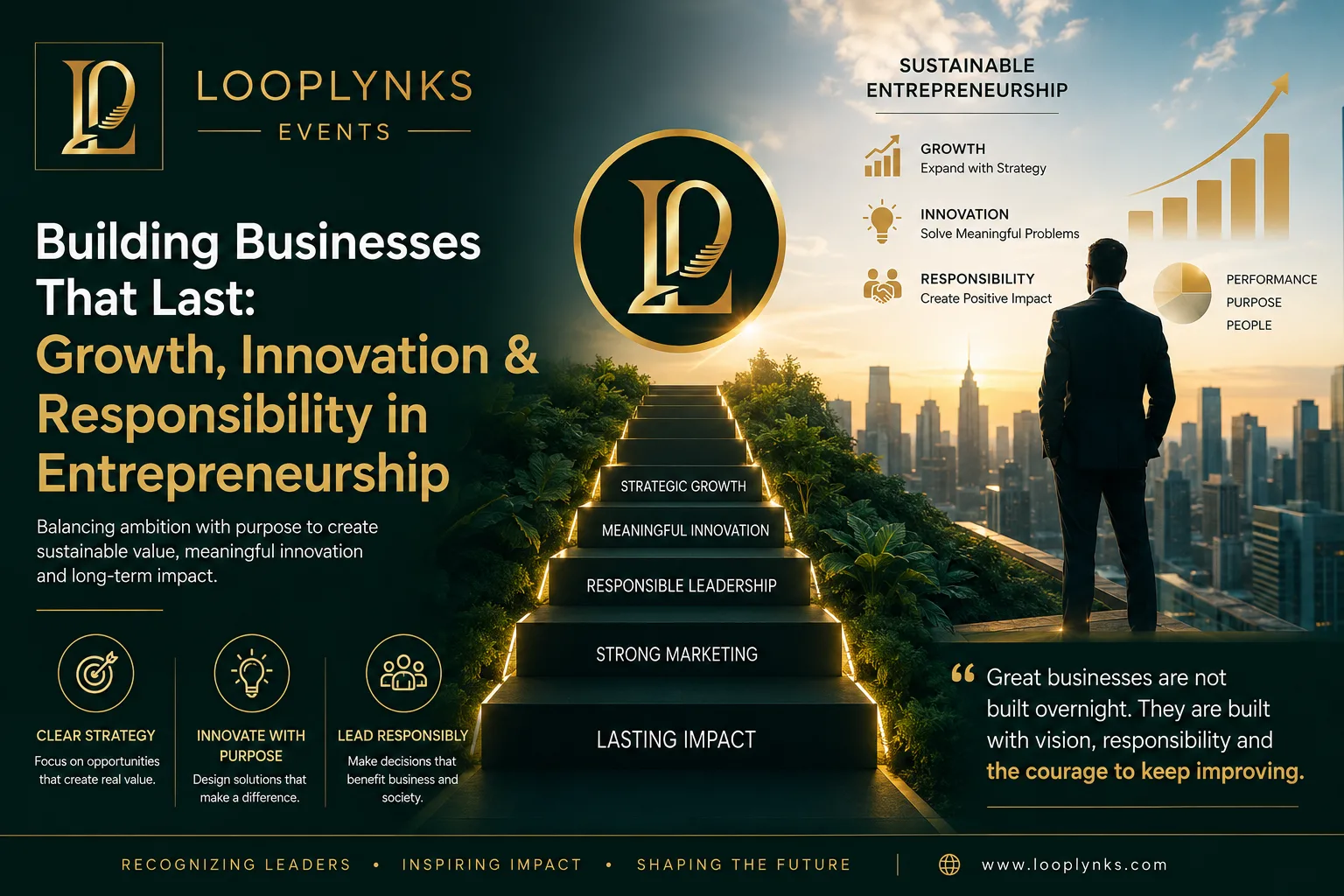
Entrepreneurship involves more than building a profitable business. It requires decisions about where to invest, which ideas to pursue, how to respond to changing customer needs, and what responsibilities accompany commercial success. For entrepreneurs seeking long-term relevance, growth, innovation, and responsibility cannot operate as separate priorities. They must inform one another.
A sustainable entrepreneurship award reflects an area of professional achievement in which business development and responsible decision-making intersect. The underlying challenge is practical: how can entrepreneurs expand their businesses, introduce new ideas, and remain accountable to the people and communities affected by their decisions?
The answer lies in treating growth as a long-term process rather than a race for immediate results.
1. Growth Needs a Clear Strategic Direction
Business growth can take several forms, including entering new markets, expanding a product portfolio, strengthening customer relationships, or improving operational efficiency. However, pursuing every opportunity can stretch resources and distract a business from its core purpose.
Entrepreneurs need to distinguish between growth that strengthens their position and expansion that merely increases complexity.
Before committing to a new opportunity, they can evaluate three questions:
- Market relevance: Does the opportunity address a genuine customer need?
- Business viability: Can the organisation support the investment without undermining its financial stability?
- Long-term value: Will the decision strengthen the business beyond its immediate financial return?
This approach encourages disciplined expansion. It also helps entrepreneurs assess whether an opportunity supports the principles associated with a sustainable entrepreneurship award, particularly when evaluating the relationship between commercial performance and responsible business practices.
2. Innovation Should Solve Meaningful Problems
Innovation is often associated with advanced technology, new products, or disruptive business models. Yet its value depends on whether it solves a meaningful problem.
Entrepreneurs can innovate by improving an existing service, simplifying a customer experience, redesigning an internal process, or finding a more effective way to deliver value. Technology can support these efforts, but introducing a new tool does not automatically create progress.
A practical innovation process follows four stages:
- Identify: Understand a customer problem, operational gap, or emerging need.
- Test: Develop a limited solution and assess its usefulness before committing substantial resources.
- Evaluate: Examine customer feedback, cost, feasibility, and unintended consequences.
- Improve: Refine the solution based on evidence and expand it when the results justify doing so.
This cycle makes experimentation more manageable. It also creates room to identify risks before an innovation reaches a larger audience.
For entrepreneurs, the objective is not to innovate continuously for its own sake. It is to build a business that can learn, adapt, and deliver better outcomes over time.
3. Responsibility Must Be Part of Business Decisions
Responsibility becomes meaningful when it influences everyday operations rather than remaining a statement in a company’s values document.
It can involve transparent communication with customers, fair treatment of employees, careful use of resources, ethical technology adoption, and honest representation of products or services. The priorities will differ by industry, business model, and scale, but the principle remains consistent: decisions should account for their wider consequences.
Entrepreneurs can use the following table to assess whether their priorities are working together.
| Business priority | Key question | Practical measure |
| Growth | Is the business becoming more resilient? | Revenue quality, customer retention and financial stability |
| Innovation | Is the new approach solving a real problem? | Adoption, customer feedback and measurable improvement |
| Responsibility | Are decisions consistent with stated values? | Ethical practices, resource use and stakeholder feedback |
| Leadership | Can the organisation sustain its progress? | Team development, accountability and execution quality |
These measures are illustrative rather than universal. Each business should select indicators that reflect its actual objectives and operating conditions.
The same discipline can inform a sustainable entrepreneurship award assessment: responsible leadership is more convincing when supported by decisions, actions, and outcomes rather than broad claims alone.
4. Marketing Must Connect Purpose With Performance
Even a useful product or responsible business model needs a clear way to communicate its value. Marketing helps entrepreneurs explain what they offer, whom they serve, and why customers should care.
However, effective marketing requires more than visibility. It depends on understanding audiences, communicating consistently, and ensuring that promotional claims match the actual customer experience.
This is where creativity and accountability intersect. A campaign may attract attention, but its longer-term value depends on whether the business can deliver on its promises.
The principles behind global marketing excellence awards are relevant to this discussion because marketing excellence involves strategic thinking, creative execution, audience understanding, and meaningful business objectives, not simply the volume of promotional activity.
Entrepreneurs can strengthen their marketing decisions by:
- Defining a specific audience before selecting communication channels.
- Connecting campaign objectives to broader business priorities.
- Using customer insights to refine messages and experiences.
- Avoiding sustainability or social-impact claims that cannot be substantiated.
- Evaluating outcomes instead of relying exclusively on reach or impressions.
A strong marketing strategy helps a business grow without creating a gap between the image it projects and the value it delivers.
5. A Practical Framework for Balancing the Three Priorities
Growth, innovation, and responsibility can compete for the same limited resources. A new technology investment may delay expansion, while a rapid expansion plan may leave insufficient time to improve internal processes.
Entrepreneurs can manage these tensions through a simple decision framework.
Step 1: Define the objective. Identify the business problem or opportunity behind the proposed decision.
Step 2: Assess the trade-offs. Consider financial cost, execution capacity, customer impact, and potential risks.
Step 3: Set measurable outcomes. Establish what success should look like and how it will be evaluated.
Step 4: Review the consequences. Check whether the decision delivers the intended value without creating avoidable problems elsewhere.
Step 5: Adjust when evidence changes. Be prepared to refine, delay, or discontinue an initiative when results do not support the original assumptions.
This framework does not remove difficult choices. It gives entrepreneurs a consistent way to make those choices with greater clarity.
6. Leadership Turns Principles Into Practice
A company’s priorities are shaped by its leadership. Founders and executives influence which opportunities receive funding, how teams approach experimentation, and whether responsibility remains part of decision-making when commercial pressure increases.
Leadership also involves recognising that progress is rarely a single achievement. It develops through repeated decisions, learning, collaboration, and accountability.
This perspective aligns with LoopLynks Events, which positions leadership as a continuous journey and brings attention to individuals and organisations whose work reflects innovation, integrity, and meaningful contribution. Its recognition platform spans professional fields, including executive leadership, technology and innovation, sustainability, and marketing and creative strategy.
Recognition can provide a moment to acknowledge achievement, but the more important question is what that achievement represents: the judgement, consistency, and work behind the result.
Conclusion: Build for Progress That Lasts
Entrepreneurs do not have to choose between ambition and responsibility. They need to ensure that expansion remains financially considered, innovation addresses genuine needs, and business decisions reflect clear principles.
A sustainable entrepreneurship award and global marketing excellence awards represent distinct areas of professional recognition, yet both connect to a broader discussion about how businesses create and communicate value. Their relevance lies not in the labels themselves, but in the leadership, strategy, and execution that underpin meaningful achievement.
By balancing growth with thoughtful innovation and responsible decision-making, entrepreneurs can build organisations better equipped to adapt, earn trust, and create value over time. Ultimately, lasting progress depends not only on how far a business grows, but also on how it grows and the impact its decisions leave behind.