
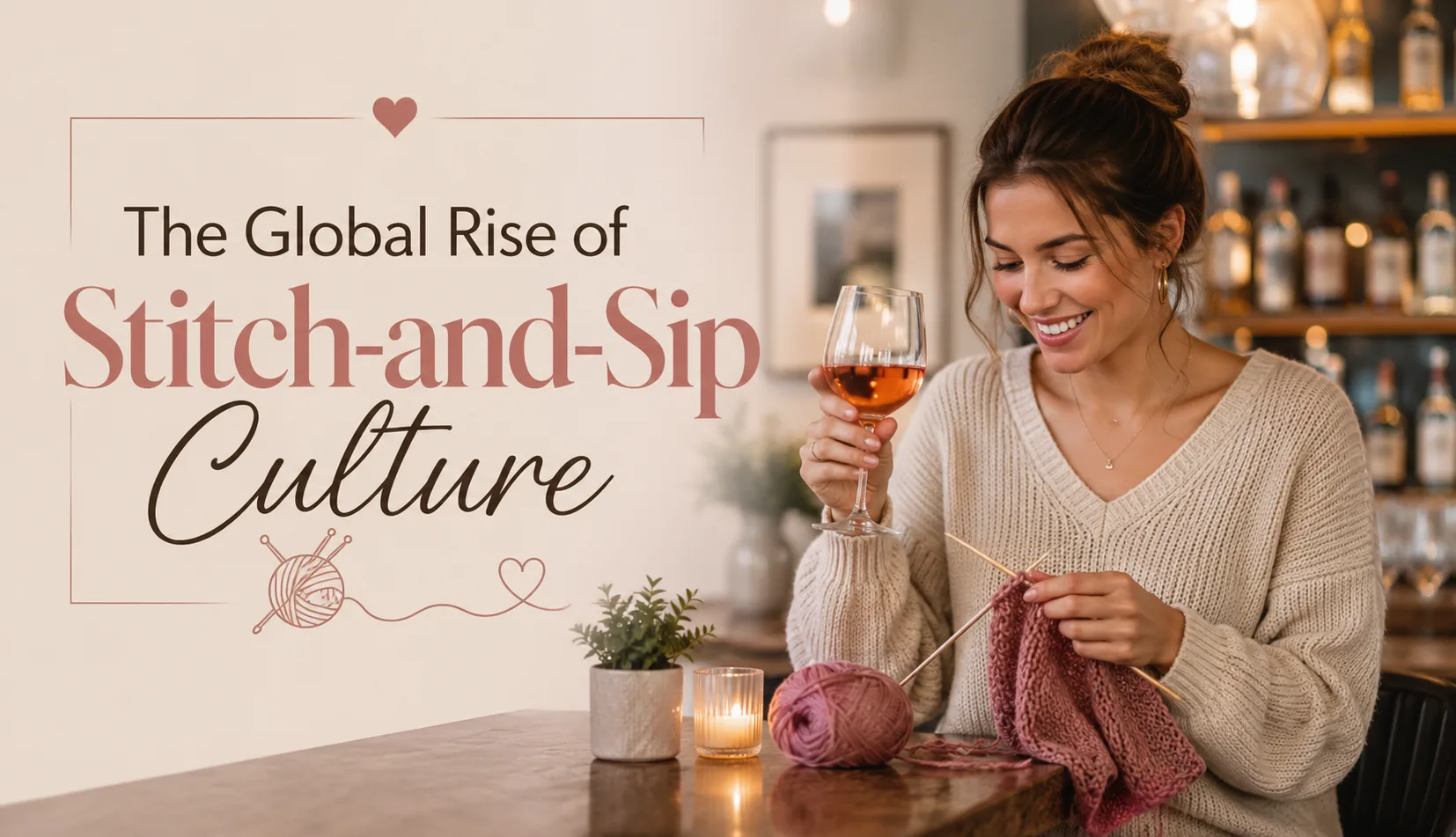
Sipping coffee, talking, and knitting in a coffee shop or in the community center is trending. The soft clicking of knitting needles and the quiet snag of a crochet hook are always inspiring for others. Welcome to stitch-and-sip culture, the global movement turning yarn crafts into the social plan of choice for people who are tired of loud bars and louder phones.
If you haven't experienced one, a stitch-and-sip is exactly what it sounds like: a casual meetup where people bring their current knitting or crochet project, order a drink — coffee, tea, wine, or increasingly a mocktail and spend an hour or two making things with their hands while they talk. There is no pressure to finish a project or to be an expert. You just need yarn, company, and something to sip.
From Knitting Circles to a Worldwide Trend
Knitting groups have been around forever. What's changed is the setting, the audience, and the reason people are showing up. Stitch-and-sip events used to be the domain of local yarn shops running the occasional Tuesday evening drop-in.
A yarn shop in a strip mall can suddenly have a Tuesday night waitlist; a cafe that used to close by 6 pm starts staying open for a knit night that runs past nine.
It's a low-cost, high-loyalty format — the shop or cafe gets a room full of regulars, and the crafters get expert help, better lighting than their living room, and someone else to make the coffee.
Why Now? Three Forces Behind the Boom
People are craving for third place. It's not home, and it's not work — it's somewhere you can just exist, without an agenda. For years, that role was filled by bars and coffee shops on their own. Now those same spaces are being asked to do double duty as creative studios, and crafting communities are becoming some of the most reliable third places.
Gen Z is rewriting the rules of a night out. Gen Z is leaning toward slower nights out — coffee over cocktails. They are widely described as the "sober-curious" generation — many are actively seeking out venues that offer the social atmosphere of a bar, minus the pressure to order something alcoholic. Stitch-and-sip nights fit that mood perfectly — they offer the ritual, the shared table, and the low-stakes chat of a bar night, minus the noise and the next-day regret.
Screens are exhausting, and hands want something to do. Years of doomscrolling and endless notification pings leave your mind exhausted, hungry for something different. Crafting has an edge that most other hobbies don't. It's creative, portable, and — unlike scrolling — impossible to do one-handed. A stitch-and-sip session demands a presence that's hard to find anywhere else: hands busy, phone in a bag, eyes on the person across the table instead of a screen.
What a Stitch-and-Sip Looks Like
Walk into one of these gatherings anywhere in the world, and you will see the difference. Someone sets a start and end time, usually an hour and a half to two hours. Attendees bring whatever they're working on — a simple cowl, a granny square blanket, or a sock that's been languishing in a project bag for months. A beginner two seats down might be learning to purl for the first time, coached by someone who picked up the hobby during lockdown and never put it down. Nobody's grading anyone's tension.
Social media — especially the crossover between crafting content and platforms like TikTok and Instagram Reels — has poured fuel on this. Crafters are filming their stitch-and-sip meetups the same way food bloggers film a dinner table, turning a quiet local gathering into content that pulls in curious newcomers from three time zones away. That visibility has done a lot of the heavy lifting in making stitch-and-sip feel like a movement rather than a niche hobby night.
The Quiet Benefits Nobody's Marketing
Ask them why they keep coming back, and the answer is rarely "I finished a lot of projects."It's usually something closer to "I look forward to it all week." There's a meditative quality to repetitive stitch work that pairs naturally with conversation — your hands are occupied enough to keep you calm, but not so occupied that you can't talk. That combination is part of why so many crafters describe these evenings as genuinely restorative rather than just fun.
Bringing Your Own Kit to the Table
Ask any regular what's in their bag, and you'll notice a pattern. Someone's sock project stalls mid-row because a cheap needle join keeps catching the yarn — and suddenly they're untangling a cable instead of talking to the person across the table. It's a small thing, but it's the difference between an evening that flows and one spent quietly wrestling with your own project. That's why so many crafters end up trading their old tools for ones built to disappear into the background: an interchangeable needle set that folds down small enough for a handbag, a hook whose join is smooth enough that you forget it's there, a case that keeps everything in one place instead of rolling under someone else's chair. The best tools at a stitch-and-sip are the ones nobody notices — because nobody's stopping to fix a problem the equipment shouldn't have caused in the first place.
Summary
Stitch-and-sip culture doesn't look like a passing fad. It sits at the intersection of three trends that all show every sign of sticking around: the search for real-world third places, a generation drinking less but socialising just as much, and a broader craving for slower, more tactile ways to spend an evening. Yarn shops, cafes, and bars that have embraced it report the same pattern: the same faces showing up week after week, not just a one-time crowd chasing a trend — which is usually the surest sign a trend has become a habit.
So if you've been meaning to pick knitting or crochet back up, there's rarely been a better excuse. Find a local group, grab whatever's on your needles, and order your drink of choice. The best part of stitch-and-sip culture was never really the sip. It's the hour and a half of company that comes with it.