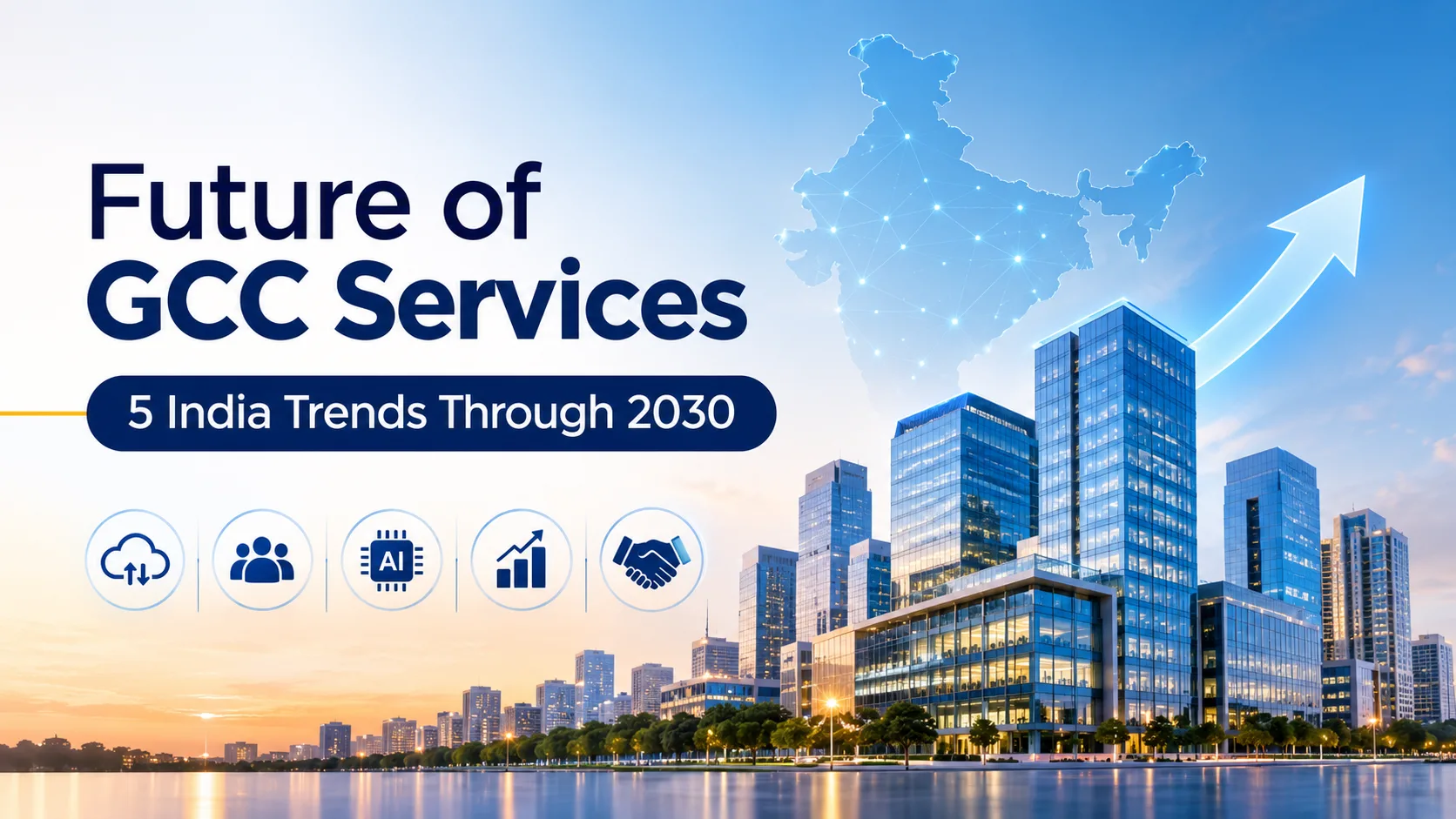
Through 2030, Global Capability Centers (GCCs) in India will continue moving up the value chain—from handling back-office tasks to owning products, running AI, and setting standards for their parent companies. One practical route for many firms is Build Operate Transfer IT outsourcing: build the center with a partner, operate it until it reaches maturity, and then take ownership rather than carrying the full risk of a cold start.
This article examines five trends shaping that shift and what they mean for setting up a GCC.
Forward-looking statements involve uncertainty. Treat dated projections as directional rather than guaranteed, and verify market figures against current sources before using them for planning.
Trend 1: From Cost Centers to Innovation Engines
GCCs are moving beyond labor arbitrage toward core product development, advanced analytics, and AI. This shift is also explored in [how AI and automation are transforming GCC services](/blog/ai-automation-transforming-global-capability-center-services-2026).
By 2030, centers measured only by cost per seat may look outdated compared with those measured by business outcomes. The strategic question is shifting from “How cheaply can this work be done?” to “How much of our product and innovation can this center own?”
Trend 2: Agentic AI and Intelligent Automation Inside Operations
Automation within GCCs is moving beyond conventional robotic process automation (RPA) toward Intelligent Process Automation and agentic systems. These systems can plan multi-step work and check their own outputs.
Autonomous agents are expected to take on more routine work across IT, finance, and data operations, while people supervise outcomes. As a result, the workforce mix may shift toward engineers and reviewers who design, govern, and oversee the rules that agents follow.
Trend 3: Expansion into Tier-2 Cities
GCC growth is spreading beyond Bengaluru, Hyderabad, and Gurugram into Tier-2 cities such as Kochi, Jaipur, and Coimbatore. These locations offer lower costs, steady engineering talent, and lower attrition, making them attractive as major metros become more crowded and expensive.
More centers and satellite sites may emerge in Tier-2 locations through 2030. The trade-off is a thinner pool of senior talent, which makes choosing a capable local partner especially important.
Trend 4: Data Sovereignty and Localized AI
As GCCs take on more AI workloads and handle increasingly sensitive data, data sovereignty is becoming a core design requirement rather than an afterthought.
More centers may run fine-tuned open-source models within their own secure environments instead of sending proprietary data to public APIs. This can help keep intellectual property in-house and support compliance with requirements such as India’s DPDP Act, the GDPR, and the CCPA.
Security and compliance therefore need to be considered early in the build. The cost of getting them wrong increases as the data handled by a center becomes more valuable.
Trend 5: Ownership Models and the Rise of Build Operate Transfer IT Outsourcing
The way companies establish GCCs is changing. More organizations want an owned captive center without taking on the full upfront risk of building one from scratch. The [Build Operate Transfer (BOT) model](/engagement/bot) is designed to bridge that gap.
Build Operate Transfer IT outsourcing is positioned to gain ground because it sits between renting a vendor team and building and owning a full GCC independently. A partner builds and operates the center before transferring it to the client.
For more detail, see [the evolution of IT outsourcing and the BOT model](/blog/build-operate-transfer-it-outsourcing) and the [step-by-step guide to setting up a GCC in India](/blog/how-to-set-up-a-gcc-in-india-step-by-step-guide).
What the 2030 Trends Mean for Build Operate Transfer IT Outsourcing
The five trends point to one practical conclusion: design a GCC to own products and run AI from the beginning, rather than focusing only on cost reduction.
When evaluating Build Operate Transfer IT outsourcing, consider these priorities:
- Build for AI early: Include agent workflows, governance, and a strong data foundation during the build phase, not after the transfer.
- Choose the location deliberately: Match a Tier-1 or Tier-2 location to the work being done and the seniority mix required.
- Design compliance in from day one: Data residency and sovereignty are foundational design decisions, not later additions.
- Choose a partner who can transfer ownership cleanly: Evaluate the transfer methodology and how the client will take control of the center, not just the partner’s sales proposition.
Ready to Build a Future-Ready GCC in India?
MetaDesign Solutions uses Build Operate Transfer IT outsourcing to establish GCCs designed for AI, ownership, and compliance from day one, then transfers the center to the client.
Frequently Asked Questions
What are the biggest GCC trends in India through 2030?
The main trends are the shift from cost centers to innovation engines, agentic AI and intelligent automation in operations, expansion into Tier-2 cities, data sovereignty with localized AI models, and the growing use of ownership models such as Build Operate Transfer IT outsourcing.
How will AI change GCCs by 2030?
Automation is moving beyond conventional RPA toward intelligent process automation and agentic systems that can handle multi-step work and check their own outputs. Agents may take on more routine IT, finance, and data operations, while people supervise outcomes. The workforce mix is likely to place greater emphasis on engineers and reviewers who define the rules agents follow.
Why is Build Operate Transfer IT outsourcing becoming the default GCC path?
Build Operate Transfer IT outsourcing bridges the gap between renting a vendor team and owning a captive center. A partner builds and operates the center, then transfers it to the client. This provides a path to ownership without requiring the company to carry the full upfront risk of a cold build.
Will GCCs expand beyond metros by 2030?
The article identifies growth spreading into Tier-2 cities such as Kochi, Jaipur, and Coimbatore. These locations offer lower costs, engineering talent, and lower attrition than crowded metros. More centers and satellite sites may be established in Tier-2 locations, with local partners helping address the thinner senior-talent pool.