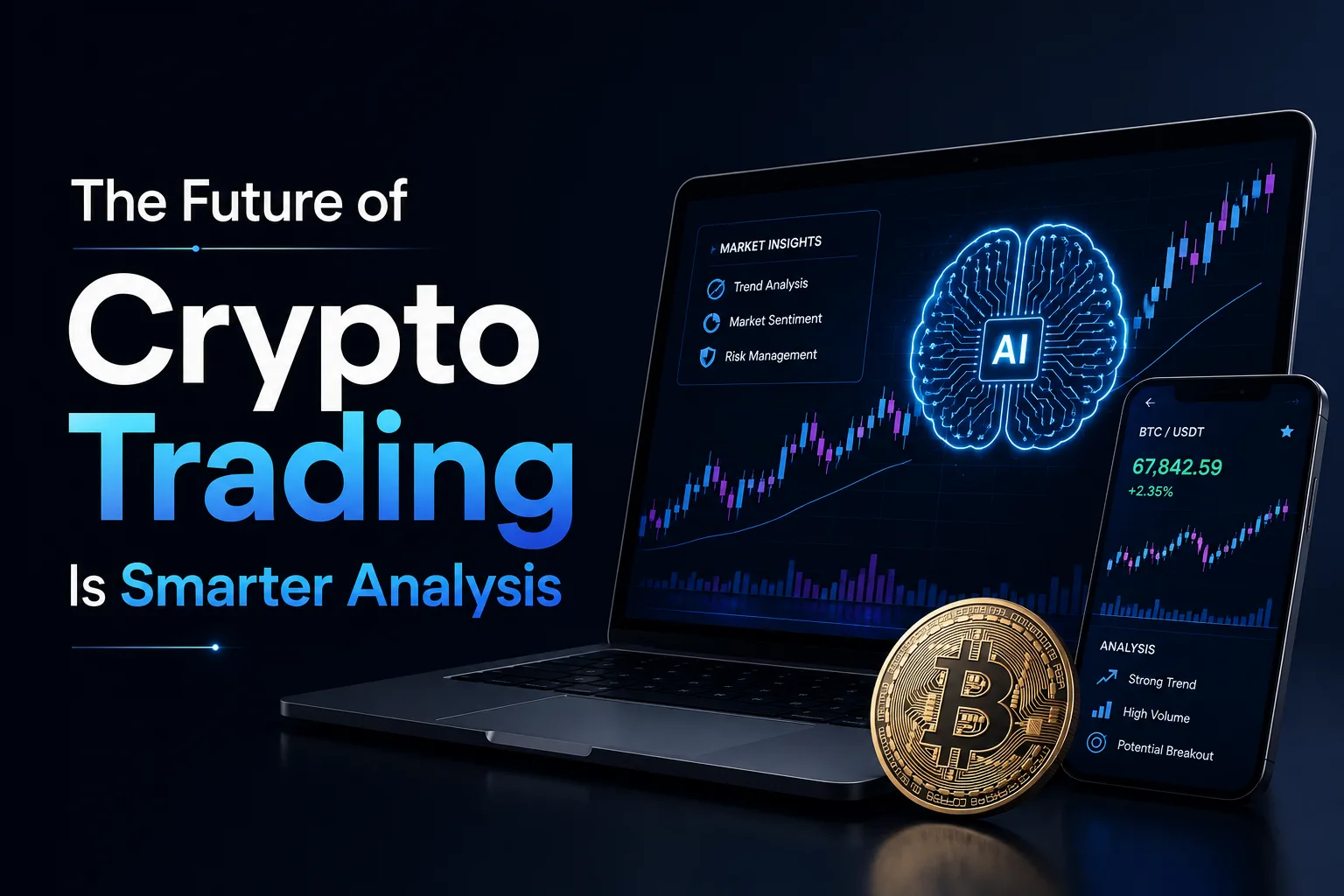
Crypto trading has changed significantly. Traders once relied mainly on price charts, a handful of indicators, and information from a few trusted sources. Today, the market produces far more data than any individual can reasonably monitor.
Prices move across exchanges. News can change sentiment within minutes. Liquidity shifts as traders enter and exit positions. Derivatives markets reveal changing leverage and positioning. Social activity can amplify a narrative before it reaches the wider market.
The challenge is no longer simply finding information.
The challenge is understanding which information matters, how different signals connect, and what they mean for the market.
This is where smarter crypto market analysis is becoming increasingly important.
Why More Data Does Not Always Mean Better Trading
Crypto traders have access to more information than ever, but having more data does not automatically lead to better decisions.
A trader can monitor dozens of charts, hundreds of social posts, breaking news alerts, trading indicators, and market dashboards and still miss an important development.
The problem is information overload.
What matters is being able to identify meaningful changes within all that noise.
For example, a sudden increase in trading volume may look bullish. But if the move is caused by short liquidations, the situation could be very different. Similarly, positive social sentiment may attract attention, but weak liquidity or unfavorable derivatives positioning could make the move difficult to sustain.
Smarter analysis focuses on context rather than isolated signals.
From Price Watching to Market Intelligence
Traditional technical analysis remains useful. Price structure, support and resistance, volume, momentum, and trend analysis can help traders understand market behavior.
But crypto markets have become too interconnected to evaluate price alone.
A major move can be influenced by news, liquidity, exchange activity, derivatives positioning, macroeconomic events, or changing market sentiment.
This has created a growing role for crypto market intelligence.
Market intelligence brings different sources of information together so traders can understand not only what the market is doing, but also the conditions surrounding the move.
That shift is important because the same price pattern can have very different implications depending on what is happening underneath it.
Real-Time Information Is Becoming More Important
Crypto markets operate around the clock.
There is no traditional closing bell that gives traders a clear pause between one session and another. News can emerge at any hour, and market conditions can change rapidly.
Because of this, outdated information can become less useful very quickly.
Real-time crypto market data can help traders monitor changes in price, volume, liquidity, derivatives activity, and other market conditions as they develop.
The goal is not to react to every movement.
It is to identify changes that could materially affect a trading decision.
AI Is Changing How Traders Process Information
Artificial intelligence is becoming an important part of this shift.
AI can process large amounts of information much faster than a human trader can manually review. It can help identify relationships between market activity, news, price movements, and other signals.
This does not mean AI can predict every crypto market move.
Markets remain uncertain, and unexpected events can invalidate even strong analysis.
The more practical use of AI is helping traders filter information, identify relevant developments, and build context around potential opportunities.
That makes AI-powered crypto trading less about replacing human decision-making and more about improving the information available before a decision is made.
Why Context Matters More Than a Single Signal
A trading signal can tell you that something is happening.
Context can help explain why.
Consider a token that suddenly breaks above resistance. A basic trading system might identify the breakout and generate a bullish signal.
A smarter analysis would ask additional questions.
Is trading volume increasing?
Is liquidity strong enough to support the move?
Are derivatives traders increasing their exposure?
Is there a major announcement behind the price movement?
Is broader market sentiment improving?
Are other assets in the same sector moving in the same direction?
These questions can change how the original signal should be interpreted.
This is why crypto trading intelligence is becoming more valuable as markets become increasingly data-driven.
The Role of Liquidity and Derivatives Data
Liquidity and derivatives activity can reveal information that is not always visible on a standard price chart.
Liquidity shows how easily buying and selling pressure can be absorbed by the market. Thin liquidity can make prices more vulnerable to sharp movements.
Derivatives data can provide insight into leverage, positioning, funding rates, open interest, and liquidation activity.
When combined with price and volume data, these signals can provide a deeper understanding of market conditions.
For active traders, this broader view can be particularly useful during periods of high volatility.
Smarter Analysis Can Reduce Emotional Decisions
Trading psychology remains one of the biggest challenges in crypto.
Fear can cause traders to exit too early. FOMO can encourage late entries. A few successful trades can create overconfidence, while a series of losses can lead to revenge trading.
Better information does not eliminate emotions, but a structured analysis process can help traders make decisions based on evidence rather than immediate reactions.
Instead of buying simply because a token is trending, a trader can evaluate the trend, liquidity, volume, sentiment, and market context first.
That small difference can have a significant impact on decision-making.
Where Platforms Like i5 Fit Into This Future
The future of crypto trading is unlikely to be about traders manually collecting information from dozens of different sources.
It is more likely to involve intelligent systems that bring relevant information together and help traders understand the market more efficiently.
This is the direction platforms such as i5 are exploring.
By combining trading signals with broader market intelligence, real-time information, and contextual analysis, i5 aims to help traders look beyond isolated price movements.
The value is not simply receiving another alert.
It is having more context around the alert so that the trader can decide whether the information is actually relevant to the situation.
What Will Smarter Crypto Trading Look Like?
Smarter crypto trading will likely involve a combination of human judgment and intelligent technology.
Traders will still need to define their strategies, manage risk, understand market behavior, and make final decisions.
At the same time, AI systems can help monitor markets continuously, process large datasets, identify unusual activity, and surface potentially important developments.
This creates a more efficient relationship between the trader and the information available to them.
The objective is not to remove humans from trading.
It is to help humans spend less time searching for information and more time understanding it.
The Future Is Not About More Signals
Crypto traders already have access to countless indicators, alerts, and trading signals.
Adding more signals does not necessarily solve the problem.
The real opportunity is creating better connections between different types of information.
A price movement combined with liquidity data, derivatives activity, news, sentiment, and market structure can tell a much richer story than price alone.
That is the direction in which AI market analysis and crypto market intelligence are moving.
The future of trading is therefore unlikely to be defined by who has the most information.
It will be defined by who can understand the most relevant information quickly and make disciplined decisions from it.
Final Thoughts
The future of crypto trading is not simply about faster execution or more trading signals.
It is about better understanding.
As crypto markets become more complex, traders need tools that can help separate meaningful developments from constant market noise. AI, real-time data, derivatives analysis, liquidity monitoring, and crypto market intelligence can all contribute to that process.
The trader of the future may not be the person watching the most charts.
It may be the person who can understand the right information at the right time and turn that information into a disciplined trading decision.