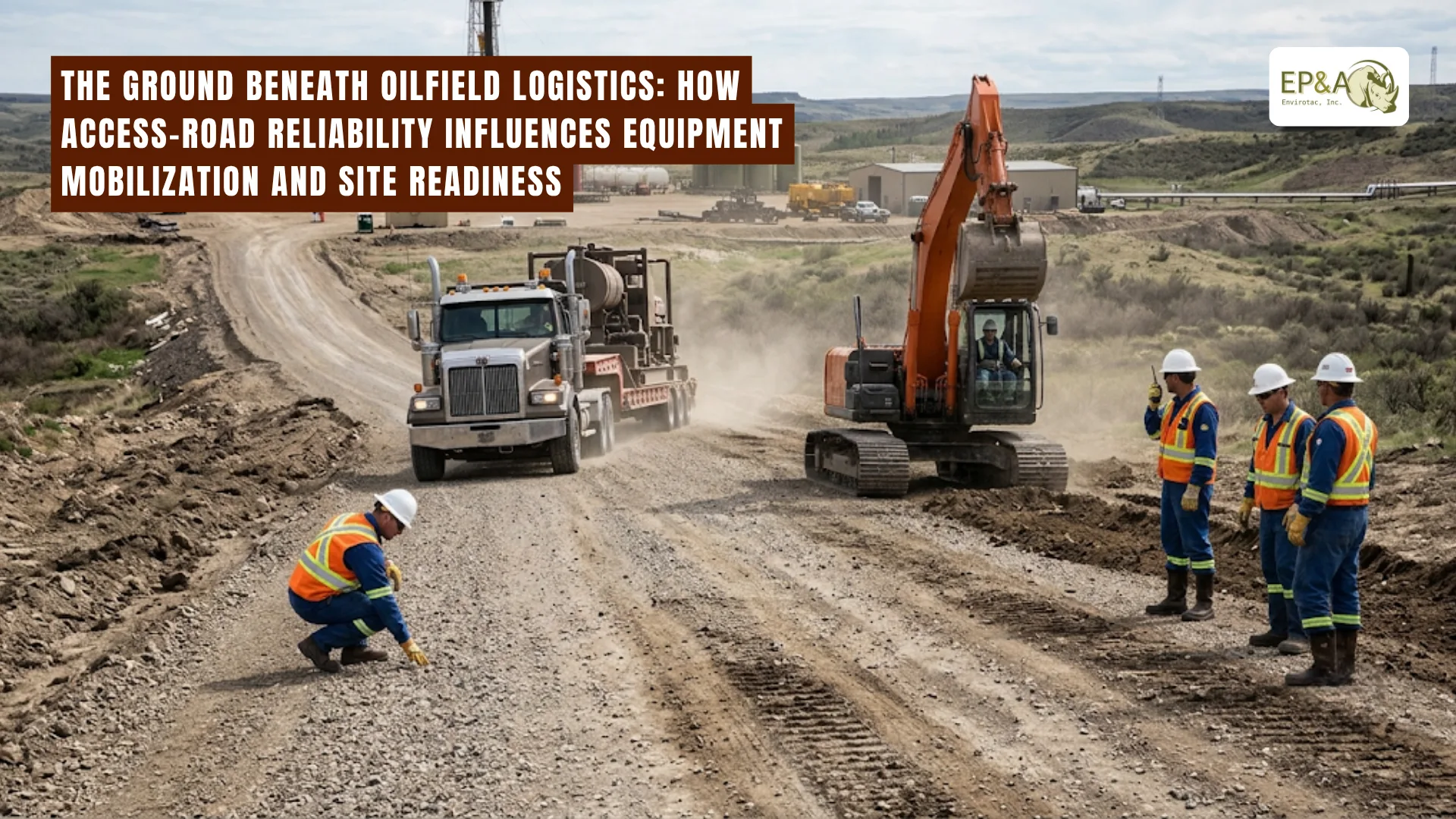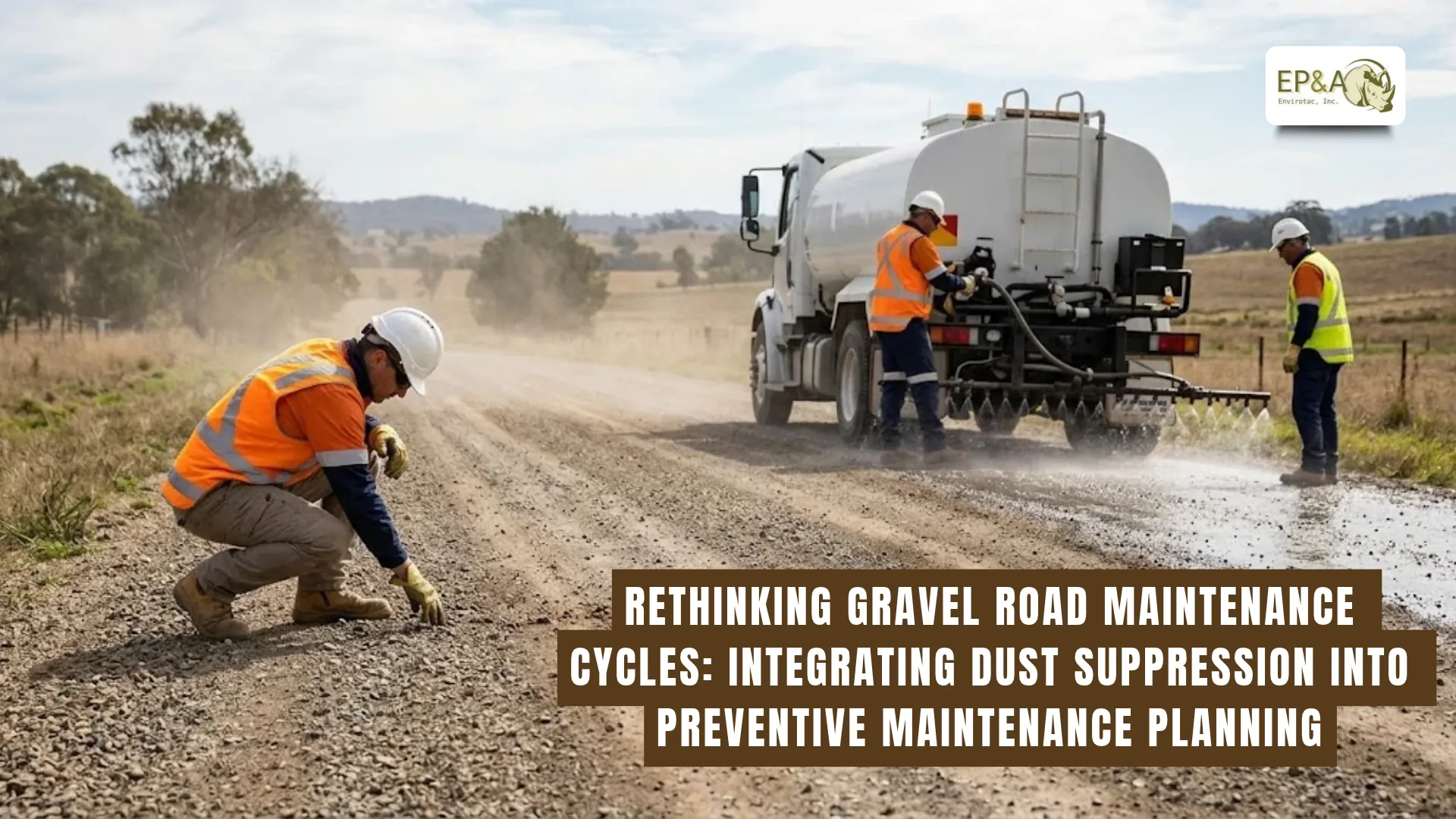
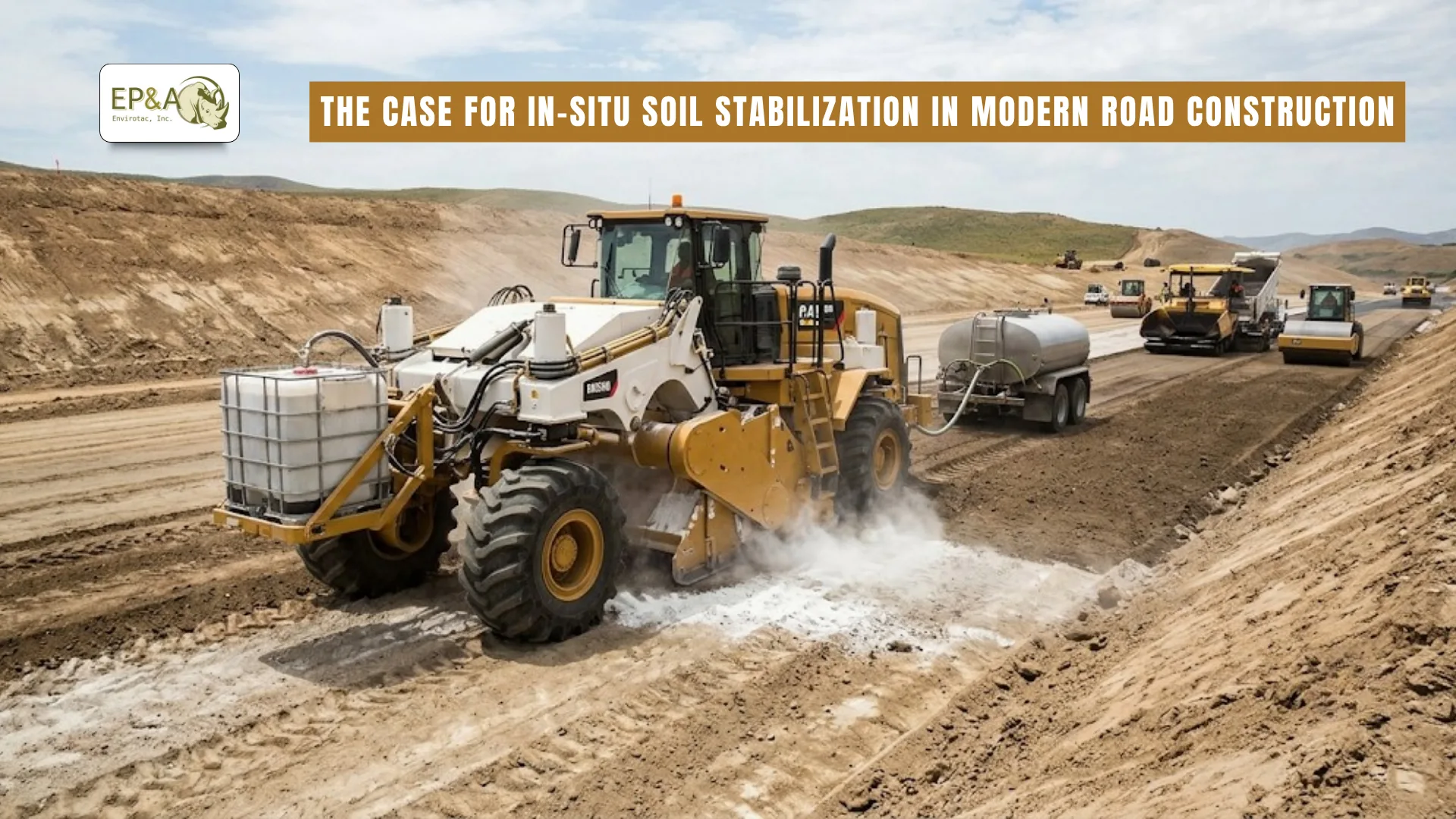
Plenty of road treatments fail before the first truck drives over them, simply because nobody tested the soil. The US Federal Highway Administration (FHWA) ran into this when it visited unpaved road programs. Road managers rarely did more than limited testing of their road materials, so the treatments they bought often didn’t match what was under their wheels, and performance suffered. Those were dust treatments on gravel roads, but the same thing happens on larger projects.
Every road rests on its soil. If that soil is soft, wet, or inconsistent, the road shows it through ruts, regrading, and a maintenance budget that keeps coming back. The conventional answer is to dig out the weak material, bring in good fill, and haul the waste away. In situ stabilization works with what’s already on site. It won’t suit every project, and a surface that feels firmer doesn’t prove the road is stronger. What follows covers how to judge whether it fits, what evidence to ask for, and where it stops working.
What Is In-Situ Soil Stabilization in Road Construction?
How it works
You treat the existing soil or road material in place, so it ends up with the properties your specification asks for. A binder or additive is spread and mixed in to a set depth. The moisture is adjusted, and the layer is compacted. Depending on the project, you might be after more bearing support, less sensitivity to water, or better resistance to erosion.
Soil modification versus structural stabilization
People use these two terms interchangeably, and they shouldn’t. Modification makes soil easier to handle or less plastic, which helps the construction crew but gives the designer no strength value to work with. Stabilization aims at a measurable increase in strength and durability that the pavement design can count on.
Indian guidance is a good example of how seriously designers take the difference. For cement-bound sub-bases, the usual formula can produce a stiffness of 2,000 to 4,000 MPa. IRC:SP:89 (Part II)-2018 still tells designers to use 600 MPa, because weakly cemented sub-bases tend to crack under construction traffic. The code simply doesn’t trust the lab number that far.
Where treated material sits in the road
Subgrade, sub-base and base each ask for something different from the treated material. A treated subgrade mostly gives you a firm platform to build on. A treated base takes much more load, and IRC:SP:89 (Part II) asks for 4.5 to 7 MPa there. It also wants laboratory strength at least 1.1 times the design value, since field conditions rarely match the lab. For design traffic of 2 million standard axles or more, a crack relief layer is required on top.
Which Road Problems Can It Help Address?
Weak or unsuitable subgrade
Low bearing support usually starts the conversation. The California Bearing Ratio (CBR) test measures how well a soil resists penetration compared with a standard crushed stone. A low result confirms the foundation is weak, but it doesn’t say how to fix it. Stabilization is one option among several.
Moisture sensitivity and plasticity
Clay soils often lose a good part of their strength once they get wet, and they swell and shrink through the seasons. Treatment can calm that down, provided the binder suits the soil chemistry.
Dust and repeated maintenance on unpaved roads
Vehicles grind fine material into dust, and the wind carries it off. Over time the road loses the very fines that held it together, and crews end up regrading again and again. FHWA’s handbook points out that an additive only works well on a properly engineered road that is maintained and rejuvenated at sensible intervals. A good road stays good longer. A poor one stays poor.
When something else is needed
Some failures come from poor drainage, deep soft deposits, or bad geometry, and treating the upper layers won’t change that. In those cases water management or a proper geotechnical investigation has to come first, or at least go in alongside.
How It Compares With the Alternatives
No option wins everywhere. The right choice depends on the problem, the design requirement, and the site.
OptionBest suited toMain considerationsIn-situ stabilizationSuitable soils, long road lengths, limited access to good fillNeeds soil testing, mix design and tight construction controlExcavation and replacementUnsuitable or contaminated soil, localized failuresHeavy haulage, disposal and imported material costsMechanical blending or regradingGradation problems, modest loadingLimited gains in strength and moisture resistanceDrainage correctionWater-driven failuresOften necessary alongside other measuresSurface dust suppression or sealingDust on unpaved roadsDoes not raise structural capacityOther ground improvementSoils unsuited to conventional stabilizationSpecialist design and higher complexityHow to Tell Whether the Soil Is Suitable
First, look at the road: expected traffic, climate, drainage, what’s happened on the site before and which layer you’re treating. Then sample the soil and test its classification, gradation, and plasticity. Soil changes along a road, so a route that crosses three soil types needs three assessments.
Plasticity often narrows the choice quickly. FHWA’s pavement guidance, as summarized by the Geo-Institute, suggests considering lime once the plasticity index (PI) passes 12, with Portland cement mostly kept for non-plastic soils. IRC:SP:89 (Part II) caps the PI at below 20 for sub-base and below 10 for base mixes.
Which performance tests you run depends on the design target, and few projects need all of them. The usual candidates are
- CBR for bearing strength
- Unconfined compressive strength (UCS) for treated material that gains strength
- Moisture–density testing to find the optimum moisture content (OMC) and maximum dry density (MDD) for compaction
- Swell testing and chemical compatibility checks where relevant
Pass marks differ from country to country. One review of cement-stabilized soil standards lists 7-day UCS thresholds spanning roughly 0.75 MPa for Indian sub-bases and 0.8 MPa for low-traffic roads in Malaysia up to 1.72 MPa for AASHTO sub-base and subgrade, 4.1 MPa for FHWA bases in cold regions, and 5.17 MPa for an AASHTO base. Work to your own specification.
When the results come in, they point you somewhere: a binder, a laboratory mix design, a trial section. Occasionally they point away from treatment altogether. That’s still a useful answer, and it’s cheaper to get it before the equipment arrives.
Common Methods and How to Choose
Mechanical stabilization blends materials to improve gradation. It is simple and economical but offers limited strength gain.
Lime treatment suits clayey soils. It reacts with clay minerals to reduce plasticity and, under the right conditions, builds strength over time.
Cement stabilization generally suits granular and low plasticity soils, producing a stiffer, stronger layer. It demands careful moisture control and timely compaction.
The most useful field comparison comes from an Ohio study. Researchers followed four test sections on State Route 2 with 6% cement, 5% lime, 3% lime plus 3% cement, and an untreated control. All the treated sections ended up stiffer. Cement led early, while the lime section was still gaining strength three years after construction. Keep in mind that the cement section sat on sandy soil and the others on clay, so this isn’t a clean head-to-head. What it shows is each binder doing its job in the soil it suits.
Lime and fly ash blends and other approved combinations extend the options for certain soils.
Chemical and polymer treatments are heavily promoted, but the published data is thin. Most of these products are proprietary, a University of California guide notes, with little disclosed about their chemistry or the conditions under which they perform best, and most carry no formal specification or environmental testing. IRC:SP:89 (Part II) goes further: because long-term performance data isn't available, it requires a two-year trial with two assessments a year, plus leaching tests. If a supplier sends you brochures and nothing else, ask for independent test data.
Whatever approach you pick, the dosage should come out of laboratory mix design and project validation, so treat any off-the-shelf percentage with suspicion. IRC:SP:89 and the associated MoRTH requirements are the starting reference for Indian projects. Check the latest editions and what your contract says.
From Site Assessment to Acceptance
Procedures vary with the stabilizer and the specification, but the order of work is broadly the same:
- Define the performance requirement.
- Investigate the site and sample the material.
- Characterize the soil and develop the treatment design.
- Validate the mix or method.
- Prepare the profile and address drainage.
- Apply the treatment at the designed rate and depth.
- Mix uniformly and condition moisture.
- Compact to specification.
- Cure or protect the layer.
- Test, document, and accept against set criteria.
- Monitor performance and maintain the road.
Mixing deserves extra attention, because uneven mixing ruins more jobs than most people expect. IRC:SP:89 (Part II) calls for specialized in-place mixing machinery. Hand mixing is only allowed on low-volume roads and only where the loose soil is 100 to 120 mm deep or less. A stabilized sub-base also needs at least 15 days of curing before the next layer goes on.
Keep good records while you work: material test results, treatment quantities, depth checks, moisture and compaction readings, and strength tests. Anything that wasn’t written down can’t be checked later.
Evaluating Cost, Time, and Lifecycle Value
Material price tells you little about what a job really costs. A fair comparison should cover:
- Treatment material and application
- Mobilization, labor, and equipment
- Sampling, laboratory testing, and quality control
- Water and moisture conditioning
- Imported material, haulage, excavation, and disposal
- Curing, traffic management, and rework
- Maintenance, monitoring, and expected service life
Set the options side by side on the same footing: identical road dimensions, treatment depth, performance target, and evaluation period.
Be equally careful with savings figures you read elsewhere. Enfield Council in London reported that recycling eight damaged roads in place saved £1.75 million, about 300 truck movements and an estimated 59 tonnes of CO₂, and finished in about a third of the time full reconstruction would have taken. Those are estimates from the council and its contractor, with no baseline given. The roads were also tar-bound pavements being recycled, not weak soil being improved. The numbers describe one job and shouldn’t be carried over to yours.
Can It Reduce Road Dust?
It can, depending on how the treatment works. A surface treatment binds loose particles at the top of the road. A mixed-in treatment changes the material through its full depth. Soil type, traffic, weather, workmanship, and maintenance all affect the outcome.
FHWA’s earlier finding applies again here: performance depends mostly on how well the treatment matches the wearing course material. When someone claims less dust, ask how it was measured. Visible dust, airborne particle readings, material loss, and structural tests each tell you something different. A road that raises less dust hasn’t necessarily gained bearing capacity, a better CBR, or a longer life.
Environmental Considerations
Reusing material and cutting haulage can reduce a project’s footprint, especially on long or remote roads. Whether the project comes out ahead overall depends on what the product contains, how much water it needs, how easily it washes off or leaches, and how sensitive the site is. Indian guidance handles this through testing. IRC:SP:89 (Part II) warns that stabilizers can be toxic through leaching and requires heavy-metal leaching tests under the US EPA’s TCLP method. Ask for safety data sheets, technical documents, and a site-specific assessment. A general sustainability claim doesn’t tell you much.
Why Treatments Underperform
Most disappointing results trace back to mistakes that could have been avoided:
- Choosing a treatment before characterizing the soil
- Ignoring drainage or the underlying cause of failure
- Using an unsuitable stabilizer or unverified dosage
- Uneven treatment depth or mixing
- Incorrect moisture conditioning or compaction
- Inadequate curing or premature traffic loading
- Treating variable soil as uniform
- Skipping acceptance tests, monitoring, or maintenance
Durability testing catches many of them early. The same IRC document requires specimens to survive 12 wet-dry or freeze-thaw cycles and still retain at least 20% of their 28-day UCS. It also sets a maximum mass loss that varies by soil group: 7% for the most problematic clays, 10% for intermediate soils, and 14% for sandy and gravelly ones. Every risk on that list can be managed through design, oversight, and testing. None of them disappears because you picked a particular supplier.
A Checklist Before Approving a Proposal
- Clearly diagnosed road problem
- Representative soil data
- Treatment compatibility and design evidence
- Written performance targets and acceptance criteria
- Specified treatment depth, rate, and construction controls
- Drainage and environmental considerations
- Comparable cost and lifecycle assumptions
- Trial section or staged validation where warranted
- Monitoring and maintenance plan
Conclusion: Decide on Evidence, Not Assumptions
Look back at the Ohio test sections, the IRC limits, and FHWA’s field review, and they agree on one thing. The binder on its own rarely decides how a stabilized road performs. The match between soil, treatment, and construction control does. Get that right, and in-situ stabilization can cut haulage, use local material, and give the designer a layer to depend on. Get it wrong, and it’s the wrong tool, and a sound assessment will tell you so.
If stabilization is on the table for your road, begin by writing down the performance requirement and collecting the soil data you already have. Then get in touch with our team to talk through your site and whether a further assessment or trial section makes sense.
Frequently Asked Questions
Is lime or cement better? Neither, in general. Lime usually suits plastic clays, and cement usually suits granular or low plasticity soils. In the Ohio trial, cement gave the early strength while lime kept gaining for three years. Laboratory testing settles it.
How is quality verified? Through depth checks, moisture and compaction records and strength tests against the agreed acceptance criteria. For stabilized bases, IRC:SP:89 (Part II) also calls for field stiffness checks and monitoring over time.
What causes stabilized layers to fail? Usually poor soil characterization, unresolved drainage, uneven mixing, wrong moisture or compaction, and opening the road to traffic too early.
About Clay Anderson
Clay Anderson writes about soil stabilization, road construction, and modern ground improvement techniques. His articles explore soil testing, in-situ stabilization methods, and practical ways to improve road strength, construction quality, and long-term durability. He focuses on helping infrastructure professionals make informed decisions through proper soil assessment and proven construction practices.