The Capability Pivot: Why Most Corporate AI Training Strategies Fail
The modern business environment is caught in a fascinating paradox. Walk through any corporate office today, and you will find teams trying to use advanced artificial intelligence to automate their daily tasks. Yet, despite millions of dollars poured into digital tools, true organizational productivity rarely moves the needle. The issue is not the technology itself; it is the way we teach people how to use it.
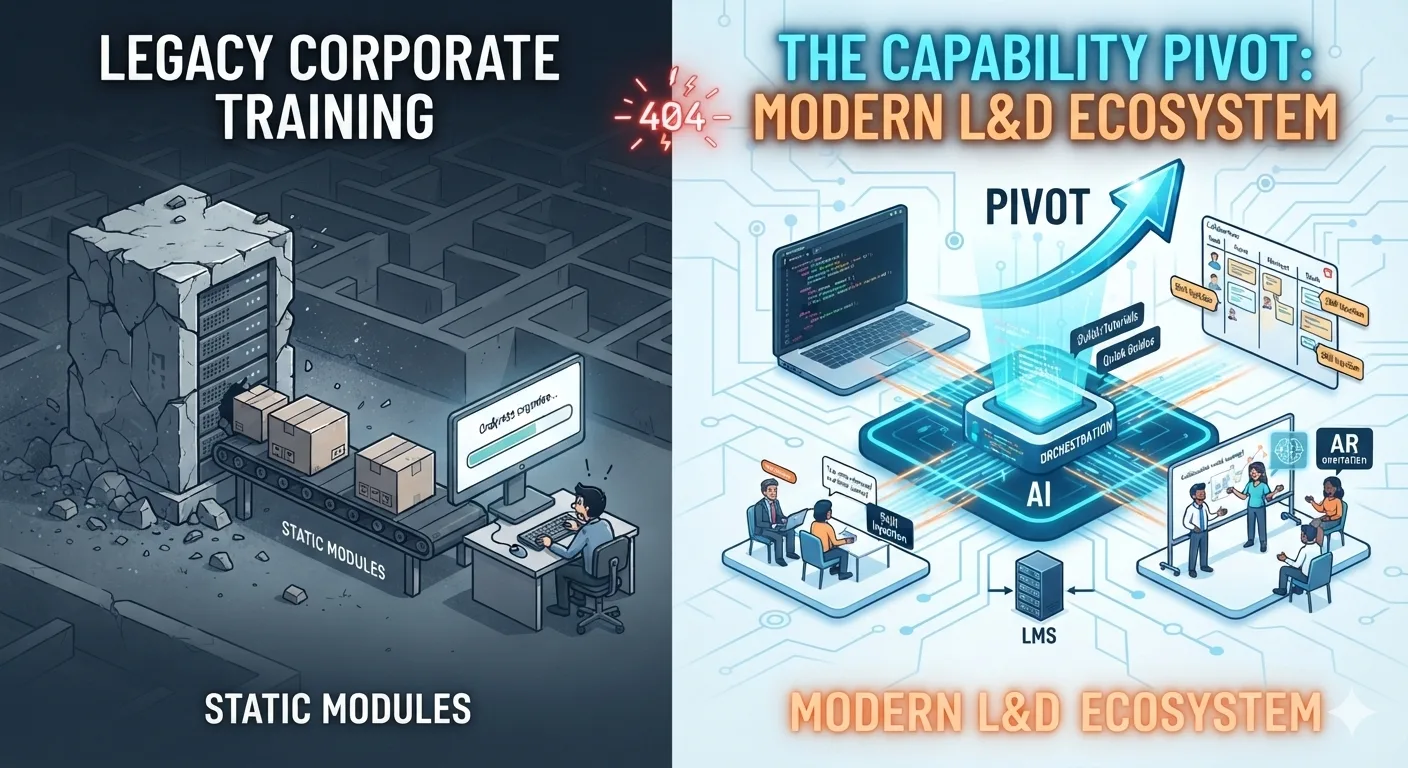
For years, corporate upskilling followed a familiar, linear blueprint: identify a skill gap, purchase a software license, and push a mandatory module down to the workforce. This legacy framework is officially broken. When a company treats cutting-edge machine learning like a simple compliance checklist, employees simply click through the slides to get back to their real work. The real hurdle facing modern leaders is shifting the collective mindset from basic text generation to true workflow orchestration.
Content Curation Over Production
The initial phase of digital transformation in corporate education focused heavily on speed. Instructional design teams eagerly embraced automation to generate text, transcribe videos, and draft course outlines in a matter of hours. While these tools certainly saved valuable time, they merely accelerated the traditional corporate course factory rather than modernizing the learning experience.
True professional growth does not happen simply because an employee hits "complete" on a digital learning pathway. Real business value is generated only when that knowledge translates directly into on-the-job problem-solving. According to recent data from a collaborative survey by i4cp and Training magazine, high-performance organizations are prioritizing generative AI spending at double the rate of low-performing firms, realizing that the real secret lies in using technology to augment human decision-making, not replace it. If your staff cannot confidently apply digital tools to eliminate operational bottlenecks, your digital investments are essentially going to waste.
Moving Toward Real-Time Skill Intelligence
To unlock the true power of modern corporate learning, organizations must transition from managing basic administrative records to building a comprehensive ecosystem of continuous skill development. The classic Learning Management System (LMS) remains an important foundational tool for compliance tracking, baseline onboarding, and macro-level organization. However, it was never designed to deliver real-time, highly contextualized coaching tailored to a worker's immediate daily tasks.
"AI is just a tool, not the solution itself. The true competitive advantage lies within the insights, creativity, and adaptability of teams that understand how to wield it." — Scarlett Howery & Chris Campbell, Workplace Transformation Experts
By evolving past static data repositories, forward-thinking organizations can wrap their existing educational assets in smart contextual layers. Instead of forcing a worker to step away from their desk for an exhaustive multi-hour workshop, smart algorithms can now analyze micro-level performance metrics. They break down expansive knowledge databases into tiny, highly relevant recommendations delivered exactly when a worker faces a challenge. This approach turns regular business workflows into continuous learning environments.
The 2026 Shift: AI Agents and Point-of-Need Enablement
As we navigate through 2026, a major shift has emerged in how leading organizations approach workforce development. Corporate learning is moving completely away from rigid, pre-recorded modules toward conversational, agentic ecosystems. Instead of browsing a massive catalog of old videos, employees now interact with dedicated internal AI assistants that understand proprietary business logic, brand tone, and role-specific compliance.
These smart digital twins do not just fetch data; they act as on-demand coaches that adapt their explanations based on the worker’s past performance and current project context. This real-time alignment allows learning teams to shift their energy away from repetitive course building and focus entirely on strategic business enablement.
Balancing Automation with Human Mentorship
While automation handles the heavy lifting of data analysis and content curation, live human interaction remains completely irreplaceable. Complex professional capabilities such as strategic leadership, deep emotional intelligence, and navigating highly nuanced regulatory frameworks cannot be successfully taught by an algorithm alone.
High-performing enterprises realize that human guidance and digital tools must work in tandem. For instance, a modern Training management system (TMS) can be used to streamline complex operational logistics, schedule sessions, and track resource allocation across global offices. This level of back-end automation frees up internal teams to focus on what matters most: human connection. The future of corporate development belongs to organizations that seamlessly blend automated skill intelligence with live, collaborative spaces where workers can safely practice critical communication, empathy, and creative problem-solving.
Frequently Asked Questions
Q1: How can small businesses implement AI training without a massive budget?
Small businesses can start by training custom internal assistants on their existing documents, standard operating procedures, and guides. This allows you to build a highly functional, localized knowledge coach without needing an expensive corporate software overhaul.
Q2: What role does an LMS play when a company transitions to real-time AI learning?
The classic system does not disappear; its role simply shifts. It remains the essential anchor for secure data compliance, mandatory certifications, and macro-level organizational tracking, while the real-time tools deliver micro-learning in the daily workflow.
Q3: How do you measure the ROI of human-led training vs. automated training?
Human-led training is best evaluated through behavioral shifts, such as improved leadership scores, team retention, and cross-departmental collaboration. Automated training ROI is typically measured through immediate operational metrics, like reduced support ticket volumes or faster software adoption times.
Q4: Will AI content creation eventually replace instructional designers completely?
No. Technology can draft basic outlines and initial text quickly, but it lacks the contextual understanding of a company’s unique cultural landscape. Human designers are shifting from repetitive content builders to strategic capability architects.
Q5: What are the main data privacy risks of using AI in corporate training?
The greatest risk is feeding proprietary company data or sensitive employee metrics into public machine learning models. Organizations must use secure, sandboxed enterprise versions of tools to ensure their intellectual property remains entirely private.