How Enterprise Teams Are Governing Multi-Agent AI in 2026
By 2028, Gartner predicts a third of all enterprise software will feature agentic AI. In 2024, that number was less than 1%.
That gap is closing fast, and the teams pulling ahead aren't the ones with the biggest models. They're the ones who figured out how to orchestrate them.
From Chatbots to Agents to Agent Networks
Before we get into the risks and architecture, it's worth defining the term clearly. Multi-agent AI orchestration is when multiple specialized AI agents work together inside a single governed pipeline, each handling a focused task, rather than one model trying to do everything at once.
Most companies started with a single AI assistant. Ask it a question, get an answer. Useful, but limited.
The next step was agents: AI that doesn't just answer, but acts. It calls APIs, queries databases, and writes back to systems.
But even a single capable agent hits a wall when the task is complex enough. That's where multi-agent orchestration comes in.
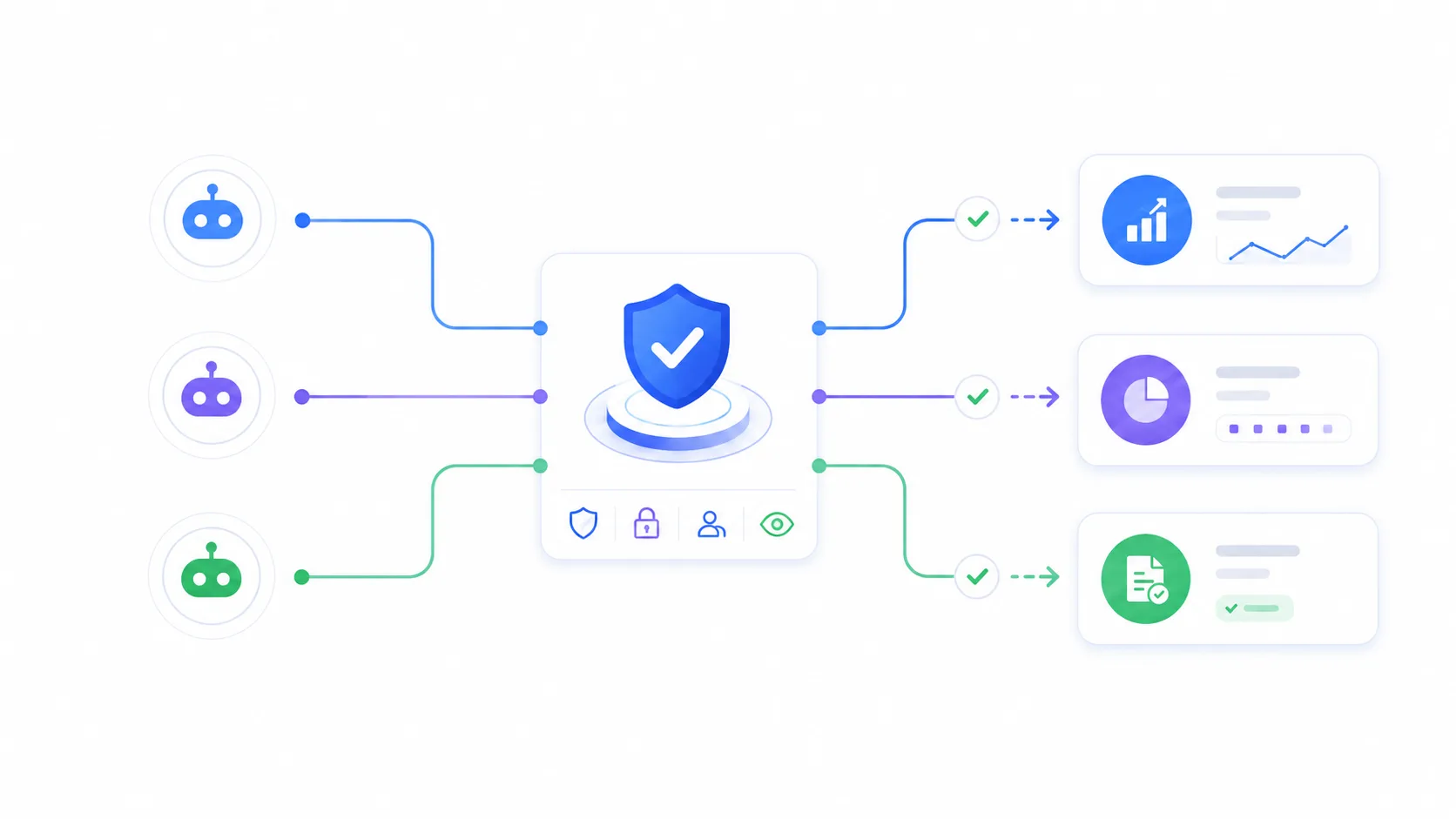
Instead of one AI trying to do everything, you deploy a network of specialized agents working in parallel, each with a focused job, its own permissions, and a clear lane. An orchestrator breaks the task down, hands off to specialists, and a governance layer makes sure nothing goes sideways.
What This Actually Looks Like
Say your finance team wants to reconcile invoices against purchase orders and flag anything over $5,000.
In a governed multi-agent setup, that's four agents working in sequence:
- Agent A pulls the relevant invoices from SAP or NetSuite
- Agent B matches them against POs, with access to only what it needs, nothing more.
- Agent C flags the discrepancies.
- Agent D surfaces the exceptions to a human before anything gets written back to the accounting system.
No one agent touches more than it should. Every action is logged. A human stays in the loop before any irreversible step.
That's the difference between AI that's useful and AI that's trustworthy.
Single Agent vs. Multi-Agent: When Does It Matter?
Not every problem needs a fleet of agents. Here's a simple way to think about it:
- Single Agent is best for drafting emails, summarizing docs, and classifying tickets. It runs linearly with one credential set.
- Multi-Agent is best for cross-platform reconciliation, compliance auditing, and multi-step ops workflows. It runs in parallel with granular per-agent access.
If the task is contained and conversational, a single agent is fine. If it spans multiple systems, requires parallel processing, or touches regulated data — you need orchestration with proper guardrails.
The Real Risk Nobody Talks About
The hype around multi-agent AI is real, but so are the failure modes. Three in particular keep showing up.
Permission sprawl.
Developers often hardcode shared API keys to get things working fast. The result: a low-level sorting agent ends up with the same system access as your CTO. That's not a hypothetical risk; it's how breaches happen.
Context drift.
When information passes through four or five agents, each one summarizes what the last one said. By the end of the pipeline, the downstream agent may be acting on a distorted version of the original instruction. In a regulated environment, that's a serious problem.
Compliance gaps.
SOX, GDPR, SOC 2, HIPAA, they all require a clear audit trail. Who initiated the action? Under what permissions? Who approved it? Most open-source frameworks don't log at that level out of the box.
How Engini Approaches This
We built Engini around the idea that governance shouldn't be an afterthought bolted onto a workflow. It should be the foundation.
Every agent in an Engini pipeline operates under three non-negotiables:
- Scoped OAuth tokens: each agent gets the minimum access it needs for its specific task, nothing more.
- Continuous action logging: every read, write, and API call is timestamped and exportable for compliance audits.
Human approval gates: high-stakes actions pause automatically until a human signs off.
Engini connects to the systems your teams already use, SAP, Salesforce, Workday, Jira, Slack, and deploys through a visual drag-and-drop builder, so the people who actually understand your business processes can build and own their workflows without waiting on engineering.
The question for enterprise leaders isn't which AI model to pick anymore. It's how you plan to govern them at scale.
Ready to see what that looks like in practice?
Book a walkthrough with the Engini team at engini.ai