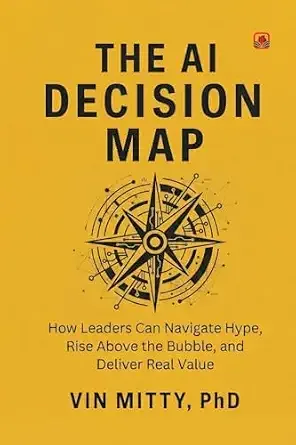
Artificial intelligence has moved from the innovation lab to the boardroom faster than almost any technology in recent memory. Yet for most executives, the hardest part isn't understanding what AI can do — it's deciding what their organization should do with it, and how to do it responsibly. That gap between capability and judgment is exactly what Vin Mitty's book, The AI Decision Map, sets out to close. Positioned as an Executive AI Playbook, the book offers leaders a structured way to move past hype cycles and build durable AI Governance practices that actually hold up under scrutiny.
Why Executives Need a Playbook, Not Just a Strategy
Most companies don't struggle with AI because they lack ambition. They struggle because ambition outpaces process. A new model or tool captures attention, a pilot gets greenlit, and within months the organization has a scattered collection of AI experiments with no shared framework for evaluating them. This is the pattern Vin Mitty calls "the Innovation Loop" — a repeating cycle of excitement, overreach, reset, and discipline that has shown up with every major wave of technological change, from the early web to cloud computing to today's AI boom.
The AI Decision Map treats this cycle not as a flaw to be avoided but as a rhythm to be managed. Rather than trying to skip straight to the "discipline" phase, the book argues that leaders need a repeatable playbook that can absorb enthusiasm during the excitement stage while still building the guardrails that prevent overreach. That's the core function of an Executive AI Playbook: it doesn't slow innovation down for its own sake, it gives innovation a container so that value can be captured before the inevitable reset arrives.
This distinction matters because so many AI initiatives fail not from bad technology but from bad decision-making around technology. Teams chase the wrong use cases, skip validation steps, or scale prototypes into production without the oversight structures that should have been in place from day one. A playbook approach forces those questions to be asked early, when they're cheap to answer, instead of late, when they're expensive to fix.
Governance as a Growth Enabler, Not a Brake
Perhaps the most important reframing in The AI Decision Map is how it treats AI Governance. In many organizations, governance is treated as a compliance checkbox — something legal or risk teams bolt onto a project after the real work is done. Mitty's approach flips that model. Governance, in this framework, is a growth enabler. It's the mechanism that lets an organization scale AI confidently because everyone — from data scientists to the board — understands how decisions get made, who is accountable for them, and what "good" looks like before a model ever reaches production.
This is a meaningful shift in how executives should think about oversight. Weak AI Governance doesn't just create legal exposure; it creates organizational hesitation. When nobody is sure who owns an AI decision or how it will be evaluated, teams either move too cautiously (leaving value on the table) or too recklessly (creating risk that eventually forces a painful reset). A clear governance structure removes that ambiguity. It tells people exactly which decisions require sign-off, which can move fast, and which need a formal review — which is precisely what an Executive AI Playbook is designed to do at scale.
Mitty's background is instructive here. Drawing on more than fifteen years leading data science and engineering teams — including work moving organizations from manual reporting processes to AI-driven systems that generated measurable new revenue — the book isn't written from a theoretical vantage point. It reflects the actual friction points executives encounter: unclear ownership, inconsistent evaluation criteria, and a persistent gap between what technical teams believe is ready and what the business is prepared to trust.
The Three Pillars of an Executive AI Playbook
While the book covers a range of frameworks, three recurring pillars anchor its approach to building an effective Executive AI Playbook:
1. Decision Clarity. Before any AI initiative launches, leadership needs a shared, written understanding of what decision the AI is meant to support, who is accountable for the outcome, and what threshold of confidence is required before the system is trusted with real decisions. Without this clarity, AI projects tend to drift — technical teams optimize for model performance while business stakeholders quietly lose confidence in outputs they don't fully understand.
2. Structured Evaluation. Rather than judging AI initiatives purely on technical metrics like accuracy or speed, the playbook calls for evaluation criteria that map directly to business impact. This is closely tied to what Mitty has publicly referred to as an "AI Value Review" — a structured checkpoint where a proposed or existing AI system is assessed not just for whether it works, but for whether it's worth scaling, given its cost, risk profile, and actual contribution to outcomes leadership cares about.
3. Governance by Design. Instead of retrofitting oversight after a system is built, AI Governance is embedded into the project lifecycle from the outset. That means defining data quality standards, model monitoring practices, and escalation paths before a single line of production code is written. This "by design" approach mirrors how privacy and security have matured in software development — moving from an afterthought to a foundational requirement — and the book argues AI oversight needs the same evolution, on an accelerated timeline.
Moving From Hype to Discipline Without Losing Momentum
One of the more counterintuitive arguments in The AI Decision Map is that discipline doesn't have to come at the cost of speed. Executives often assume that adding governance layers will slow their AI programs down, and in poorly designed systems, that's true. But the book makes the case that well-designed governance actually accelerates responsible scaling because it removes the second-guessing, rework, and trust deficits that plague ungoverned initiatives.
Consider the alternative: an organization that skips governance in the name of speed will often see a handful of high-profile AI failures — a biased output, a hallucinated recommendation, a system that behaves unpredictably at scale. Each of these incidents doesn't just cost time to fix; it costs organizational trust in AI generally, often setting back the broader initiative by months or years. A properly designed Executive AI Playbook is, in this sense, a form of risk-adjusted speed. It's slower in the first mile and faster over the full race.
This is where the book's framing of the Innovation Loop becomes genuinely useful as a diagnostic tool. Leaders can ask themselves: which stage is our organization in right now? Are we in the excitement phase, where enthusiasm is outrunning structure? Are we already seeing overreach — pilots proliferating without shared standards? Or are we in a reset, cleaning up after a failed rollout and rebuilding trust with skeptical stakeholders? Each stage calls for a different leadership response, and The AI Decision Map offers concrete guidance for navigating all four.
Who This Playbook Is For
While the book is grounded in technical realities, it's written primarily for executives and decision-makers rather than practitioners building the models themselves. That audience distinction matters. Much of the existing literature on AI implementation is written for data scientists and engineers, focused on architecture and technique. The AI Decision Map instead speaks to the people who have to decide whether to fund a project, how to evaluate its success, and how to explain its risks to a board or regulator.
This makes the book particularly relevant for leaders in regulated industries — financial services, healthcare, legal, and insurance — where AI Governance isn't optional but where existing governance frameworks often weren't designed with AI-specific risks in mind. It's equally relevant for leaders in less regulated industries who recognize that self-imposed discipline now is far cheaper than externally imposed correction later.
Final Takeaway
The AI Decision Map doesn't promise a shortcut through the noise surrounding artificial intelligence. Instead, it offers something more durable: a repeatable Executive AI Playbook for making sound decisions about where AI belongs in an organization, how much trust it has earned, and what oversight is required to protect that trust as systems scale. For leaders trying to move beyond one-off pilots toward a coherent, defensible AI strategy, the book's core argument is a useful anchor — that AI Governance isn't the opposite of innovation, but the structure that makes innovation sustainable.