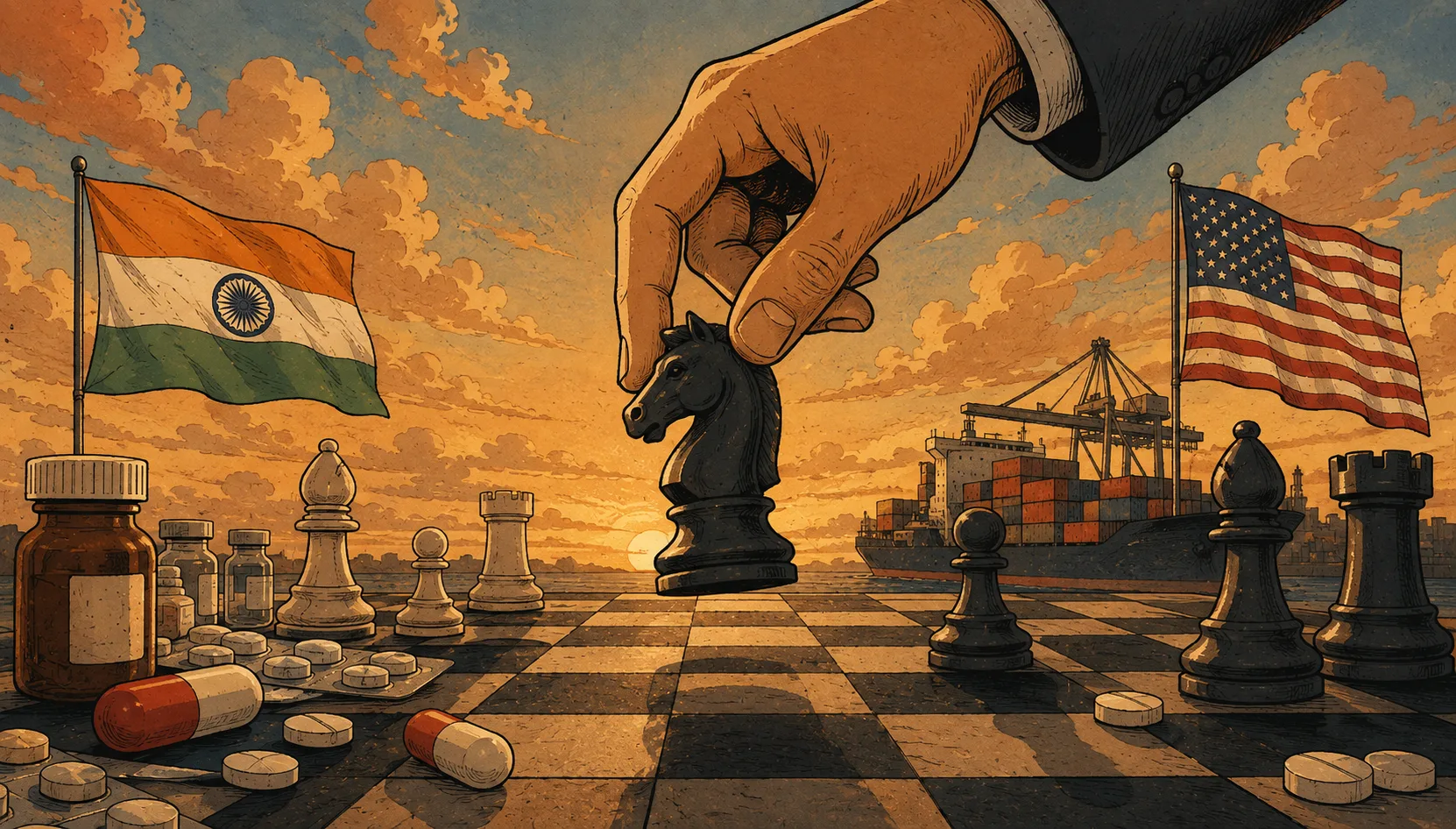
When Donald Trump posted the new generic drug tariff plan on Truth Social on July 21, 2026, most headlines led with the scariest number: 200%. That is technically accurate, and it is also the least useful way to read the policy if you are trying to understand what it means for Indian pharma stocks over the next three years.
The Real Story Is the Calendar, Not the Number
Here is the structure Trump laid out. From August 1, 2026, generic drugs entering the US continue to face a zero percent tariff, unchanged from today, for a full two years. From August 2028, that rate jumps to 100%. From August 2029, it doubles again to 200%. Tariffs on patented and branded medicines, already at 100% since April 2026 under a separate Section 232 order, remain untouched.
That means nothing changes for Indian exporters this year, or next year, or the year after that. The clock only starts running in 2028, and even then, companies get a full year at 100% before the 200% rate arrives in 2029.
Read that way, this is less an immediate tax and more a public deadline. Trump himself framed it as a "last chance," saying the escalating rate is meant as a penalty for companies that do not build manufacturing plants in the US within the window given to them.
For context on why this matters, India supplies close to 40% of the generic drugs sold in the US by volume, and generics make up roughly 90% of all US prescriptions. In FY26, India's pharmaceutical exports touched a record $31 billion, with the US accounting for a bit under a third of that, even as shipments to America slipped nearly 10% year on year on a high base and generic price erosion.

Not All Pharma Exporters Carry the Same Risk
The tariff applies specifically to generic drugs shipped into the US. That single detail splits Indian pharma into three very different exposure buckets.
Pure US-generics exporters carry the highest direct risk. These are companies deriving a large share of revenue from finished generic formulations sold into the American market, names like Sun Pharma, Dr Reddy's, Cipla, Aurobindo Pharma, Lupin, Zydus Lifesciences and Glenmark, several of which get 30-50% of overall revenue from the US. If the 2028 and 2029 steps go through as announced, these are the companies that would need to absorb margin pressure, raise US prices, or accelerate domestic manufacturing.
CDMO and API players sit in a structurally different position. Companies such as Divi's Laboratories, Syngene International, Piramal Pharma, Laurus Labs and Neuland Laboratories largely serve global innovator pharma companies rather than shipping finished generics directly to US retail. Divi gets under 10% of its revenue from the US, with much of its client base in Europe. Analysts at HSIE estimate the earnings impact on this group at a mid-single-digit percentage of EBITDA, since many CDMO contracts also carry tariff pass-through clauses that shift the cost burden toward the customer rather than the manufacturer.
Domestic-focused pharma companies are the least affected of the three. Firms whose revenue is weighted toward India rather than exports face no direct impact from a US generic drug tariff. Their fortunes track domestic prescription growth, not Washington's trade calendar.

Why "Just Build a Plant in the US" Is Harder Than It Sounds
The tariff plan assumes two years is enough time for companies to reshore generic manufacturing to the US. Industry voices have been blunt that this timeline does not match reality.
Namit Joshi, chairman of the Pharmaceuticals Export Promotion Council of India, has pointed out that even the roughly $480 billion in US manufacturing investment commitments already made by more than a dozen major global pharma companies, players like Johnson & Johnson, AstraZeneca, Roche, Novartis, and Eli Lilly, are running on timelines of four to ten years. Those commitments were also aimed at branded and patented medicines, which account for only about 10% of US prescriptions but a much larger share of drug spending. Building out an equivalent ecosystem for generics, which carry thinner margins and lower per-unit value, would need at least five years by his estimate and is a far less attractive capital allocation decision to begin with.
New manufacturing facilities in the US also need FDA inspection and product approval cycles on top of construction, a process that alone can take a couple of years once a plant is physically ready. Add permitting, land acquisition, and workforce buildout, and a two-year window looks tight even before ground is broken.
The Policy Has Already Shown It Can Move
It is worth remembering this isn't the first time generics have brushed up against a US tariff threat. When Section 232 tariffs on patented pharmaceuticals took effect at 100% in April 2026, generics and biosimilars were explicitly carved out, with the proclamation using the phrase "at this time," a signal the exclusion was conditional rather than permanent. Commerce was given a one-year window to revisit that exclusion.
That history matters for how investors read the current announcement. This is a policy area that has already moved once; generics were spared in April and then targeted in July with a delayed start date, and industry voices close to Delhi's trade negotiations have suggested exemptions, delays, or renegotiation remain realistic possibilities before 2028 actually arrives, especially with a midterm and a presidential election cycle sitting between now and the first rate hike.

What to Watch in Upcoming Earnings Commentary
None of this means the risk is imaginary. It means the picture is more layered than a single headline number suggests. Investors tracking pharma sector earnings calls over the next few quarters may want to watch for a few specific signals, without treating any of them as a buy or sell trigger:
- How much detail management teams at US-generics-heavy exporters share about domestic capex plans and timelines for American manufacturing
- Whether CDMO and API players continue to describe limited direct US exposure and pass through contract protections in their disclosures
- Any commentary on FDA facility inspection queues or approval timelines for new US-based plants
- Updates on India-US trade talks generally, since pharma has already been pulled in and out of separate tariff tracks (the April Section 232 order, and the August 2025 Russia oil related duties) more than once in the past year
The 2028 deadline is real, but it is also three years away, sitting behind a US election, ongoing trade negotiations, and a reshoring timeline that even industry insiders call unrealistic. For now, that gap between the headline tariff rate and the actual timeline is the part of the story worth following most closely.
Disclaimer—This is a factual overview of a US trade policy and its structural implications for Indian pharma sub-segments, not investment advice or a recommendation.