
Market Overview:
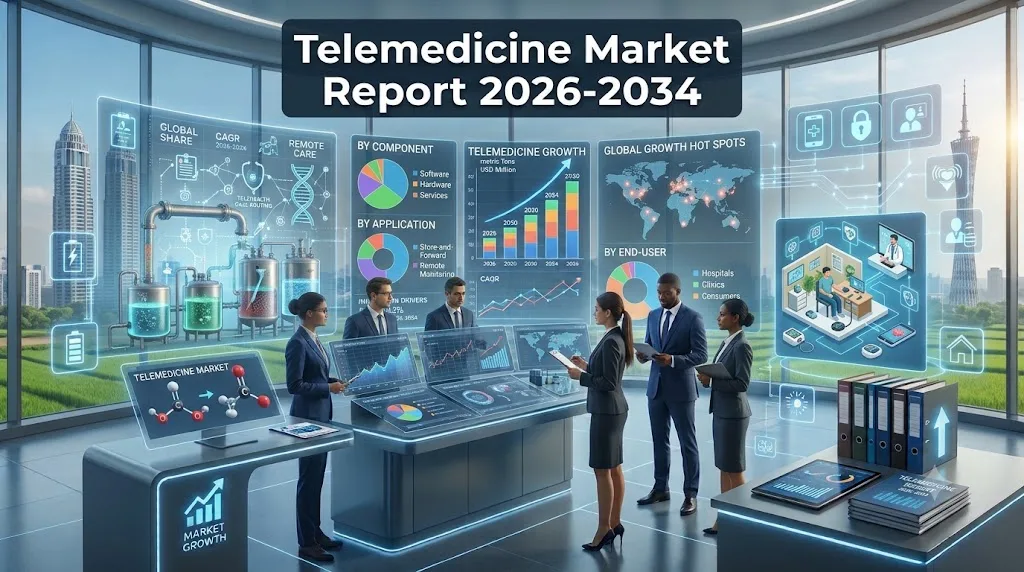
According to IMARC Group’s latest research publication, “Telemedicine Market: Global Industry Trends, Share, Size, Growth, Opportunity and Forecast 2026-2034”, The global telemedicine market size grew from USD 111.4 Billion in 2025 to USD 134.4 Billion in 2026. Looking forward, IMARC Group estimates the market to reach USD 602.1 Billion by 2034, exhibiting a CAGR of 20.62% from 2026-2034.
This detailed analysis primarily encompasses industry size, business trends, market share, key growth factors, and regional forecasts. The report offers a comprehensive overview and integrates research findings, market assessments, and data from different sources. It also includes pivotal market dynamics like drivers and challenges, while also highlighting growth opportunities, financial insights, technological improvements, emerging trends, and innovations. Besides this, the report provides regional market evaluation, along with a competitive landscape analysis.
How AI is Reshaping the Future of the Telemedicine Market
- AI-powered diagnostic tools integrated into telemedicine platforms are enabling real-time analysis of patient vitals, medical images, and health records, reducing diagnostic turnaround times and improving clinical accuracy in virtual consultations.
- Government initiatives such as India’s tele-mental health program, which launched 23 centers of excellence in collaboration with institutions like NIMHANS, are deploying AI-backed remote care to bridge access gaps in rural and underserved regions.
- Teladoc Health’s acquisition of Catapult Health in February 2025 for USD 65 million, a provider of virtual preventive care, reflects how AI-led early detection models are being integrated into mainstream telehealth to reduce emergency visits and manage chronic conditions proactively.
- AI in telemedicine is enabling advanced teledermatology outcomes, with platforms using machine learning to classify skin conditions from patient-submitted images, improving accuracy for conditions like acne, rashes, and lesions without requiring in-person visits.
- The US Census Bureau projects the population of Americans aged 100 and older will grow from approximately 101,000 in 2024 to around 422,000 by 2054, creating a long-term structural demand for AI-enabled remote monitoring tools and virtual elder care platforms.
Download a sample PDF of this report: https://www.imarcgroup.com/telemedicine-market/requestsample
Key Trends in the Telemedicine Market
- Rising Demand for Remote Healthcare Access: Geographical barriers remain one of the strongest drivers of telemedicine adoption globally. Patients in rural and remote areas who previously lacked access to specialists can now consult physicians through virtual platforms without travel. According to the American Medical Association, 93% of doctors reported a specific advantage in using digital health tools, reflecting deepening acceptance of virtual care among healthcare providers and supporting broader patient engagement with telehealth services.
- Rapid Technological Advancements and Digital Transformation: The proliferation of smartphones, high-speed internet, and AI-enabled wearable health devices has significantly expanded the reach and effectiveness of telemedicine. Patients can download telemedicine apps, connect with providers via video, monitor vital signs remotely, share electronic medical records, and receive digital prescriptions. Web and mobile platforms account for 72.7% of the delivery mode segment in 2025, underlining how accessible digital infrastructure has become the dominant channel for virtual care delivery.
- Surge in Telepsychiatry and Mental Health Services: Growing public awareness of mental health is catalyzing strong demand for telepsychiatry and counseling services. India’s Union Ministry of Health and Family Welfare introduced tele-mental health services with 23 centers of excellence operating through prominent institutions including NIMHANS and IIIT Bangalore, specifically targeting underserved populations in rural areas. This reflects a government-backed structural shift toward digital mental healthcare that is being replicated across multiple emerging markets.
- Favorable Government Policies and Reimbursement Schemes: Policy support across major markets is accelerating telemedicine uptake. In the United States, the Centers for Medicare and Medicaid Services reported national healthcare expenditure reached USD 4.5 Trillion in 2022, prompting payers and insurers to back telemedicine as a cost reduction mechanism. In the UK, the Telederm teledermatology service diagnoses over 50,000 patients with skin conditions annually, reducing hospital appointment burdens and delivering systemic cost savings across the National Health Service.
- Expanding Healthcare Infrastructure in Emerging Markets: Brazil dedicated 9.47% of its GDP to healthcare in 2023, totaling USD 161 Billion, fueling investment in digital health platforms to overcome physician shortages in rural regions. Similarly, the UAE launched the region’s first virtual hospitals in March 2020 in partnership with telecommunications providers, setting a precedent for public-private telemedicine deployment across the Middle East and Africa that continues to generate downstream investment in the sector.
Growth Factors in the Telemedicine Market
- Growing Aging Population Driving Remote Monitoring Demand: An aging population globally is creating a structural, long-term demand for continuous and accessible healthcare. In the US, the population of Americans aged 100 and older is expected to grow more than fourfold from approximately 101,000 in 2024 to around 422,000 by 2054, intensifying the need for remote monitoring, telemedicine check-ins, and virtual chronic disease management programs that reduce the burden on physical hospital infrastructure.
- Cost Reduction Benefits Incentivizing Adoption by Payers and Providers: Telemedicine offers measurable financial advantages for both healthcare systems and patients. Research published by NIH found that telehealth was associated with reductions in overall medical expenses of USD 1,814 per individual, alongside decreases in emergency department visits of 88.6 per 1,000 individuals and inpatient hospitalizations of 32.4 per 1,000 individuals during stay-at-home periods, confirming telemedicine’s role as a cost-effective complement to traditional care delivery.
- High Smartphone and Internet Penetration Expanding Patient Access: According to the Pew Research Center, 98% of Americans possessed some form of cellphone in 2024. This near-universal device ownership removes the hardware barrier to telemedicine access and has enabled seamless uptake of mobile health apps, video consultation platforms, and remote monitoring services across both urban and rural populations.
- Rising Chronic Disease Burden Necessitating Continuous Care: The increasing global prevalence of diabetes, hypertension, cardiovascular conditions, and mental health disorders creates a persistent demand for recurring healthcare access that telemedicine is uniquely positioned to fulfill. The product segment, which includes hardware, software, and specialized diagnostic tools, accounts for 53.2% of the market in 2025, with advanced tools such as AI-enabled diagnostics and wearable devices driving continuous patient monitoring across these chronic condition categories.
- Strategic Acquisitions and Platform Consolidation Accelerating Market Maturity: The telemedicine market is experiencing rapid consolidation as companies expand their service portfolios through acquisitions. In May 2025, Equum Medical acquired VeeOne Health’s clinical services, including Tele-Psychiatry, Tele-Neurology, and Tele-ICU lines, enabling the combined entity to support physician service coverage in over 200 hospitals and post-acute facilities nationwide. Such consolidation is building integrated virtual care ecosystems with broader specialty coverage and expanded geographic reach.
Leading Companies Operating in the Global Telemedicine Industry:
- Aerotel Medical Systems (1998) Ltd.
- Allscripts Healthcare Solutions Inc.
- AMD Global Telemedicine Inc.
- American Well Corporation
- Cigna Corporation
- Cisco Systems Inc.
- Doxy.me Inc.
- HealthTap Inc.
- PlushCare Inc. (Accolade Inc.)
- SHL Telemedicine
- SOC Telemed Inc. (Patient Square Capital)
- Teladoc Health Inc.
- Twilio Inc.
Telemedicine Market Report Segmentation:
Breakup By Component:
- Product
- Hardware
- Software
- Others
- Services
- Tele-Consulting
- Tele-Monitoring
- Tele-Education
Product accounts for the majority of shares with 53.2% in 2025, driven by strong demand for telemedicine software platforms, mobile applications, wearable health monitoring devices, and AI-powered diagnostic tools that enable remote consultations and continuous patient monitoring.
Breakup By Modality:
- Real-Time
- Store and Forward
- Others
Real-time leads the modality segment, as live video consultations enable instant communication between patients and healthcare providers, offering critical advantages for urgent care, follow-up appointments, and patient education in remote settings.
Breakup By Delivery Mode:
- Web/Mobile
- Audio/Text-based
- Visualized
- Call Centers
Web/mobile (audio/text-based) dominates the delivery mode segment with 72.7% of market share in 2025, owing to the widespread availability of smartphones, high-speed internet, and user-friendly telehealth applications that make virtual consultations accessible from any location.
Breakup By Facility:
- Tele-Hospital
- Tele-Home
Tele-hospitals hold the leading position on account of their ability to deliver a comprehensive suite of remote healthcare services including consultations, diagnostics, and real-time patient monitoring, reducing the need for physical hospital infrastructure and enabling specialist access in underserved regions.
Breakup By Application:
- Teledermatology
- Teleradiology
- Telepsychiatry
- Telepathology
- Telecardiology
- Others
Teledermatology leads the application segment due to the high prevalence of common skin conditions and the effectiveness of image-based remote diagnosis for conditions such as acne, rashes, and skin infections, supported further by AI and machine learning tools that enhance diagnostic accuracy.
Breakup By End User:
- Providers
- Payers
- Patients
- Others
Providers dominate the end user segment as hospitals, clinics, and healthcare professionals increasingly adopt telemedicine platforms to extend their reach, manage higher patient volumes efficiently, reduce operational costs, and deliver timely care to patients in remote or underserved areas.
Breakup By Region:
- North America (United States, Canada)
- Asia Pacific (China, Japan, India, South Korea, Australia, Indonesia, Others)
- Europe (Germany, France, United Kingdom, Italy, Spain, Russia, Others)
- Latin America (Brazil, Mexico, Others)
- Middle East and Africa
North America holds the leading position with over 34.7% of the global market share in 2025, driven by advanced healthcare infrastructure, near-universal smartphone penetration, high investment in digital health R&D, supportive government reimbursement policies, and a rapidly aging population with strong demand for remote chronic disease management.
Recent News and Developments in the Telemedicine Market
- January 2026: Wisp, the largest women’s telehealth company in the United States, acquired TBD Health, a national sexual health platform with deep partnerships with hospital systems, enterprises, and public health organizations. This acquisition marked Wisp’s first strategic move beyond direct-to-consumer care into enterprise and hybrid care models, positioning the company to bridge consumer health, enterprise partnerships, and public health at scale.
- August 2025: Teladoc Health announced the acquisition of Telecare Australia, a technology-enabled company specializing in the virtual delivery of specialist and allied healthcare services, with a network of more than 300 specialists. The acquisition aligned with Teladoc’s international expansion strategy and introduced virtual neonatology and telesurgery support solutions to the Australian hospital market.
- May 2025: Equum Medical acquired VeeOne Health’s clinical service lines, including Tele-Psychiatry, Tele-Neurology, Tele-Infectious Disease, Tele-Pulmonary, and Tele-ICU. Following the acquisition, the combined entity expanded its physician service coverage to over 200 hospitals and post-acute facilities nationwide, strengthening the acute care telehealth segment across the United States.
Note: If you require specific details, data, or insights that are not currently included in the scope of this report, we are happy to accommodate your request. As part of our customization service, we will gather and provide the additional information you need, tailored to your specific requirements. Please let us know your exact needs, and we will ensure the report is updated accordingly to meet your expectations.
About Us:
IMARC Group is a global management consulting firm that helps the world’s most ambitious changemakers to create a lasting impact. The company provides a comprehensive suite of market entry and expansion services. IMARC offerings include thorough market assessment, feasibility studies, company incorporation assistance, factory setup support, regulatory approvals and licensing navigation, branding, marketing and sales strategies, competitive landscape and benchmarking analyses, pricing and cost research, and procurement research.
Contact Us:
IMARC Group
134 N 4th St. Brooklyn, NY 11249, USA
Email: [email protected]
Tel No: (D) +91 120 433 0800
United States: +1-201-971-6302