The first time we tried this it went badly. Not disastrously, just that familiar thing where one child ate three grains of rice, the other announced she was full before the food arrived, and the adults ate quickly while pretending to enjoy themselves.
Second attempt went completely differently, and the difference was planning rather than luck. If you are weighing up an indian amsterdam restaurant with children in tow, this is what I would do again, in order.
Order the papad before you look at anything else
Papad at 3,75 from the extras section. Thin lentil crackers, and in India they arrive before anything else does.
I mention this first because it is the single most useful thing we discovered. Eight minutes of quiet at the start of a restaurant meal, while the adults actually read the menu, is worth considerably more than three euros seventy five. Children break them into pieces and eat them slowly, which is precisely what you want during the ordering stage.
Ask for them the moment you sit down, not as part of the main order. That gap between sitting and food arriving is where family meals usually start going wrong.
The children's menu turned out not to be a dumping ground
This surprised me. Three items: Chicken Curry and Rice at 8,95, Dal Tadka and Rice at 7,95, and French Fries at 6,45.
Two of the three are real dishes from the actual menu, scaled down. The dal is the same Dal Tadka that appears in the main vegetarian section at 15,50, lentils cooked until soft and finished with a tempering of fried garlic, ginger and cumin.
That mattered more than I expected it to. My eldest ate the dal, which meant she was eating the food of the place we were sitting in rather than a plate of something borrowed from another cuisine. The step up to an adult portion next time is a small one instead of a leap.
And the chips are there for the child having a difficult day. Every kitchen needs that option and pretending otherwise is posturing.
Raita on the table, non negotiable
If I could pass on one thing to anyone taking children to eat Indian food, it would be this.
Raita at 4,50. Yoghurt with cucumber and spices. It sits in the middle of the table and it fixes anything that turns out hotter than expected, instantly, without anybody making a scene about it.
Without it, a child who takes an unexpected mouthful has only water, which makes the burn worse rather than better, and then the meal is effectively over. With raita on the table the problem lasts about four seconds and everyone carries on.
It changed what we ordered for ourselves too, because the safety net was already there. That four euro side genuinely expanded the menu for the whole table.
The mild dishes are not the boring ones
I had assumed that ordering for a family meant ordering downward, accepting a duller meal as the price of a peaceful one.
That is wrong, and it took me two visits to work out. The dishes carrying no heat marking on this menu are among the most interesting on it.
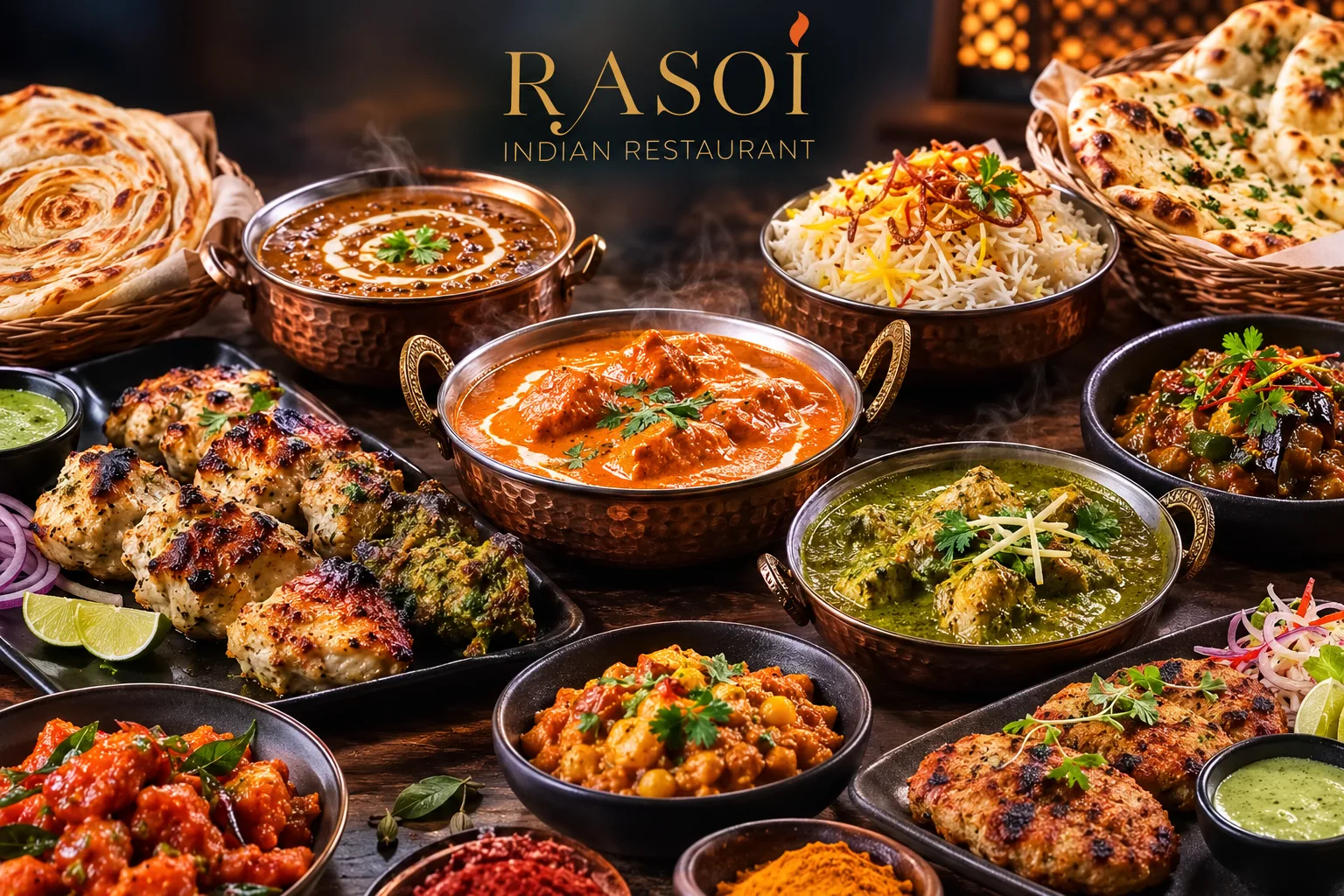
Malai Kofta at 19,25 is described as a rich mild gravy, cheese dumplings in onion, tomato and cashew. Korma Chicken at 22,50 is sweet and coconut based, built on cardamom and nuts. Prawn Malai at 24,00 sits in a white cashew gravy rather than a red one.
None of those are simplified. They are complex in a direction that has nothing whatsoever to do with chilli, which is a distinction I had never properly understood before.
What I do avoid now is anything marked very hot, because children reach across tables regardless of what you tell them. Kadai Chicken, both the chicken and mutton vindaloos, and the Hyderabadi Chicken Biryani all carry that top marking on the menu.
Bread does most of the work
Butter Roti at 3,75 or Butter Naan at 4,25, and order more than you think you need.
Bread with a bit of gravy on it is the standard route into this food for anyone hesitant, of any age. A child who will not go near a bowl of curry will frequently eat the same curry off a torn piece of bread, and I have no explanation for that beyond it being reliably true.
Plain rather than stuffed. The cheese and stuffed versions run 6,45 to 6,95 and they compete with the food rather than carrying it. Four stuffed breads adds close to twenty seven euros to a bill for what is meant to be the supporting element.
If you want one interesting bread for the adults, Malabar Parotta at 3,75 is layered and flaky and costs the same as plain roti.
Rice, and a fifty cent decision worth making
Mains arrive with rice included, so this is about upgrading rather than adding.
Steamed Rice at 4,50 is plain. Jeera Pulao at 5,00 is rice cooked with cumin. Fifty cents apart, and the pulao gives you an aromatic base rather than a neutral one.
With children I go plain, because neutral rice is the thing a cautious eater will actually accept. Adults ordering separately can take the pulao.
The logistics that decide whether the evening works
Several public parking options exist near the restaurant, which matters enormously when you are travelling with a pushchair and is not something you can assume anywhere in this city.
Cards and cash are both accepted, credit and debit.
Book rather than turning up hopeful. Some space is kept for walk-ins but it fills quickly, and a family arriving to find no table is its own specific kind of misery.
From roughly late May until late September there is a terrace seating sixteen people, which with young children is often easier than being inside. It is also the only part of the restaurant where dogs are allowed, if that is relevant to your particular circus.
The order that worked
Papad the moment we sat down. Raita in the middle of the table. One mild main for the adults to share and one to try properly. One dish from the children's menu. Plain bread and plain rice, generous quantities of both.
Nobody negotiated, nobody left hungry, and the children ate food that had actually come from the kitchen they were sitting in.
That last part is the thing I would not have thought to care about beforehand, and it is the reason we now go back rather than defaulting to somewhere easier.