Market Overview:
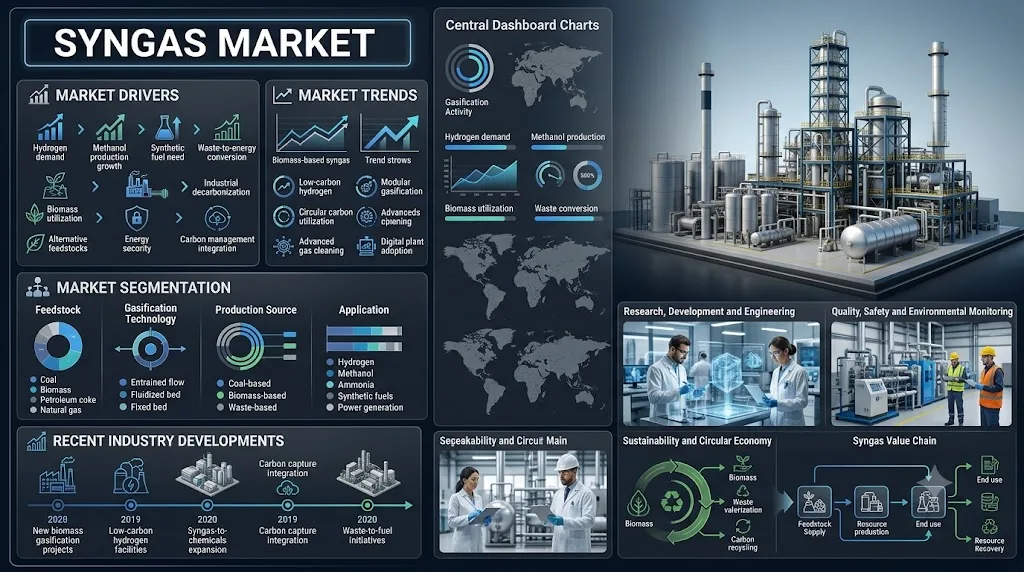
According to IMARC Group's latest research publication, "Syngas Market: Global Industry Trends, Share, Size, Growth, Opportunity and Forecast 2026-2034", The global syngas industry size reached 282.37 MM Nm³/h in 2025and is projected to reach 563.85 MM Nm³/h by 2034, exhibiting a CAGR of 7.99% during 2026-2034.
This detailed analysis primarily encompasses industry size, business trends, market share, key growth factors, and regional forecasts. The report offers a comprehensive overview and integrates research findings, market assessments, and data from different sources. It also includes pivotal market dynamics like drivers and challenges, while also highlighting growth opportunities, financial insights, technological improvements, emerging trends, and innovations. Besides this, the report provides regional market evaluation, along with a competitive landscape analysis.
How the Energy Transition is Reshaping the Global Syngas Market
- Chemicals dominate the end-use segment with a 30% share in 2025, driven by syngas' critical role as a feedstock for ammonia, methanol, and hydrogen production across global industrial facilities.
- Fixed Bed gasifiers lead gasifier-type segmentation with a 40% share in 2025, favored for their cost-effectiveness and compatibility with coal and biomass feedstocks, particularly across South and Southeast Asia.
- Asia Pacific commands a 33% regional share, reinforced by China's coal-to-chemicals industry, where coal-based processes account for over 70% of methanol output and around 85% of ammonia production.
- The U.S. Bipartisan Infrastructure Law has allocated over USD 8 Billion for clean hydrogen hubs, many of which integrate syngas production via steam methane reforming and autothermal reforming with carbon capture.
- In February 2026, Adani Group announced plans for a USD 8.4 Billion coal gasification facility near Nagpur, focused on producing syngas, ammonia, and hydrogen, targeting 30,000 job creations and reducing India's import dependency on industrial chemicals.
Download a sample PDF of this report: https://www.imarcgroup.com/syngas-market/requestsample
Key Trends in the Syngas Market
- Accelerating Demand for Clean Hydrogen via Syngas Pathways: Over 90% of global hydrogen is currently produced via steam methane reforming and coal gasification, both of which generate syngas as a primary intermediate. Rising hydrogen demand from steel, refining, and fuel cell sectors is sustaining large-scale investment in syngas infrastructure globally, particularly in Europe and North America.
- Coal-to-Chemicals Expansion Across Asia Pacific: China's coal-to-chemicals sector has expanded substantially, with coal accounting for 1.9 billion tonnes of oil equivalent per year in China's total primary energy consumption. New gasification projects are concentrated in Xinjiang, Inner Mongolia, and Shaanxi, reinforcing domestic feedstock security and supporting syngas-based production of methanol, ammonia, and dimethyl ether.
- Biomass and Waste-to-Syngas Commercialization: Companies such as Enerkem and Sierra Energy are scaling waste-to-syngas facilities in Europe and North America that convert non-recyclable municipal solid waste into methanol, hydrogen, and low-carbon fuels. These projects offer significantly lower lifecycle emissions compared to fossil-based syngas production, aligned with net-zero decarbonization targets.
- Power-to-X and Synthetic Aviation Fuel Applications: The EU ReFuelEU Aviation regulation mandates sustainable aviation fuel blending to reach 6% by 2030. Syngas-based Fischer-Tropsch and methanol-to-jet pathways are increasingly positioned as key low-carbon aviation fuel production routes, driving new downstream demand for gasification output.
- CCUS Integration Advancing Blue Hydrogen Economics: Pre-combustion carbon capture integrated with syngas-based hydrogen production can achieve over 90% carbon capture efficiency per facility. Projects such as Air Products' Edmonton Net-Zero Hydrogen Complex and Shell's Quest CCS facility demonstrate commercial blue hydrogen deployment, positioning syngas infrastructure as a bridge feedstock in the low-carbon hydrogen economy.
Growth Factors in the Syngas Market
- Rising Global Ammonia Demand Sustaining Feedstock Need: Ammonia production reached approximately 180 million tonnes globally in 2025, making it the largest downstream application of syngas. Sustained fertilizer demand linked to global food security concerns continues to support syngas market growth across Asia Pacific, the Middle East, and North America.
- Government Policy Support and Net-Zero Incentives: The U.S. Inflation Reduction Act offers clean hydrogen tax credits of up to USD 3 per kilogram, directly stimulating investment in syngas-based hydrogen production. Simultaneously, the EU's REPowerEU strategy targets 10 million tonnes of renewable hydrogen by 2030, supporting green syngas scale-up through biomass and electrolysis-based pathways.
- Fluidized Bed Gasification Gaining Market Share: Fluidized Bed gasifiers hold a 25% share and represent the fastest-growing gasifier type, driven by their ability to process diverse feedstocks including biomass and low-rank coal. In December 2025, BHEL successfully scaled its fluidized bed coal gasification pilot plant in Hyderabad, producing methanol with 99% purity, enabling cleaner and cost-effective domestic fuel output.
- India Emerging as a Major Syngas Investment Destination: India's National Hydrogen Mission targets 5 million tonnes of green hydrogen by 2030. With the country consuming approximately 17 to 19 million tonnes of ammonia annually and more than 50% of its hydrogen requirement used in fertilizer production, both conventional and green syngas pathways face strong and growing demand fundamentals.
- Advanced Catalysts Improving Production Efficiency and Compliance: In 2025, Haldor Topsoe introduced the TITAN steam reforming catalyst series, which improves hydrogen yield and reduces energy intensity for large-scale syngas plants. New membrane technologies and reforming catalyst innovations are collectively reducing syngas production expenses by approximately 30%, supporting wider commercial adoption across emerging markets.
Leading Companies Operating in the Global Syngas Industry:
- Air Products and Chemicals, Inc.
- Linde plc
- L'Air Liquide S.A.
- BASF SE
- Shell Global Solutions International B.V.
- Siemens Energy AG
- Chiyoda Corporation
- A.H.T. Syngas Technology N.V.
Syngas Market Report Segmentation:
Breakup By Gasifier Type:
- Fixed Bed
- Fluidized Bed
- Entrained Flow
Fixed Bed gasifiers account for the largest share due to their cost-effectiveness and proven operational performance with coal and biomass feedstocks across developing markets in South and Southeast Asia.
Breakup By Feedstock:
- Coal
- Natural Gas
- Petroleum
- Pet-Coke
- Biomass and Waste
Coal dominates the feedstock segment, accounting for 32% of the market in 2025, driven by large-scale coal-to-chemicals and coal-to-hydrogen capacity across China and India.
Breakup By Technology:
- Steam Reforming
- Partial Oxidation
- Combined or Two-Step Reforming
- Auto Thermal Reforming
- Others
Steam Reforming leads the technology segment with a 25% share, supported by its high efficiency and established commercial infrastructure across North America and Europe.
Breakup By End-Use:
- Chemicals (Ammonia, Gas to Liquid, Hydrogen, Methanol, N-Butanol, Dimethyl Ether)
- Liquid Fuels
- Gaseous Fuels
- Power Generation
Chemicals dominate with a 30% share owing to syngas' essential role in producing ammonia for fertilizers, methanol for industrial applications, and hydrogen for refining and energy storage.
Breakup By Region:
- North America (United States, Canada)
- Asia Pacific (China, Japan, India, South Korea, Australia, Indonesia, Others)
- Europe (Germany, France, United Kingdom, Italy, Spain, Russia, Others)
- Latin America (Brazil, Mexico, Others)
- Middle East and Africa
Asia Pacific leads the market with a 33% share, driven by China's coal-chemical expansion, India's fertilizer and hydrogen demand, and large-scale gasification capacity investments across the region.
Recent News and Developments in the Syngas Market
- January 2026: Linde plc commissioned a new syngas processing plant on the U.S. Gulf Coast, enhancing feedstock utilization and boosting production of higher-value chemicals, reinforcing the company's position in North America's growing clean syngas supply chain.
- February 2026: Haldor Topsoe introduced the advanced TITAN steam reforming catalyst series, improving hydrogen yield, extending catalyst lifespan, and reducing energy intensity for large-scale syngas plants, with new membrane technology collectively cutting production expenses by approximately 30%.
- March 2026: BPCL entered a long-term agreement with Air Products to develop a syngas and derivatives plant in India, reinforcing investment momentum in Asia Pacific and supporting India's ambition to expand domestic hydrogen and ammonia production capacity.
Note: If you require specific details, data, or insights that are not currently included in the scope of this report, we are happy to accommodate your request. As part of our customization service, we will gather and provide the additional information you need, tailored to your specific requirements. Please let us know your exact needs, and we will ensure the report is updated accordingly to meet your expectations.
About Us:
IMARC Group is a global management consulting firm that helps the world's most ambitious changemakers to create a lasting impact. The company provides a comprehensive suite of market entry and expansion services. IMARC offerings include thorough market assessment, feasibility studies, company incorporation assistance, factory setup support, regulatory approvals and licensing navigation, branding, marketing and sales strategies, competitive landscape and benchmarking analyses, pricing and cost research, and procurement research.
Contact Us:
IMARC Group
134 N 4th St. Brooklyn, NY 11249, USA
Email: [email protected]
Tel No: (D) +91 120 433 0800
United States: +1-201-971-6302