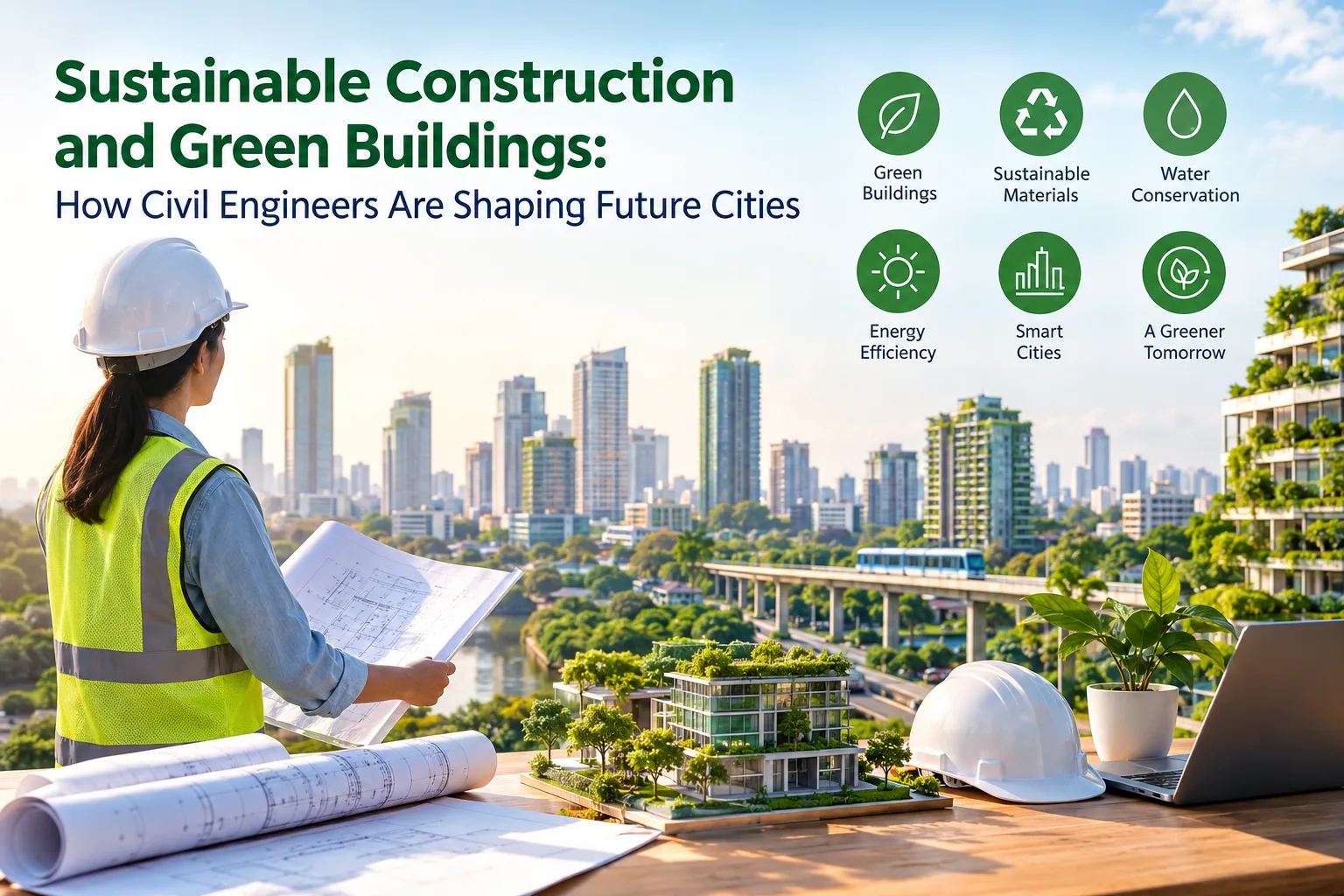
Cities around the world are growing rapidly, creating new demands for housing, transportation, water supply, energy and public infrastructure. At the same time, urban development faces challenges such as rising energy consumption, construction waste, water scarcity and the effects of climate change.
These challenges are changing how buildings and infrastructure are planned and constructed. Sustainable construction and green buildings are becoming important considerations for architects, engineers, developers and urban planners who want to create spaces that use resources efficiently and provide healthier environments for people.
Civil engineers play a significant role in this transformation. Through better material selection, efficient structural design, water management, waste reduction and climate-resilient infrastructure, they can help shape cities that are more resource-efficient and prepared for future challenges.
For students interested in engineering, sustainable construction also presents an opportunity to contribute to projects that combine technical innovation with environmental responsibility.
What Is Sustainable Construction?
Sustainable construction refers to planning, designing, building and maintaining structures in ways that consider environmental impacts, resource consumption, economic viability and human well-being.
Traditional construction practices often focus primarily on completing a project within its budget and schedule. Sustainable construction considers these objectives alongside the long-term performance of buildings and infrastructure.
This approach can include using materials efficiently, reducing construction waste, improving energy performance, conserving water and selecting designs that support durability and easier maintenance.
Sustainability should also be considered throughout a structure's lifecycle, from the extraction and production of construction materials to building operation, renovation and eventual demolition or reuse.
For example, a building designed to use less electricity and water throughout its operating life may offer long-term benefits even if some sustainable features require additional investment during construction.
Civil engineers help evaluate these trade-offs and identify solutions that are technically sound, economically practical and environmentally responsible.
What Are Green Buildings?
Green buildings are structures designed, constructed, operated and maintained to reduce environmental impacts while supporting the comfort, health and productivity of their occupants.
A green building is not simply a building with plants on its roof or solar panels installed on top. Its sustainability depends on several interconnected factors, including energy efficiency, water use, material selection, indoor environmental quality and site planning.
Key Features of Green Buildings
Energy-efficient design: Buildings can reduce energy demand through appropriate orientation, shading, insulation, efficient lighting and ventilation.
Natural lighting and ventilation: Well-designed windows, building layouts and ventilation systems can improve indoor comfort and, where conditions permit, reduce reliance on artificial lighting and mechanical cooling.
Water conservation: Rainwater harvesting, efficient plumbing fixtures, wastewater treatment and water reuse can help reduce demand for freshwater.
Responsible material selection: Materials can be evaluated according to durability, availability, recycled content, embodied carbon and other relevant environmental considerations.
Waste management: Planning for material reuse, recycling and efficient construction processes can reduce the amount of waste sent to landfills.
Green spaces: Trees, landscaped areas and green roofs can contribute to shade, urban cooling, biodiversity and improved outdoor environments when appropriately designed and maintained.
These features work best when they are integrated during the planning and design stages rather than added as isolated measures after construction is complete.
How Civil Engineers Contribute to Sustainable Construction
Civil engineers help translate sustainability goals into practical designs and construction methods. Their work covers structural performance, construction materials, site conditions, transportation, drainage and other systems that influence the long-term performance of buildings and cities.
1. Designing Structures That Use Materials Efficiently
Concrete, steel, bricks and other construction materials have environmental impacts associated with extraction, manufacturing, transportation and installation.
Civil engineers can help reduce unnecessary material consumption by developing efficient structural designs that meet applicable safety requirements.
For example, engineers may compare different structural systems, assess material quantities and optimise member sizes while ensuring that the building satisfies relevant design standards.
They can also evaluate the suitability of recycled aggregates, supplementary cementitious materials and other lower-impact alternatives where technical requirements and local standards permit.
Material efficiency does not mean using the least possible material regardless of safety. It means achieving the required strength, durability and serviceability with a well-considered design.
2. Promoting Energy-Efficient Buildings
Buildings consume energy for lighting, cooling, heating, ventilation and equipment operation. In warm climates, including many parts of India, cooling demand can be particularly important.
Civil engineers collaborate with architects and building services professionals to support designs that reduce unnecessary energy demand.
Building orientation, external shading, roof design, insulation and appropriate construction materials can influence indoor temperatures and thermal comfort.
Digital modelling tools can help design teams evaluate alternative approaches before construction begins.
When passive design strategies are combined with efficient equipment and renewable energy systems where appropriate, buildings can reduce their operational energy requirements.
3. Improving Water Conservation and Management
Water management is a major concern for growing cities, particularly where demand is increasing or rainfall patterns are unpredictable.
Civil engineers contribute through the design of water supply networks, rainwater harvesting systems, stormwater drainage, wastewater treatment facilities and water reuse infrastructure.
Rainwater harvesting systems can collect rainfall from suitable roof surfaces and store it for approved non-potable uses or groundwater recharge, depending on local conditions and regulations.
Efficient drainage systems help manage surface runoff and reduce the risk of localised flooding.
Wastewater treatment and reuse can also reduce pressure on freshwater resources when systems are properly designed, operated and monitored.
By integrating these approaches into building and urban infrastructure projects, engineers can support more responsible water use.
4. Reducing Construction Waste
Construction and demolition activities generate waste from concrete, bricks, timber, metals, packaging and other materials.
Poor planning can increase material losses, transportation requirements and disposal costs.
Civil engineers can help reduce waste through accurate quantity estimation, improved coordination between contractors, appropriate storage practices and the reuse or recycling of suitable materials.
Digital construction tools can support this process by improving the accuracy of material schedules and identifying design conflicts before work begins.
For example, coordinated building models may help teams avoid unnecessary rework caused by clashes between structural components and building services.
Reducing waste benefits both the environment and project budgets, although recycling and reuse options must be evaluated for quality, safety and practical feasibility.
Sustainable Construction Technologies Shaping Future Cities
Technology is helping engineers evaluate environmental performance and manage infrastructure more effectively.
Several digital tools and construction methods are particularly relevant to sustainable development.
Building Information Modeling (BIM)
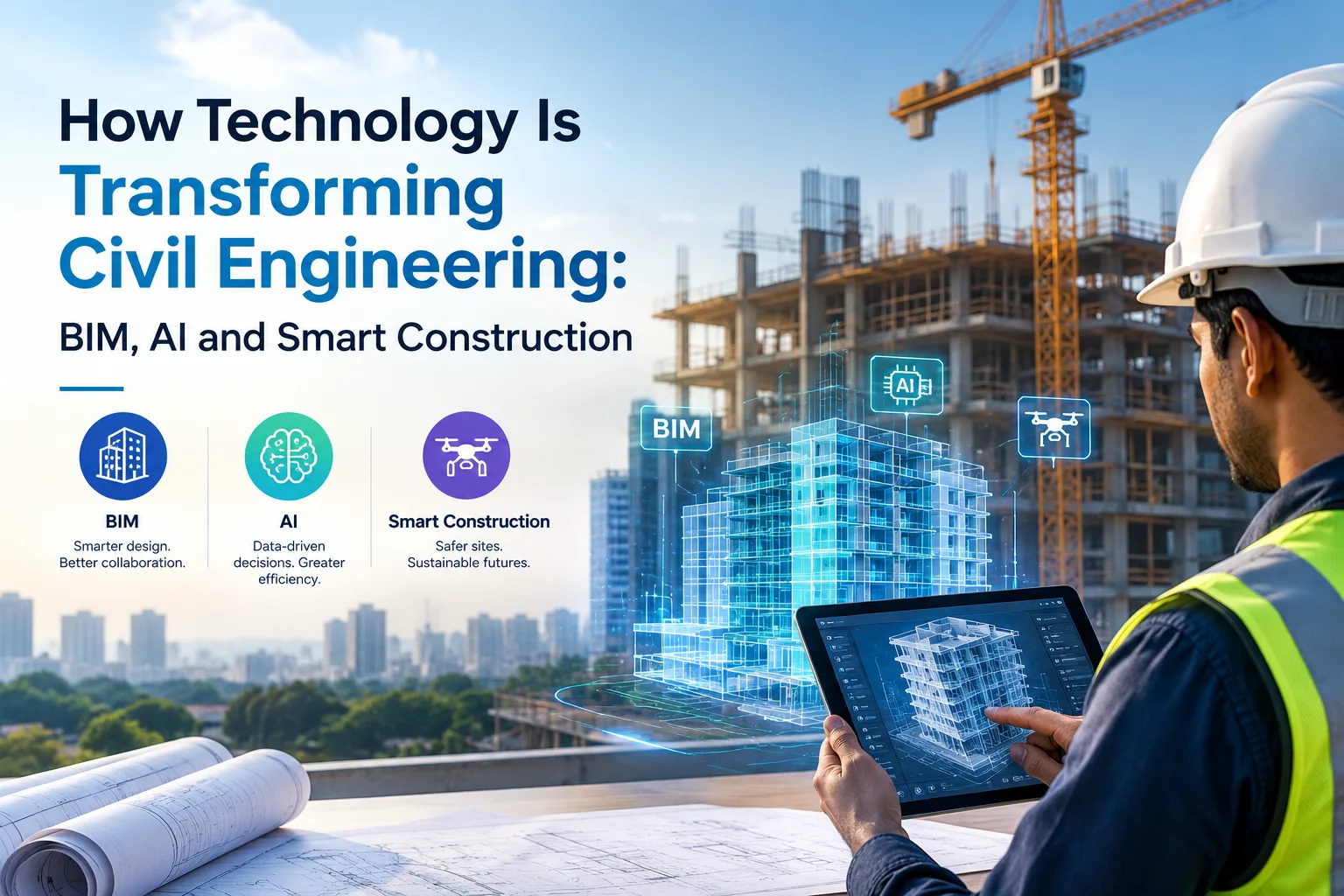
Building Information Modeling allows project teams to develop and coordinate digital representations of buildings and infrastructure.
BIM can support material quantity estimation, design coordination and the evaluation of alternative construction approaches.
When linked with suitable energy or lifecycle assessment tools, building models can also contribute to sustainability analysis.
However, the accuracy of the results depends on the quality of the model, the assumptions used and the data available.
Artificial Intelligence and Data Analysis
Artificial intelligence and data analytics can help engineers interpret large datasets, compare design alternatives and identify opportunities for improvement.
For example, analytical tools may assist with forecasting energy demand, monitoring infrastructure performance or identifying patterns in water consumption.
These tools should support engineering decisions rather than replace technical validation and professional judgement.
Smart Sensors and Building Management Systems
Sensors can monitor factors such as indoor temperature, humidity, lighting, energy consumption and water use.
Building management systems can use this information to adjust equipment operation and identify unusual consumption patterns.
Such systems may improve operational efficiency when properly configured and maintained.
Solar Energy and Renewable Systems
Solar photovoltaic panels can provide renewable electricity for buildings, while solar thermal systems can support selected hot-water applications.
The effectiveness of these systems depends on factors such as building orientation, available space, local weather, energy demand and maintenance requirements.
Integrating renewable energy with energy-efficient design can help reduce dependence on conventional electricity sources.
How Sustainable Construction Is Shaping Future Cities
The benefits of sustainable construction extend beyond individual buildings. When sustainability is incorporated into wider urban planning, it can influence how cities manage resources, respond to climate risks and support their residents.
Climate-Resilient Infrastructure
Cities face risks associated with intense rainfall, flooding, extreme heat and other environmental hazards.
Civil engineers can help address these risks through improved drainage, resilient transport infrastructure, flood management systems and designs that account for local climate conditions.
Climate resilience requires an understanding of local hazards, future scenarios, maintenance requirements and the expected service life of infrastructure.
Better Public Transportation
Transportation systems influence energy use, air quality, traffic congestion and the accessibility of urban services.
Civil engineers contribute to the planning and development of roads, metro systems, railways, bus infrastructure, pedestrian pathways and cycling facilities.
Well-coordinated public transportation and active mobility networks can help reduce dependence on private vehicles when they provide safe, reliable and accessible alternatives.
Urban Green Spaces
Parks, tree-lined streets, green roofs and other vegetated areas can provide shade, support biodiversity and improve the quality of public spaces.
Civil engineers work alongside landscape architects, urban planners and environmental specialists to integrate green infrastructure with drainage, utilities and transport systems.
For example, carefully designed rain gardens and permeable surfaces can help manage stormwater while creating more attractive urban environments.
Circular Economy in Construction
A circular approach aims to keep materials and products in use for longer through durability, repair, reuse and recycling.
In construction, this can involve designing adaptable buildings, recovering suitable materials during renovation and demolition, and identifying opportunities to reuse structural or non-structural components.
Such practices require careful assessment of material condition, structural integrity, contamination risks and applicable regulations.
Over time, circular construction methods may help reduce demand for virgin resources and minimise waste.
Challenges in Adopting Green Building Practices
Although sustainable construction offers important potential benefits, implementation is not always straightforward.
Higher Initial Costs
Some sustainable technologies and materials can require additional investment. The financial outcome depends on local prices, project design, operating costs, maintenance and the expected life of the building.
A lifecycle cost assessment can help compare the initial investment with potential savings over time.
Limited Awareness and Expertise
Project teams may lack experience with certain sustainable materials, certification systems or digital performance tools.
Training and collaboration among engineers, architects, contractors and building owners can help address this challenge.
Availability of Materials
The availability, cost and quality of lower-impact materials can vary by location. Engineers must verify that proposed alternatives meet relevant strength, durability, fire safety and other performance requirements.
Maintenance and Long-Term Performance
Sustainable features require proper operation and maintenance to deliver their intended benefits.
For example, a rainwater harvesting system may perform poorly if storage tanks, filters and collection surfaces are neglected.
Sustainability should therefore be considered alongside maintenance planning and the practical capacity of building owners to operate the systems.
Balancing Environmental Goals With Safety
Environmental performance must never come at the expense of structural safety or essential building requirements.
Civil engineers need to evaluate alternative materials and designs carefully, using appropriate calculations, testing, standards and professional review.
What Skills Do Civil Engineers Need for Sustainable Construction?
Students interested in green buildings and sustainable infrastructure can develop a combination of core engineering knowledge and specialised skills.
Structural design: Understanding loads, structural behaviour, material properties and relevant design standards is essential for safe and efficient buildings.
Construction materials: Knowledge of concrete, steel, masonry, recycled materials and material testing helps engineers evaluate suitable construction options.
Environmental engineering: Understanding water management, waste treatment, pollution control and environmental assessment can support sustainable infrastructure projects.
Digital design tools: CAD, BIM and relevant modelling applications can help engineers coordinate designs and assess material quantities.
Energy and resource awareness: Familiarity with energy efficiency, water conservation and lifecycle thinking can help engineers consider environmental performance throughout a project's life.
Project management: Skills in cost estimation, scheduling, quality control and stakeholder coordination help translate sustainability objectives into workable projects.
Communication and teamwork: Sustainable construction involves multiple disciplines, making collaboration and clear technical communication important professional skills.
Students can begin developing these capabilities through coursework, laboratory activities, internships, technical projects and exposure to actual construction practices.
How Engineering Education Supports Sustainable Development
Engineering colleges help prepare future professionals to respond to changing construction practices and infrastructure needs.
Students benefit from a strong foundation in civil engineering fundamentals, supported by laboratory experiments, design assignments, surveying activities and practical project work.
Exposure to sustainable materials, digital design tools, environmental systems and infrastructure planning can also help students understand how sustainability is applied in professional projects.
Those exploring this career path can review the Civil Engineering programme at Kumaraguru College of Technology (KCT) to learn more about the programme and assess whether it aligns with their academic interests.
When comparing engineering colleges, prospective students should examine the curriculum, laboratory facilities, faculty expertise, practical training, industry exposure and opportunities to participate in technical projects.
Choosing an institution that supports both fundamental engineering knowledge and practical learning can help students prepare for a range of civil engineering career paths.
The Future of Sustainable Construction in India
India's growing cities require infrastructure that supports housing, transportation, employment, water supply and public services while making responsible use of resources.
Sustainable construction can contribute to these goals through efficient building design, improved material use, better water management and infrastructure that responds to local environmental conditions.
Green building rating systems, energy-efficiency standards and sustainability initiatives can provide frameworks for evaluating building performance. Their requirements and applicability vary, so project teams should refer to the relevant official standards and certification bodies.
Future developments may also include wider use of BIM, digital monitoring, low-carbon materials, prefabrication and data-driven infrastructure management.
The success of these approaches will depend on appropriate design, quality construction, skilled professionals, effective regulation and long-term maintenance.
Civil engineers will continue to play an important role by translating sustainability goals into infrastructure that is safe, durable, functional and suited to local needs.
Conclusion
Sustainable construction and green buildings are becoming important considerations in the development of future cities. Through efficient structural design, responsible material selection, water conservation, energy-efficient buildings and climate-resilient infrastructure, civil engineers can help reduce environmental impacts while supporting urban growth.
Digital tools such as BIM, smart sensors and data analytics can strengthen these efforts by improving design coordination and helping project teams evaluate performance. However, successful sustainable construction also depends on sound engineering principles, practical implementation, appropriate maintenance and informed decision-making.
For students considering civil engineering, sustainability offers an opportunity to contribute to meaningful infrastructure projects while developing skills relevant to an evolving industry.
The cities of the future will need more than new buildings and roads. They will need infrastructure designed to serve communities responsibly over the long term. Civil engineers have an essential role in helping make that future possible.