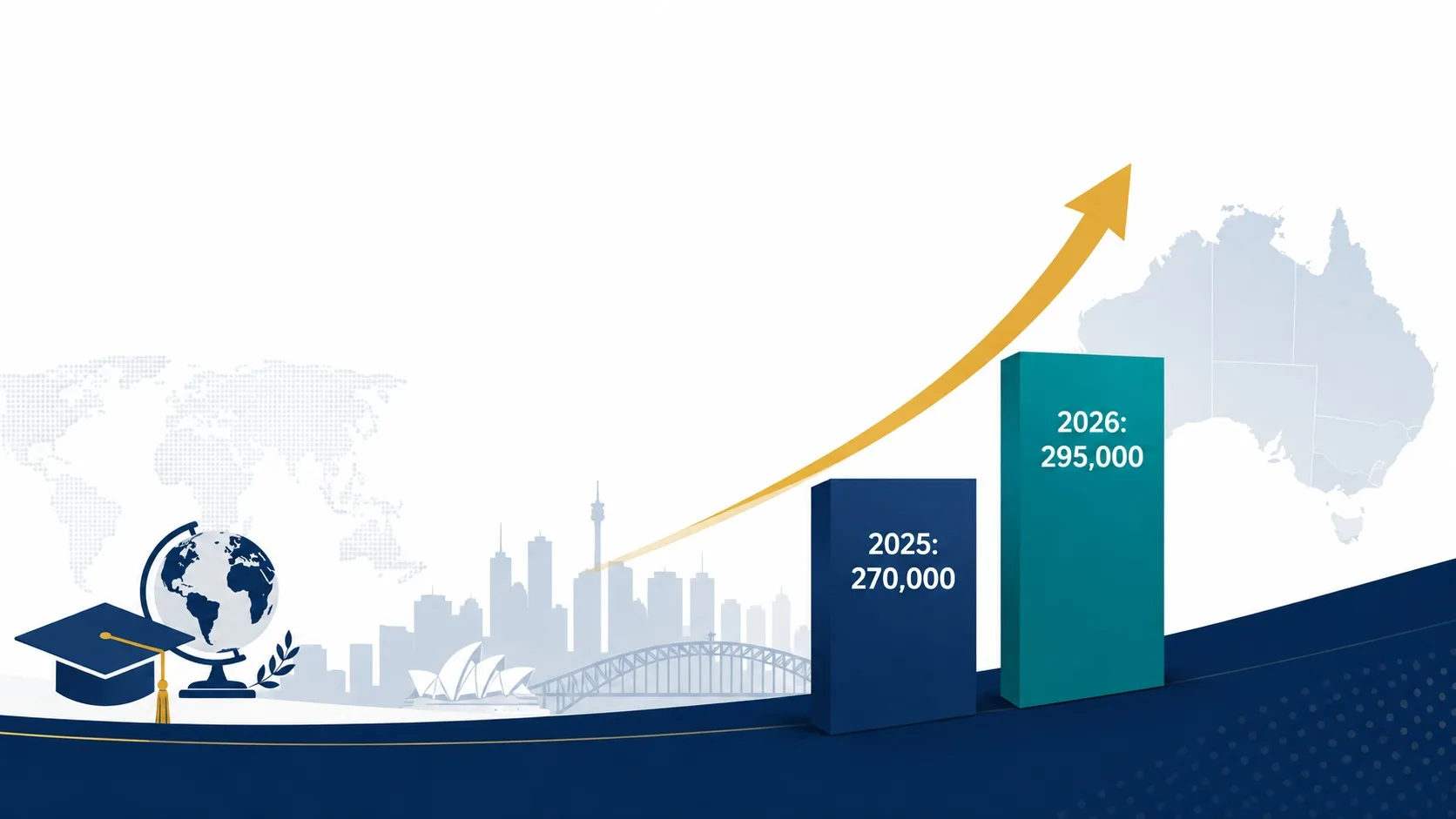
Australia is making room for more international students in 2026. The federal government has set the national planning level at 295,000 new international student commencements, compared with 270,000 in 2025. The increase signals continued demand for Australian education, but it also comes with a more complicated environment for students arriving from overseas.
For anyone planning to study in Australia 2026, the headline number is encouraging. The reality behind it requires closer attention. Visa processing has become more selective, accommodation remains difficult in major cities, and rising living costs can place pressure on students before their academic workload even begins.
Australia’s bigger student intake comes with conditions
The 295,000 target represents a 9% increase from the previous year's level. For prospective students, that means the country is planning for substantially more international enrolments.
However, the source material highlights changes in visa processing during the first half of 2026. Applicants from several major source countries experienced higher rejection rates, while priority processing favored certain groups. These included Southeast Asian applicants, students from Pacific countries and Timor-Leste, and scholarship recipients.
Other applicants may have to wait longer for decisions.
This makes early preparation more important. Students cannot treat the Australia student visa 2026 process as a simple administrative step after receiving an offer. Visa processing can affect travel plans, accommodation arrangements and the timing of a student's move.
Education providers are also operating under additional expectations. Universities seeking larger allocations need to demonstrate stronger regional engagement and progress on student accommodation. That requirement connects international education policy directly with one of the biggest problems students face after arrival.
The message is clear: increasing student numbers only works if the surrounding infrastructure can handle them.
Housing and living costs remain major obstacles
The challenge does not end when a student receives a visa.
The source identifies cost of living and housing availability as the leading concerns in recent international student sentiment surveys. Academic difficulty itself ranks lower, which reveals an important part of the study-abroad experience that intake figures cannot capture.
A student might be academically prepared but still struggle to settle into university life if finding affordable accommodation becomes a daily problem.
Melbourne and Sydney have experienced particular housing pressure as large numbers of international students settle in these cities. Limited availability can increase competition for rooms and make budgeting more difficult.
Living expenses add another layer. Students need to manage rent, food, transport and other everyday costs while also paying attention to course requirements. Those pressures can quickly affect the amount of time and energy available for study.
Academic support for international students therefore has a practical role. When students face unfamiliar coursework structures or demanding assessment schedules, having access to subject-specific guidance can make difficult academic tasks easier to understand.
Academic preparation matters after arrival
The most useful support is not necessarily the kind students seek before leaving home. Once classes begin, the challenge shifts from securing entry to keeping up.
Australian universities and TAFE pathway providers can have different coursework structures, assessment formats and deadlines. International students may understand their subject but still need time to adjust to how assignments and projects are assessed.
Expertsmind's expansion into Australia reflects this gap. The platform, which already supports students in the United States, United Kingdom and Canada, is broadening academic assistance for students dealing with Australian coursework and assessment timelines.
This focus is especially relevant for students in demanding fields such as engineering and business management. A technical assignment, for example, may require a student to understand both the subject theory and the specific way that theory must be applied in an assessment.
Support at that point is less about replacing independent study and more about helping students work through areas they find difficult.
What prospective students should prepare for
The 2026 international student intake creates new opportunities, but students should not interpret the higher number as a promise of an easier pathway.
The source points to three issues that deserve attention: visa processing, accommodation and the cost of living. Academic workload then sits alongside those pressures once students begin their studies.
That means preparation should happen on several fronts. Students need to understand their visa requirements, plan accommodation as early as possible and create a realistic budget. They should also research their course structure and assessment expectations before classes begin.
Australia's international education settings are likely to remain under scrutiny as policymakers balance student demand with housing and infrastructure capacity. Similar intake levels have also been flagged for 2027, suggesting that the sector's expansion will remain an active issue.
For international students, the opportunity is real. So are the challenges.
The smartest approach is to view the 295,000 intake not as the finish line, but as the opening of a longer process. Getting admitted gets a student to Australia. Preparation, financial planning and reliable academic support help determine what happens next.