In the rapidly advancing world of industrial processes, filtration is not just a matter of convenience—it is absolutely essential to guarantee efficiency, protect sensitive equipment, and maintain the quality of products. Whether in chemical manufacturing, oil and gas refineries, food and beverage production, wastewater treatment plants, or even pharmaceutical environments, choosing the right filtration media is the backbone of a reliable workflow. Among the multiple filtration solutions available today, the stainless steel perforated filter stands out as a robust, versatile, and high-performance option.
1. What is a Stainless Steel Perforated Filter?
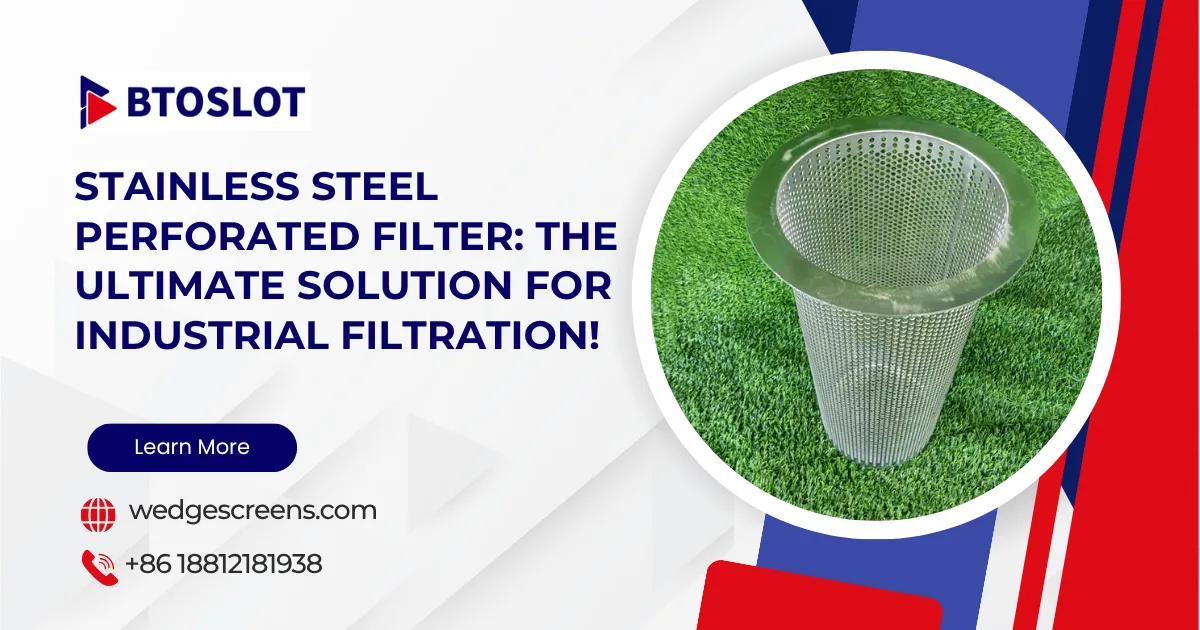
A stainless steel perforated filter is a filtration component manufactured from stainless steel sheets or tubes that have been systematically perforated—punched with precise holes or slots—to create a screen or mesh-like structure. This perforated medium acts as a physical barrier: it blocks particles above a certain size while allowing liquids or gases to pass through.
The combination of the mechanical resilience of stainless steel and the customizable nature of the perforations allows engineers and system designers to tailor these filters to match specific process requirements.
2. How Does a Stainless Steel Perforated Filter Work?
Filtration using a stainless steel perforated filter is fundamentally a mechanical process. As the process fluid (liquid or gas) passes through the filter, any solid particles or contaminants larger than the perforation size are retained on the filter surface.
The key operation steps are:
- Initial Capture: Particles larger than the perforation openings are immediately blocked.
- Surface Filtration: Most debris accumulates on the inlet surface, which can be easily monitored and cleaned.
- High Throughput: Optimized perforation patterns allow large volumes of fluid to pass with minimal pressure drop.
- Backwashing or Cleaning: The filter can be reversed or cleaned using simple mechanical or fluid procedures.
The versatility of the perforated filter means it can be used alone or as a support layer for finer wire mesh, non-woven fabrics, or other filter materials.
3. Why Choose Stainless Steel: Material Benefits and Properties
The superiority of the stainless steel perforated filter rests both in its construction and the properties of stainless steel itself. Here’s why stainless steel is the material of choice:
- Corrosion Resistance: Stainless steel, especially grades like 304 and 316, offers unmatched resistance to rust and chemical attack, making the filters ideal for harsh environments or those involving aggressive chemicals.
- Temperature Tolerance: Withstands both high and low temperatures, allowing use in hot processing lines or cryogenic systems.
- Mechanical Strength: Superior tensile and yield strength compared to polymeric or aluminum filters. Can withstand pressure variations and impacts.
- Longevity: Stainless steel filters often outlast other material types by years, even under demanding use.
- Hygienic and Non-reactive: Ideal for food, beverage, and pharmaceutical processing where product purity is essential.
- Ease of Cleaning: Stainless steel is non-porous and easily sanitized, supporting repeat use and simple maintenance.
At Anping County BT Wire Mesh Products Co.,Ltd, we select only high-quality stainless steel for our perforated filters, ensuring maximum service life and efficiency.
4. Core Features of Stainless Steel Perforated Filters
What sets a stainless steel perforated filter apart? Here are the defining features:
- Controlled Perforation Size/Pattern: Customizable round holes, slots, or complex geometries to suit specific filtration requirements.
- Uniformity: Consistent perforation ensures even flow and predictable filtration efficiency.
- High Open Area: Maximizes flow rate while retaining contaminants.
- Structural Integrity: Maintains form, even under high flow or pressure.
- Scalability: Can be manufactured as discs, tubes, cones, baskets, or sheets for any scale of operation.
These properties are enhanced further by options such as multi-layer construction, reinforcement rings, and integration with support cages.
5. Types and Configurations
The versatility of stainless steel perforated filters allows them to be produced in a range of formats, such as:
- Perforated filter tubes or cylinders: Common in pipeline, vessel, and cartridge filtration.
- Filter baskets and strainers: For pump protection or batch processing.
- Flat or curved screens: Used as separator plates or support screens.
- Cone or wedge shapes: Specialized for hydrocyclones or gravity separators.
- Layered filters: Combining perforated sheets with wire mesh for finer filtration.
Each configuration is tailored for strength, fluid path optimization, and easy installation within specific systems.
6. Applications Across Industries
Few filtration products are as universally applicable as the stainless steel perforated filter. Key sectors benefiting include:
- Oil and Gas: Sand control, pre-filtration before fine cartridges, and well screens.
- Water Treatment: Pre-filtration for RO plants, straining, and desalination.
- Food and Beverage: Clarification of juices, edible oil filtration, grain drying.
- Chemical Manufacturing: Slurry filtration, catalyst recovery, solvent purification.
- Pharmaceutical and Biotech: Ensuring sterility and protecting downstream equipment.
- Mining and Minerals: Dewatering, slurry handling, and separation processes.
- Pulp and Paper: Fiber recovery and clarification.
- Automotive: Oil and fuel filter elements.
Because each industry brings unique demands, Anping County BT Wire Mesh Products Co.,Ltd specializes in custom manufactured solutions to fit your workflow and compliance needs.
7. Benefits Over Traditional Filters
Why are stainless steel perforated filters overwhelmingly preferred over other options?
- Reusable/Long-lasting: Unlike disposable paper or polymer filters, these can be cleaned and reused, offering significant cost savings over time.
- High Pressure/Temperature Resistance: They will not collapse or degrade where competitors fail.
- Non-leaching: No unwanted compounds migrate into your product.
- Customization: Every variable—material, hole size, arrangement, geometry—can be engineered.
- Sustainability: Stainless steel is recyclable, reducing the environmental impact.
These factors culminate in lower operational costs and higher product assurance.
8. Design and Customization Options
Filters from Anping County BT Wire Mesh Products Co.,Ltd can be engineered for:
- Perforation size: From micrometer levels to several millimeters.
- Open area percentage: For balancing flow and retention.
- Thickness and grade: To meet structural or chemical process demands.
- End fittings and flanges: For easy connection.
- Surface finish: Mirror polished, pickled, passivated, or electropolished as required.
Custom mounting, multi-layer assembly, and sanitary welding are also available.
9. Installation Best Practices
Proper installation is essential for optimal filter performance and lifespan:
- Correct Orientation: Install the filter in the intended flow direction.
- Gasket/Seal Use: Ensure leak-free operation.
- Support Structure: Use appropriate brackets, cages, or pressure-retaining housings.
- Avoid Over-tightening: Prevents filter deformation or system stresses.
- Accessibility: Place filters for easy routine removal and servicing.
Our engineers provide technical support and guidance to assist each customer with installation.
10. Maintenance and Cleaning Procedures
One of the prime benefits of the stainless steel perforated filter is easy, thorough cleaning:
- Manual washing or brushing: Removes surface debris.
- Back-flushing: Reverses fluid flow to dislodge trapped solids.
- Ultrasonic cleaning: For fine particulate or sensitive applications.
- Chemical cleaning: For strongly bonded contaminants, using compatible cleaning agents.
Regular maintenance prevents fouling, maintains throughput, and supports a long operational life.
11. Common Problems and How to Avoid Them
While durable, even the best stainless steel perforated filter can face issues such as:
- Clogging or blinding: Prevent with routine cleaning schedules.
- Corrosion (rare in 316 stainless): Monitor water chemistry or select higher grades for caustic environments.
- Physical damage: Avoid impact or over-pressurization.
- Gasket wear/leaks: Replace seals periodically, especially in high-cycle systems.
Close attention to installation and monitoring ensures reliable long-term performance.
The right filter is the cornerstone of any successful industrial process, shaping both product quality and plant reliability. The stainless steel perforated filter proves itself every day in the depths of chemical reactors, the lines of food processors, the smoothing hum of refineries, and the critical circuits of water plants. It offers unmatched durability, precision, safety, and return on investment—benefits that translate into fewer headaches, greater uptime, and peace of mind.
Frequently Asked Questions (FAQ)
Q1: What is the typical lifespan of a stainless steel perforated filter?
A: With proper use and cleaning, a stainless steel perforated filter can last from several years up to a decade or more, depending on process conditions and mechanical stresses.
Q2: How do I select the right perforation size?
A: The perforation size depends on the size of particles you want to retain. We recommend consulting with our engineers to perform a particle size analysis of your process fluid.
Q3: Are these filters suitable for high-temperature processes?
A: Yes, stainless steel (particularly grades 316 and 304) is excellent for temperatures ranging from cryogenic to above 800°C.
Q4: How can I prevent clogging in my filter?
A: Routine cleaning, back-flushing, and, if needed, installing pre-filters or multi-stage systems will help reduce clogging risk.
Q5: Can stainless steel perforated filters handle corrosive environments?
A: Yes! However, choose the correct grade—for highly corrosive applications, 316L or even higher grades like duplex stainless steels are recommended.
Q6: Is customization of shape and design possible?
A: Absolutely! At Anping County BT Wire Mesh Products Co.,Ltd, we create custom solutions tailored to each project.
Q7: Is there a risk of metal leaching into my process fluid?
A: Certified food- or pharma-grade stainless steel is non-leaching and safe for demanding purity applications. Always specify your industry needs when ordering.
Q8: How do I know when it’s time to replace my filter?
A: Replace the filter if you observe structural damage, increased pressure drop, persistent fouling despite cleaning, or evidence of corrosion.
Q9: Are multi-layer filter options available?
A: Yes, we offer single-layer and multi-layer assemblies, often combining perforated metal with finer wire mesh or fabric.
Q10: What’s the maximum pressure rating for these filters?
A: This depends on wall thickness, diameter, and support design. We will provide pressure ratings upon request, tailored to your system's needs.