For years, getting HTTPS on a website was relatively straightforward: choose an SSL certificate provider, complete validation, install the certificate, and remember to renew it before it expires.
That routine is changing.
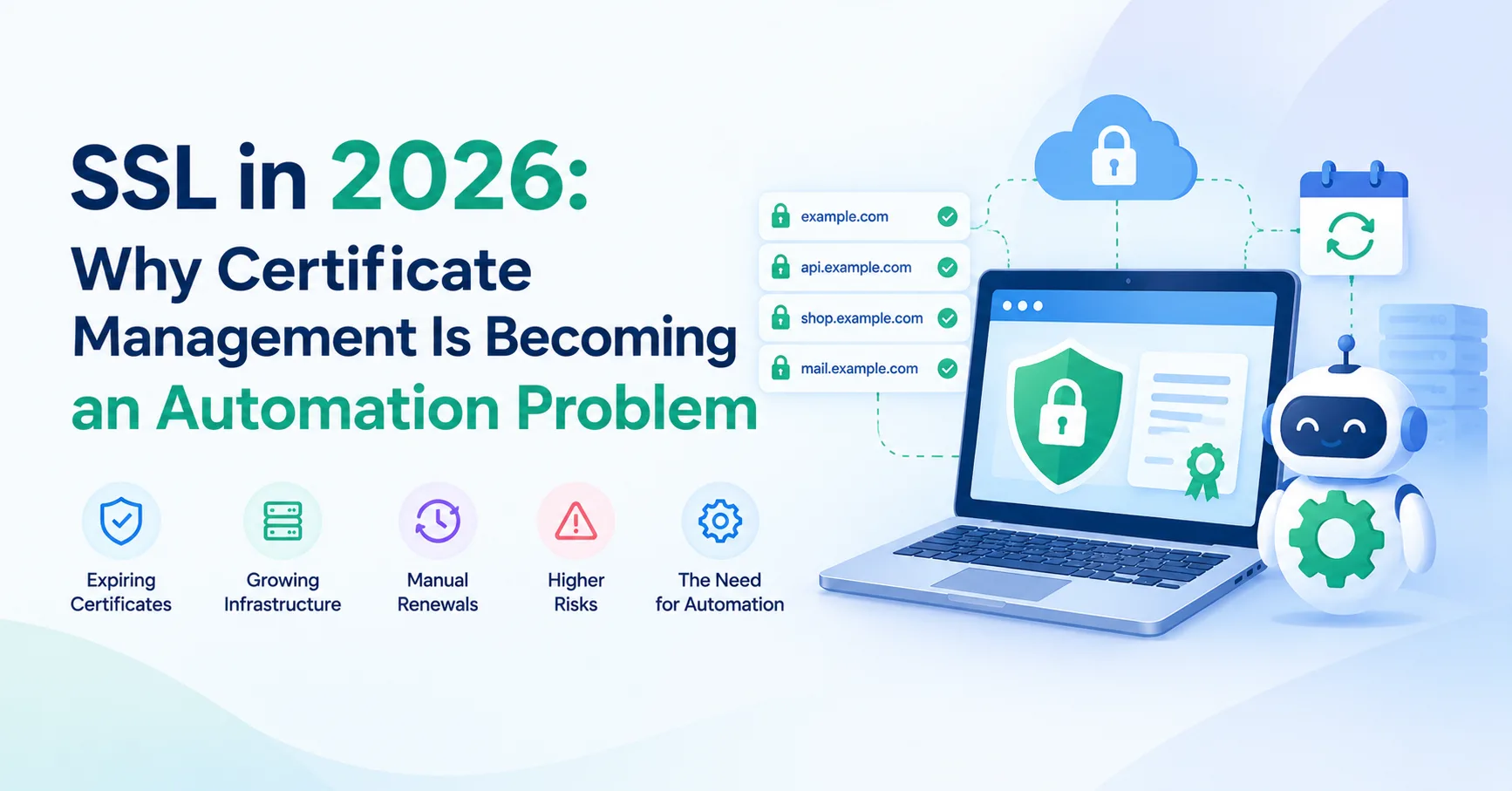
In March 2026, the maximum validity period for public TLS certificates dropped to 200 days under the updated CA/Browser Forum requirements. The limit is scheduled to fall again to 100 days in March 2027 and eventually to 47 days in March 2029.
For someone running one small website, this may not sound like a major problem. For companies managing dozens or hundreds of domains, however, it changes how SSL certificates need to be handled.
The real question is no longer simply where to buy an SSL certificate. It is how to keep certificates renewed, installed, monitored, and replaced without turning every renewal into a manual IT task.
Why Are SSL Certificates Getting Shorter?
Shorter certificate lifetimes are intended to reduce the security risks associated with long-lived credentials and outdated validation information.
Under the current schedule, certificates issued from March 15, 2026 can have a maximum validity of 200 days. That drops to 100 days from March 15, 2027 and 47 days from March 15, 2029.
There is a security benefit here. If a certificate or related information becomes problematic, it does not remain valid for as long as it might have under the previous rules.
But there is a practical trade-off: more frequent certificate replacement means more certificate-management work.
That is where automation starts becoming less of an optional convenience and more of an operational requirement.
The Hidden Problem With Manual Certificate Renewal
Imagine a company has 30 websites.
Today, someone might maintain a spreadsheet containing:
- Domain name
- Certificate type
- Issuing CA
- Expiration date
- Server location
- Person responsible for renewal
That system may work when renewals happen roughly once a year.
It becomes much harder to maintain when certificates have to be replaced more frequently.
And expiration dates aren't the only thing to worry about. A renewal may also involve generating a new CSR, completing domain control validation, downloading the certificate, installing it on the correct server, and checking that the new certificate is actually being served.
Sectigo's current renewal documentation, for example, notes that SSL renewal can require a new CSR and Domain Control Validation (DCV).
A certificate can therefore be successfully renewed but still cause an outage if the renewed certificate isn't installed correctly.
What Should an SSL Certificate Provider Offer in 2026?
Choosing an SSL certificate provider is increasingly about more than certificate pricing.
Businesses should consider the complete certificate lifecycle.
Useful questions include:
How easy is certificate issuance?
The provider should make validation and certificate delivery straightforward.
Can certificates be renewed automatically?
Automation can reduce the risk of certificates being forgotten.
Does the provider support ACME?
ACME can allow compatible systems to request and renew certificates programmatically.
How are certificates monitored?
Organizations need visibility into certificates across servers, domains, and environments.
What happens when validation fails?
A good automation setup should not silently fail. Teams need alerts and clear remediation steps.
This is particularly important for organizations running cloud workloads, load balancers, containers, Kubernetes clusters, and multiple hosting environments.
How to Automate SSL Certificate Renewal
The good news is that businesses do not necessarily need to build a complicated system from scratch.
A common approach is to use ACME-compatible automation where supported.
The basic workflow looks something like this:
- The system detects that a certificate needs renewal.
- A renewal request is created.
- Domain control is validated automatically.
- The new certificate is issued.
- The certificate is installed or deployed.
- The system verifies the deployment.
- Monitoring confirms that the new certificate is active.
This is what it means to automate SSL certificate renewal rather than simply setting a calendar reminder.
The distinction matters.
A reminder tells someone that a certificate needs attention. Automation actually performs the renewal process.
When Does SSL Automation Make Sense?
Not every website needs sophisticated certificate automation.
If you manage a single brochure website and replacing its certificate takes five minutes, manual management may still be reasonable.
The situation changes when you have:
- Multiple websites
- Multiple subdomains
- Several production servers
- Cloud infrastructure
- Development and staging environments
- Load balancers or reverse proxies
- Frequently changing infrastructure
- A large certificate inventory
At that point, manually tracking every certificate becomes an unnecessary source of operational risk.
The bigger your environment becomes, the more valuable automation tends to be.
Don't Confuse Auto-Renewal With Full Automation
This is an important distinction.
Some certificate platforms offer an automatic renewal option. That can automatically initiate a new certificate order, but it does not necessarily mean the newly issued certificate has been deployed everywhere it needs to go.
For example, Sectigo's documentation describes auto-renewal as automatically placing a new renewal order before expiration, while the renewal process can still require a new CSR, validation, and certificate installation.
Full lifecycle automation goes further.
It should ideally cover the path from renewal detection → validation → issuance → deployment → verification.
That is the model businesses should increasingly aim for as certificate lifetimes shrink.
What About Businesses That Want to Buy an SSL Certificate for Multiple Domains?
The certificate type matters too.
A company with one domain may only need a standard single-domain certificate. Another business might operate several related domains or many subdomains.
Before deciding where to buy an SSL certificate, consider the actual architecture of your websites.
For example:
- One domain → single-domain certificate may be sufficient.
- Multiple domains → consider a Multi-Domain/SAN certificate.
- Many subdomains under one domain → a Wildcard certificate may be more convenient.
- Large enterprise environment → centralized certificate lifecycle management may make more sense.
The cheapest certificate isn't necessarily the cheapest solution if managing it creates additional manual work.
APractical Checklist for 2026
If you currently manage SSL certificates manually, this is a good time to review the process.
Start with a complete certificate inventory.
Record:
- Every active certificate
- Covered domains and subdomains
- Issuing certificate authority
- Expiration dates
- Validation type
- Installation location
- Renewal method
- Person or team responsible
Then identify certificates that could be automated.
Pay particular attention to certificates that protect customer-facing services or critical infrastructure.
Finally, test the renewal process before relying on it.
Automation that has never been tested isn't really automation you can trust.
The Bigger Change Is Operational, Not Just Technical
The move toward shorter TLS certificate lifetimes is sometimes described as a certificate problem.
In practice, it is more accurately a process problem.
The technology for automated issuance and renewal already exists. The challenge for many organizations is connecting that technology to their actual infrastructure and internal processes.
A company might successfully automate certificate issuance but still have a manual deployment step. Another might automate deployment but fail to monitor renewal errors.
The goal should be to remove as many manual steps as possible while keeping enough monitoring and control to know when something goes wrong.
What Businesses Should Do Now
The industry is already in the first stage of the certificate-lifetime reduction. The next stages will arrive quickly: 100-day certificates in 2027 and 47-day certificates in 2029.
Businesses don't need to panic, but they should stop treating certificate renewal as an annual administrative task.
If you are evaluating an SSL certificate provider, look beyond the initial certificate price. Consider validation options, automation support, deployment workflows, monitoring, and the tools available for managing certificates at scale.
And if you are still renewing certificates manually, start experimenting with ways to automate SSL certificate renewal now.
When 47-day certificates become the norm, organizations that already have an automated process will have one less operational problem to solve.
The future of SSL management isn't simply about buying certificates faster. It is about making sure the entire certificate lifecycle can keep up with the speed of modern infrastructure.